80/20 Rule (Pareto Principle)
What It Is
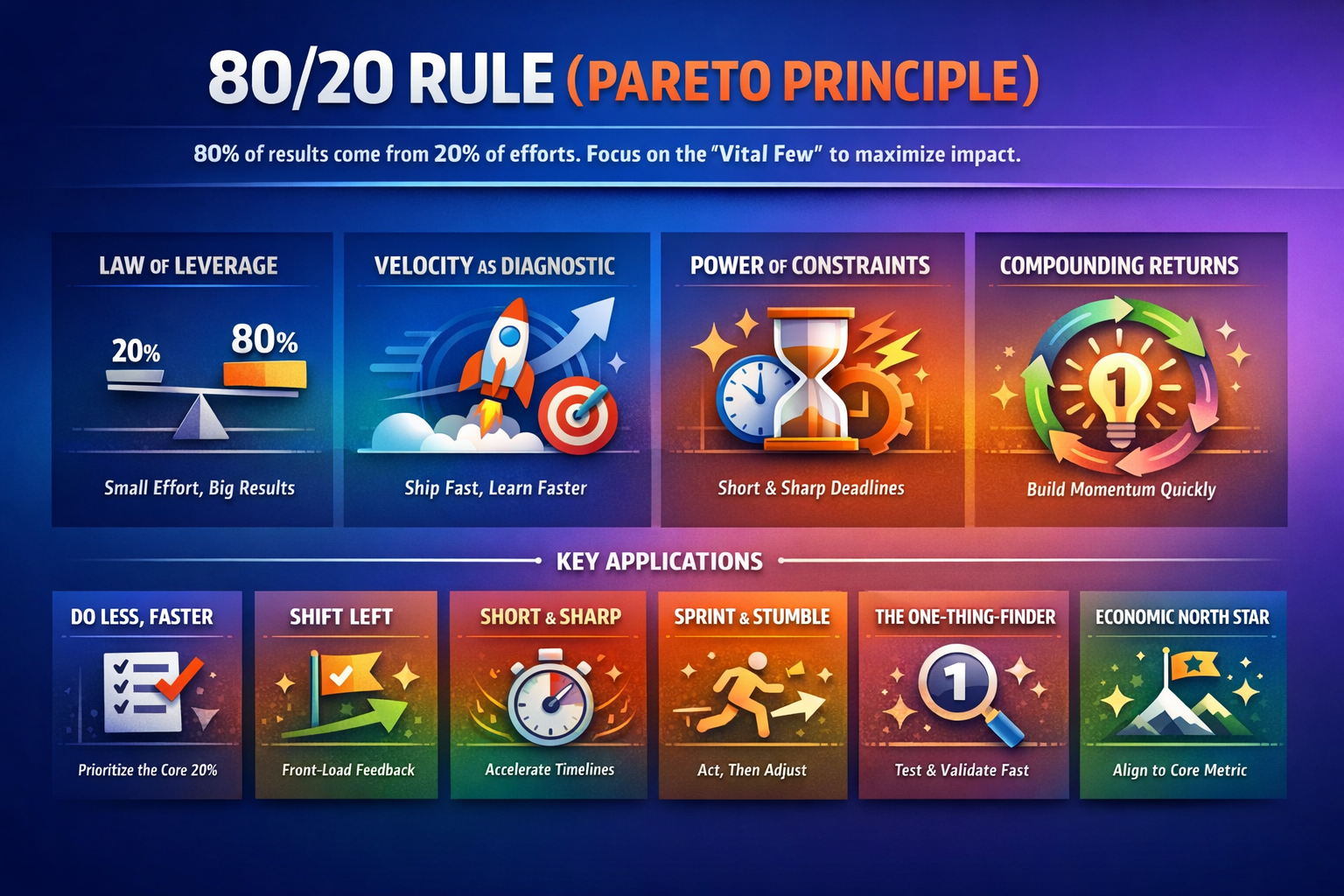
The 80/20 Rule, or Pareto Principle, is the observation that in almost any system, the relationship between inputs and outputs is non-linear. Specifically, a minority of causes (roughly 20%) is responsible for the majority of effects (roughly 80%). In a high-performance environment, this is not just a statistical curiosity; it is a foundational law of efficiency. It suggests that most of what we do is noise, and a small sliver of our effort is responsible for nearly all of our progress.
At its core, this mental model is an aggressive filter for reality. It forces an acknowledgment that not all tasks are created equal. In a business or personal productivity context, the principle dictates that if you have a list of ten items to accomplish, two of those items will likely yield more value than the other eight combined. Identifying that "vital few" and separating them from the "trivial many" is the difference between meaningful impact and mere "busy-ness."
Why It Matters
The problem the 80/20 Rule solves is the "Law of Diminishing Returns" and the trap of cognitive overload. Without this model, the default human tendency is to treat all incoming demands as having equal weight. We check off easy tasks to feel productive while the high-leverage, often more difficult, activities are pushed to the periphery. This leads to a state of being "exhausted but ineffective"—working 12-hour days but seeing the needle barely move.
When you internalize the 80/20 Rule, you stop optimizing for volume and start optimizing for leverage. What becomes possible is a radical acceleration of results. By disproportionately allocating resources—time, money, and mental energy—toward the 20% of activities that generate 80% of the value, you create a compounding effect. You aren't just working harder; you are ensuring that every unit of effort is applied to the point of maximum impact.
How It Works
The mechanism of the 80/20 Rule requires a ruthless audit of your current outputs. It functions through a three-step framework: Identification, Categorization, and Reallocation.
First, you must define what "value" looks like in your specific context. Value isn't just "doing work"; it is the output that leads to your primary objective (e.g., revenue, product completion, strategic clarity). Once value is defined, you audit your activities. You look at the last week or month of work and map the results back to the specific actions that triggered them.
Second, you categorize these actions. You will find that a handful of meetings, one specific technical fix, or a particular relationship accounted for the lion's share of your wins. This is your 20%. The remaining 80%—the status updates, the low-impact emails, the "maintenance" work that doesn't move the needle—is identified as low-value.
Finally, you reallocate. The goal isn't just to know what the 20% is; it’s to clear the decks so you can double down on it. This often involves the "One-Two Rule" logic: if you can identify the top one or two activities that deliver the most value, everything else becomes a candidate for delegation, deferral, or elimination. The 80/20 Rule is a mandate to stop doing the bottom 80% to make room for an obsessive focus on the top 20%.
When to Apply
This model should be applied whenever you feel overwhelmed or when progress has plateaued despite high effort. It is particularly valuable during strategic planning phases. Instead of trying to improve every aspect of a business or a project simultaneously, use the 80/20 Rule to find the one or two "bottlenecks" or "levers" that, if addressed, would solve the majority of the problems.
It is also a daily operational tool. At the start of every workday, rather than looking at a long to-do list, you should ask: "Which 20% of these tasks will produce 80% of today's value?" It is the trigger used to reset your focus when you find yourself caught in the "thick of thin things." It applies to customer management (focusing on the 20% of clients who provide 80% of revenue), product development (focusing on the 20% of features that 80% of users actually use), and even personal health.
Common Traps
The most dangerous misconception of the 80/20 Rule is using it as an excuse for laziness or a justification for ignoring details. The "trivial many" 80% of tasks often still need to be done—emails must be answered, and bills must be paid—but they should not be the focus. The trap is thinking the 80/20 Rule means you only have to do 20% of the work. In reality, it means you must ensure that your best energy is reserved for the 20%, and the rest is handled with as little friction as possible.
Another trap is the "100% Perfectionist Trap." People often spend 80% of their time trying to get the final 20% of a project perfect. While this is necessary for heart surgeons or aerospace engineers, in most business contexts, that final push for perfection offers very little incremental value. The 80/20 Rule suggests that "good enough" on the low-value details allows you to be "exceptional" on the high-value strategy.
Finally, the 80/20 ratio is not a literal, fixed mathematical law. It might be 90/10 or 70/30. The trap is getting hung up on the math rather than the principle of asymmetry. The point is not the numbers; the point is the imbalance.
How It Connections
While the provided evidence does not list specific related concepts, the 80/20 Rule logically fits into a broader system of high-performance mental models. It is the precursor to Opportunity Cost. By choosing to spend time on the low-value 80%, you are implicitly choosing not to spend time on the high-value 20%. The cost of busy-work is the impact you could have made elsewhere.
It also connects to the concept of Leverage. If the 80/20 Rule is the "what" (what to focus on), Leverage is the "how" (how to get the most out of that focus). Together, they form a strategy for exponential growth rather than linear improvement. Without understanding the 80/20 distribution of value, any attempt to apply leverage will be diluted by being applied to the wrong things.
Evidence from Sources
Focus on High-Value Activities
"80/20 rule - focus on high-value activities" — Mental Model Map from Miro
Value Concentration
"The 80/20 rule (Pareto Principle) suggests focusing on the 20% of work that delivers 80% of the value" — Mental Model Map from Miro
In Practice
Scenario 1: The Software Developer
A developer is faced with a backlog of 50 bugs. Instead of fixing them in the order they were reported, she applies the 80/20 Rule. She analyzes crash reports and realizes that 10 of those bugs (20%) are responsible for 80% of the user-reported crashes. By ignoring the 40 minor UI glitches and focusing exclusively on those 10 critical errors, she drastically improves the user experience in a fraction of the time it would have taken to clear the entire backlog.
Scenario 2: The Sales Executive
A sales executive realizes he is spending equal time on all 50 of his leads. However, a review of his historical data shows that 10 of his clients (the 20%) provide 80% of his commissions and have the shortest closing cycles. He decides to automate the follow-up for the 40 small-lead accounts and reallocates his saved time to provide white-glove service and proactive strategy for the top 10. His revenue increases even though his total hours worked remains the same.
Scenario 3: Product Management
A product team is tempted to add six new features to their app to satisfy various edge-case requests. Using the 80/20 Rule, they look at the analytics and see that 80% of their active users only use two core features. Instead of building the six new features, they spend their entire quarter refining and simplifying those two core features. The result is a massive increase in user retention and a cleaner, more defensible product, whereas adding the other features would have likely cluttered the UI and provided minimal return.
Have questions about 80/20 Rule (Pareto Principle)?
Ask the AI Mentor — free, 10 questions/month
See This Model in Action
Real sessions where Ray teaches 80/20 Rule (Pareto Principle) live.
Implementing Conditional Message Editing and Deletion in Mobile Chat

Resolving API Error in Basketball Player Record Retrieval

Integrating Quill Editors and Navigating Xano API Limits
Integrating Shad CN Alert Dialogs with Existing Modal Context
Join State Change to watch full sessions and access 1,000+ more.
Go Deeper
Mental models are just the beginning. Here’s what members get:
Live Office Hours
Ray teaches this model in real time — with your real problems, real code, and real breakthroughs.
Session Vault
1,000+ recorded sessions searchable by topic. Find exactly the moment this model clicks.
AI Skills & MCP Tools
Your AI assistant learns these models too — Skills and MCP servers that bring Ray's thinking to your workflow.
Builder Community
Ask questions, share breakthroughs, get unstuck with 500+ builders who think in models, not just code.