AI as an Extension of Low Code Philosophy
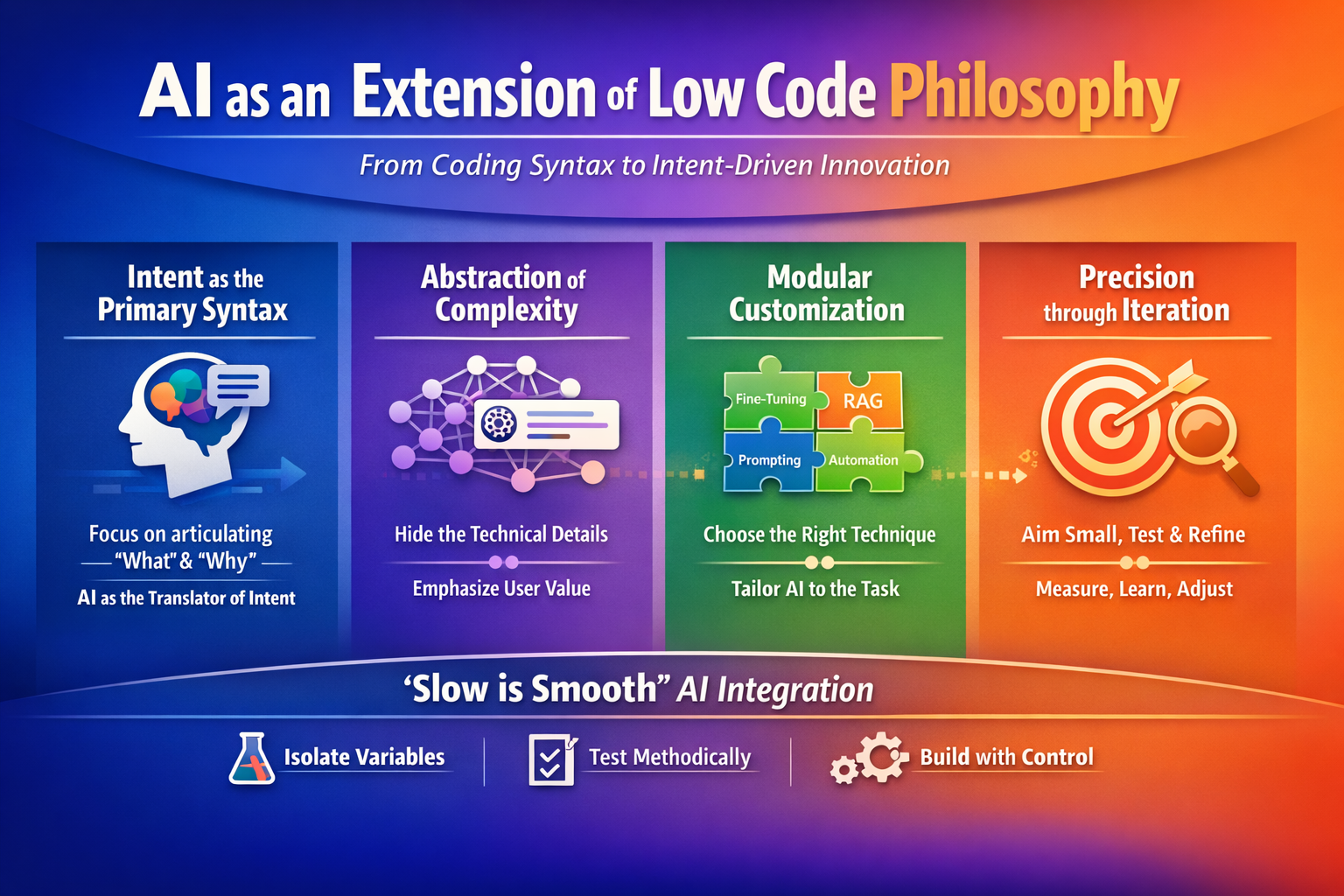
What It Is
AI as an Extension of Low Code Philosophy is a mental model that views Artificial Intelligence not as a separate, magical entity, but as the next logical step in the evolution of software development. At its core, this model posits that AI is simply another tool for expressing intent to machines.
In the traditional software world, "intent" had to be translated into rigid, syntax-heavy code (C++, Java, Python). Low-code platforms (like Bubble, Xano, or Airtable) moved the needle by abstracting away that syntax, allowing builders to express intent through visual interfaces and logic blocks. AI extends this trajectory even further. It allows a builder to describe a desired outcome in natural language or through patterns, and the "machine" handles the implementation details.
This mental model shifts the focus from how to build a feature to what the feature should accomplish. It treats LLMs (Large Language Models) as high-level components within a larger system—much like a database or an API—that can be configured, tuned, and automated to perform complex tasks without the overhead of manual algorithmic coding.
Why It Matters
Without this mental model, builders often treat AI as a "black box" or a parlor trick. They get stuck in the "chat" interface, failing to see how AI can be integrated into a functional business process. When you view AI through the lens of low-code, you stop asking "What can this bot say?" and start asking "What can this component do?"
The insight here is that AI solves the "last mile" of low-code development. Traditional low-code is excellent at structured data and predictable workflows, but it struggles with "fuzzy" logic—things like sentiment analysis, complex categorization, or extracting data from messy PDFs. By treating AI as a low-code extension, you bridge the gap between structured systems and unstructured human reality.
If you don't adopt this view, you risk two extremes: either over-engineering solutions with thousands of lines of code that AI could have handled in a single prompt, or building brittle AI "wrappers" that lack the necessary guardrails to be useful in a production environment. This model provides a framework for managing the unpredictability of AI by applying the same discipline we use in modular software design.
How It Works
This mental model breaks down the "extension" of low-code into four distinct approaches to AI customization. By categorizing AI work this way, it becomes as manageable as a visual workflow in a low-code tool.
- Fine-Tuning ("Studying for a Test"): This is about changing the base behavior of the model. Just as you might customize a low-code plugin, fine-tuning involves training the model on specific datasets so it learns a specific style, tone, or specialized vocabulary. It is the "internalized knowledge" of the system.
- Retrieval Augmented Generation / RAG ("Open Book Test"): This is the "database" layer of AI. Instead of expecting the AI to know everything internally, you provide it with a library of documents (a vector database) to look at before it answers. This is the low-code equivalent of a "Search" or "Filter" operation—ensuring the output is grounded in specific, verifiable facts.
- Prompt Engineering: This is the "Interface." It is the act of designing the inputs to ensure the machine understands the intent. In low-code, this is akin to setting up the parameters of a function or the fields in a form.
- Output Processing and Automation: This is the "Action." An AI response is useless if it just sits in a chat bubble. This approach involves taking the AI’s output—often formatted as JSON or a specific structured string—and feeding it into other systems (like sending an email, updating a CRM, or triggering a webhook). This is where the AI becomes a functional part of a low-code stack.
By separating AI into these four buckets, the complexity of "building with AI" disappears, replaced by a series of architectural choices.
When to Apply
This model is most valuable when you are moving from a prototype to a production-grade application. It is specifically triggered when:
- Handling Unstructured Data: When your application needs to deal with emails, transcripts, or documents that don't fit into a standard database schema.
- Building Custom Logic without Code: When a business process is too complex for simple "if/then" statements but too unique for off-the-shelf software.
- Scaling Human Decision Making: When you have a process that currently requires a human to "look at something and decide," and you want to automate that "judgment" using a low-code approach.
- Integrating Siloed Knowledge: When you have a massive internal knowledge base that employees struggle to navigate; applying the RAG (Open Book Test) approach transforms that data into an active assistant.
Common Traps
The most common misconception is thinking that AI replaces the need for structure. Just because you can talk to a machine doesn't mean the machine doesn't need a framework.
- The Fine-Tuning Trap: Many beginners think they need to fine-tune (study for the test) when they actually need RAG (an open-book test). Fine-tuning is hard, expensive, and static. RAG is dynamic and easier to debug.
- The "Chat is the Product" Fallacy: Thinking the end-user needs to see a chat box. In the low-code philosophy, the AI should often be "under the hood"—silently categorizing tickets, summarizing notes, or translating data formats—without the user ever knowing an LLM was involved.
- Ignoring Output Validation: Because AI is probabilistic (it might say something different every time), builders often forget to treat its output with the same skepticism they would a user's form input. You must still "clean" and "validate" the data before it hits your database.
How It Connects
This mental model is the bridge between Modular Architecture and Human-Centric Design. In a modular system, we want parts that can be swapped out; by treating AI as an extension of low-code, we treat the LLM as a modular "intelligence" component.
It also ties back to the concept of Technical Debt. If you write 500 lines of Python to parse a document, you have to maintain that code. If you use a well-structured AI prompt as a "low-code" component, you have traded complex code for a maintainable intent-based instruction. This aligns with the State Change philosophy of building "thin" applications that leverage powerful platforms rather than building everything from scratch.
Evidence from Sources
AI as a Tool for Intent
"Views AI as another tool for expressing intent to machines" — Nicky Taylor Podcast Interview 11/23
The Evolution of Abstraction
"...similar to how low-code platforms abstract away the complexities of traditional coding." — Nicky Taylor Podcast Interview 11/23
The Four Approaches to Customization
"Breaks down AI customization into four approaches: Fine tuning (studying for a test), Retrieval augmented generation (open book test), Prompt engineering, Output processing/automation" — Nicky Taylor Podcast Interview 11/23
In Practice
Scenario 1: The Intelligent Support Desk
A company has 10,000 pages of technical manuals. Instead of building a search engine (traditional code) or training a model from scratch (fine-tuning), they use the RAG (Open Book Test) approach. They use a low-code tool like Flowise or LangChain to connect their manuals to an LLM. When a customer asks a question, the system "looks up" the relevant manual page and uses the AI to summarize the answer. This is AI as an extension of their existing documentation system.
Scenario 2: The Automated Data Entry Clerk
A real estate firm receives hundreds of non-standardized email inquiries daily. Using the Output Processing/Automation pillar, they set up a low-code workflow (e.g., in Zapier or Make). The AI is prompted to "Read this email and return the data as JSON with fields for 'Budget,' 'Location,' and 'Property Type.'" The low-code system then takes that JSON and automatically creates a record in their CRM. The AI acts as a "logic bridge" between an unstructured email and a structured database.
Scenario 3: The Specialized Legal Drafter
A law firm wants a tool that writes in their specific "voice" and uses their specific formatting. They realize that simple prompting isn't enough. They use Fine-Tuning (Studying for a Test) on 500 of their previous successful filings. Now, the model has "internalized" their style. They combine this with Prompt Engineering to give the model the specifics of a new case. The result is a high-speed drafting tool that feels like a bespoke piece of software but was built using high-level intent rather than manual string manipulation.
Have questions about AI as an Extension of Low Code Philosophy?
Ask the AI Mentor — free, 10 questions/month
Synthesized Essay
AI as an Extension of Low Code Philosophy
Category: Principle Related Concepts: Intent-Based Computing, Abstraction Layers, Retrieval Augmented Generation (RAG), Declarative Programming.
What It Is
AI as an Extension of Low Code Philosophy is a mental model that views Artificial Intelligence not as a separate, magical entity, but as the next logical step in the evolution of software development. At its core, this model posits that AI is simply another tool for **expressing i
This is a preview. State Change members get the full essay, all infographics, audio, and unlimited AI mentoring.
Songs About This Model

The Intent is the Syntax
Upbeat indie-rock with driving drums and clean, rhythmic electric guitar

The Intent is the Syntax
Upbeat indie-rock with driving drums and clean, rhythmic electric guitar
Core Insight
AI is the ultimate low-code interface for translating human intent into machine action.
Mindset Shift
From viewing AI as a mysterious black box to managing it as a modular extension of low-code logic.
Go Deeper
Mental models are just the beginning. Here’s what members get:
Live Office Hours
Ray teaches this model in real time — with your real problems, real code, and real breakthroughs.
Session Vault
1,000+ recorded sessions searchable by topic. Find exactly the moment this model clicks.
AI Skills & MCP Tools
Your AI assistant learns these models too — Skills and MCP servers that bring Ray's thinking to your workflow.
Builder Community
Ask questions, share breakthroughs, get unstuck with 500+ builders who think in models, not just code.