Be Curious, Not Judgmental
What It Is
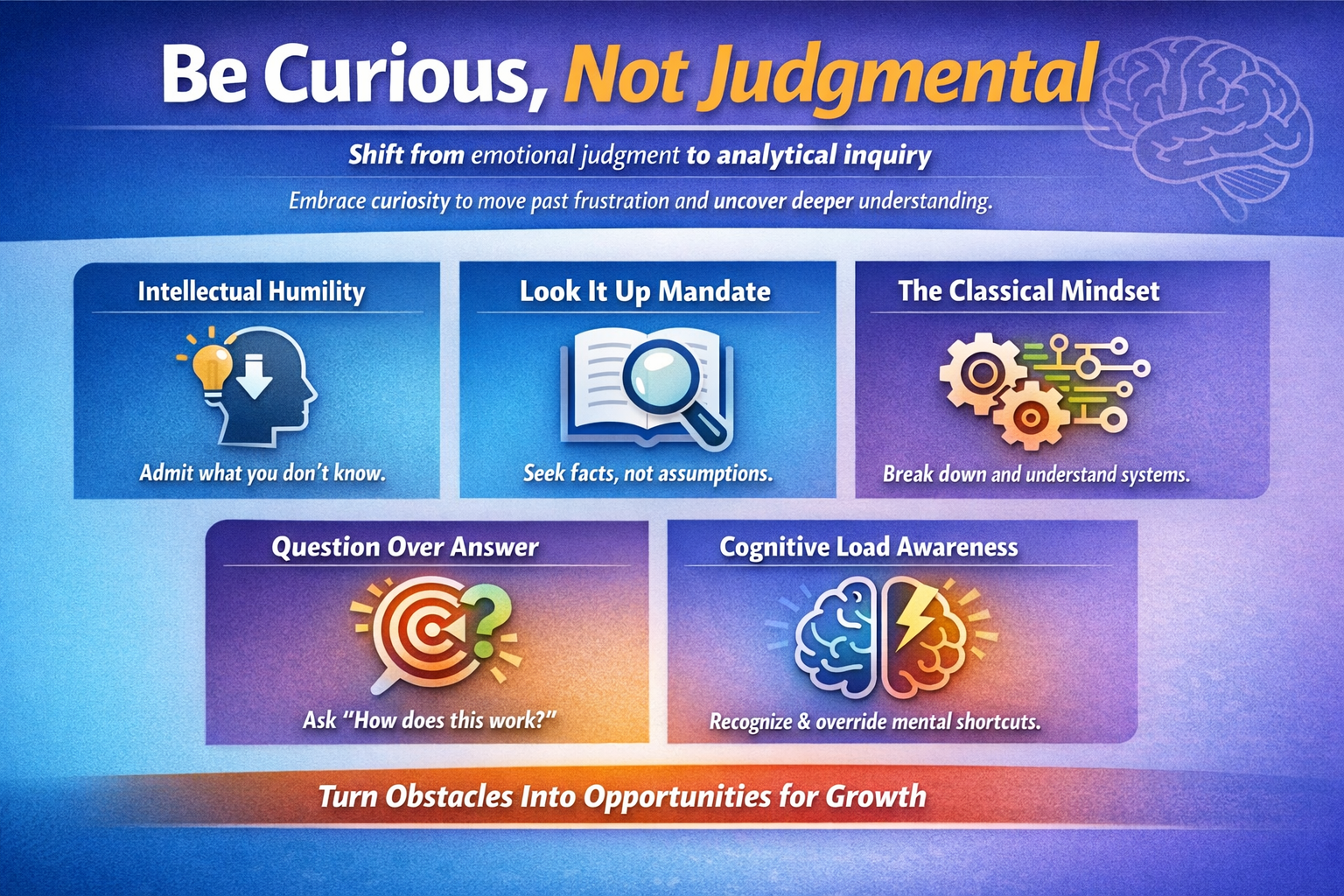
"Be Curious, Not Judgmental" is a fundamental mental model that governs how a builder interacts with technology, obstacles, and their own knowledge gaps. At its core, it is a shift from an emotional or evaluative reaction to a functional, investigative one. When a system fails, a "judgmental" posture looks for someone or something to blame—the tool is "broken," the platform is "garbage," or the builder is "not cut out for this." In contrast, a "curious" posture asks, "How is this actually working?" and "Where exactly is the data stopping?"
In the context of building—particularly with no-code or low-code tools—this model means treating every error message, unexpected behavior, or steep learning curve as a puzzle to be solved rather than a personal or systemic failure. It is the active cultivation of an exploratory mindset. Instead of getting frustrated when a workflow doesn't trigger, you move into an investigative mode: you look inside the systems, you examine the inputs and outputs, and you seek to understand the underlying mechanics that govern the behavior you are seeing.
This model is Ray’s call to replace frustration with inquiry. It demands that you drop your ego and your "loyalty" to specific ways of doing things in favor of finding the most effective solution. It’s about becoming a detective of your own builds. You aren’t just trying to "fix it"; you are trying to understand the "why" behind the "what."
Why It Matters
Without this mental model, builders quickly hit a "frustration ceiling." When things don't work as expected—which happens constantly in software development—a judgmental mindset leads to burnout and stagnation. You blame the software’s limitations, you get angry at the documentation, or you conclude that the task is impossible. This stops the learning process cold. You end up abandoning projects or settling for subpar workarounds because you’ve judged the problem as "broken" rather than "not yet understood."
When you adopt curiosity, the entire ecosystem changes. What was once a wall becomes a door. This model provides the psychological and tactical stamina required to navigate complex systems. By staying curious, you avoid the trap of "magical thinking"—the idea that software works (or doesn't work) because of some inexplicable whim of the universe. Curiosity forces you to recognize that computers are deterministic. If something isn't working, there is a logical reason for it.
Furthermore, curiosity allows for "Tool Agnosticism." Many builders get stuck in "loyalty" to a specific platform (e.g., "I'm a Bubble developer"), which limits their ability to solve problems effectively. A curious builder is more interested in the right tool for the job than in defending their existing stack. This flexibility is what allows you to build more robust, scalable, and creative solutions.
How It Works
The mechanism of "Be Curious, Not Judgmental" is broken down into several tactical principles:
1. The "Look Inside" Principle
Curiosity requires visibility. You cannot be curious about a black box. This means using debugging tools and instrumentation to see what is happening under the hood. In no-code, this might mean opening the step-by-step debugger, looking at the API connector's raw JSON response, or checking browser logs. You are looking for the discrepancy between what you thought would happen and what actually happened at the input/output level.
2. The Three Most Important Words: "Look It Up"
Curiosity is not just "thinking hard"; it is an active search for external knowledge. When you encounter a term, a function, or an error you don't understand, the curious response is to seek out documentation, forums, or tutorials. You must be willing to admit what you don't know and have the discipline to go find the answer rather than guessing.
3. Problem Decomposition
A judgmental mind sees a "complex problem" as an insurmountable monolith. A curious mind breaks that problem into smaller, digestible steps. By isolating variables and testing one small piece of a workflow at a time, curiosity makes the complex manageable. You ask: "Does this specific button click send the data?" "Does the data reach the database?" "Does the database trigger the next action?"
4. The Shopping Mindset
This is curiosity applied to your tech stack. Instead of being loyal to one platform, you stay curious about new tools and approaches in the ecosystem. You treat tools like items in a store—you evaluate them based on their utility for the specific problem at hand, not based on brand loyalty or previous habits.
5. Externalization (The Rubber Duck)
Curiosity often requires talking through the logic. By explaining the problem to someone else—or even to an inanimate object (rubber ducking)—you are forced to structure your curiosity. Often, the act of describing the "how" of a system reveals the gap in your understanding that led to the error.
When to Apply
This model is most valuable in the "Grit Phase" of building—the moments between the initial idea and the finished product where things are consistently breaking.
- When an Error Occurs: Instead of sighing or walking away, immediately trigger the "Look Inside" protocol. What were the inputs? What was the output? Where is the documentation for this error code?
- When Choosing a Stack: Use the "Shopping Mindset." Don't just pick what you used last time because it’s familiar. Be curious about whether a new tool or a different architecture (like a microservice approach) might actually solve the problem better.
- When You Are Stuck: This is the time to "Look It Up" or "Ask for Help." If you’ve spent 30 minutes staring at the same screen without progress, your curiosity has stalled. Re-ignite it by seeking external input.
- During System Design: Use curiosity to anticipate edge cases. Instead of judging a plan as "good enough," be curious about what happens if the user enters a negative number, or if the API is down.
Common Traps
The most common trap is Curiosity as Procrastination. There is a difference between being curious about a solution and falling down a rabbit hole of irrelevant information. You can spend days "looking things up" without ever applying the knowledge. Curiosity must be directed toward a specific outcome—solving the problem at hand.
Another trap is The "I Should Know This" Fallacy. This is a form of self-judgment. Builders often feel embarrassed that they don't understand a concept, so they skip "looking it up" to avoid feeling "dumb." This judgment kills the curiosity necessary to actually learn the concept. You have to be okay with being a beginner every single day.
Finally, people often confuse Curiosity with Tinkering. Tinkering is aimless; curiosity is targeted. If you are just changing settings at random to see what happens, you aren't being curious—you're gambling. True curiosity involves forming a hypothesis ("I think the issue is the data format") and then using tools to verify it.
How It Connects
While no specific related concepts were listed in the initial source data, "Be Curious, Not Judgmental" acts as the foundational layer for several other high-level building practices. It is the engine behind Rubber Ducking, providing the humility and inquisitiveness needed to explain a problem out loud. It provides the fuel for Look Inside Systems, as you cannot look inside something if you aren't first curious about what is there.
It also pairs with a Growth Mindset; by removing judgment, you treat every technical failure as a data point for your own improvement. In a broader sense, this model is what enables Tool Agnosticism, because curiosity about the best solution will always outweigh the comfort of a familiar but poorly suited tool.
Evidence from Sources
On Technical Visibility and Investigation
"Look inside systems to understand inputs/outputs" — Ray's Mental Model: Core Principles for Building with No-Code
"Use debugging tools and instrumentation to gain insight" — SC Mental Model Talk 1 6/2023
On Seeking External Knowledge
"Look it up — Three most important words: seek external knowledge" — Ray's Mental Model: Core Principles for Building with No-Code
"Be willing to look things up and search for solutions" — SC Mental Model Talk 1 6/2023
On the Investigative Approach
"Cultivate curiosity instead of judgment, especially when things don't work as expected. This involves actively seeking knowledge, understanding the underlying mechanics, and being open to learning from various sources, rather than getting frustrated or blaming external factors." — Ray's Mental Model: Core Principles for Building with No-Code
On Tool Selection and Agnosticism
"Shopping mindset — Find the right tool for THIS job, not loyalty to one platform" — Ray's Mental Model: Core Principles for Building with No-Code
"Stay curious about new tools and approaches in the ecosystem" — SC Mental Model Talk 1 6/2023
On Problem-Solving Techniques
"Often solving the problem while explaining it (rubber duck debugging)" — SC Mental Model Talk 1 6/2023
"Break complex problems into smaller steps" — Ray's Mental Model: Core Principles for Building with No-Code
In Practice
Scenario 1: The API Failure
Imagine you are trying to connect an Airtable base to a Webflow site. The data isn't showing up. The judgmental response is: "Webflow’s API is buggy, this is why no-code is hard." The project stalls. The curious response: You open the API connector. You look at the "Input" and see a 400 error. You "Look It Up" and find that a 400 error means a "Bad Request." You become curious about the specific field causing the error. You "Break the problem down" by removing fields one by one until the connection works. You find the culprit: a date format mismatch. You fixed it because you looked inside instead of judging the tool.
Scenario 2: Choosing a Database
You have used Bubble’s built-in database for every project. Now you are building a tool that requires heavy data processing. The judgmental (loyal) approach: "I'm a Bubble dev, I'll just make it work in Bubble even if it's slow." The curious approach: You adopt the "Shopping Mindset." You ask, "What are the limitations of the current tool? What else is out there?" You stay curious about the ecosystem and discover Xano or Supabase. You aren't "betraying" Bubble; you are being curious about what tool provides the best input/output performance for this specific job.
Scenario 3: The "I'm Stuck" Moment
A builder has been trying to write a complex regex pattern for two hours. They are getting angry at themselves. This is judgment. They feel they "should" know how to do this. To pivot to curiosity, they stop the internal dialogue and "Ask for help." They post the problem in a forum or talk to a peer. In the process of explaining the logic (Rubber Ducking), they realize they were misinterpreting how the start-of-line character works. By being curious enough to involve an external perspective, they solve in five minutes what judgment had blocked for two hours.
Have questions about Be Curious, Not Judgmental?
Ask the AI Mentor — free, 10 questions/month
Synthesized Essay
Be Curious, Not Judgmental
Category: Foundation Related Concepts: External Knowledge Acquisition, System Visibility, Problem Decomposition
What It Is
"Be Curious, Not Judgmental" is a fundamental mental model that governs how a builder interacts with technology, obstacles, and their own knowledge gaps. At its core, it is a shift from an emotional or evaluative reaction to a functional, investigative one. When a system fails, a "judgmental" posture looks for someone or someth
This is a preview. State Change members get the full essay, all infographics, audio, and unlimited AI mentoring.
Songs About This Model

The Delta and the Duck
Upbeat indie pop with driving drums, bright synth melodies, and a rhythmic, conversational vocal delivery

The Delta and the Duck
Upbeat indie pop with driving drums, bright synth melodies, and a rhythmic, conversational vocal delivery
Core Insight
When things don't work, say "Huh" or "That's interesting" instead of getting frustrated.
Mindset Shift
From "This should work differently" to "Why does this work this way?"
Go Deeper
Mental models are just the beginning. Here’s what members get:
Live Office Hours
Ray teaches this model in real time — with your real problems, real code, and real breakthroughs.
Session Vault
1,000+ recorded sessions searchable by topic. Find exactly the moment this model clicks.
AI Skills & MCP Tools
Your AI assistant learns these models too — Skills and MCP servers that bring Ray's thinking to your workflow.
Builder Community
Ask questions, share breakthroughs, get unstuck with 500+ builders who think in models, not just code.