Bias for Action (The "One-Two" Approach)
What It Is
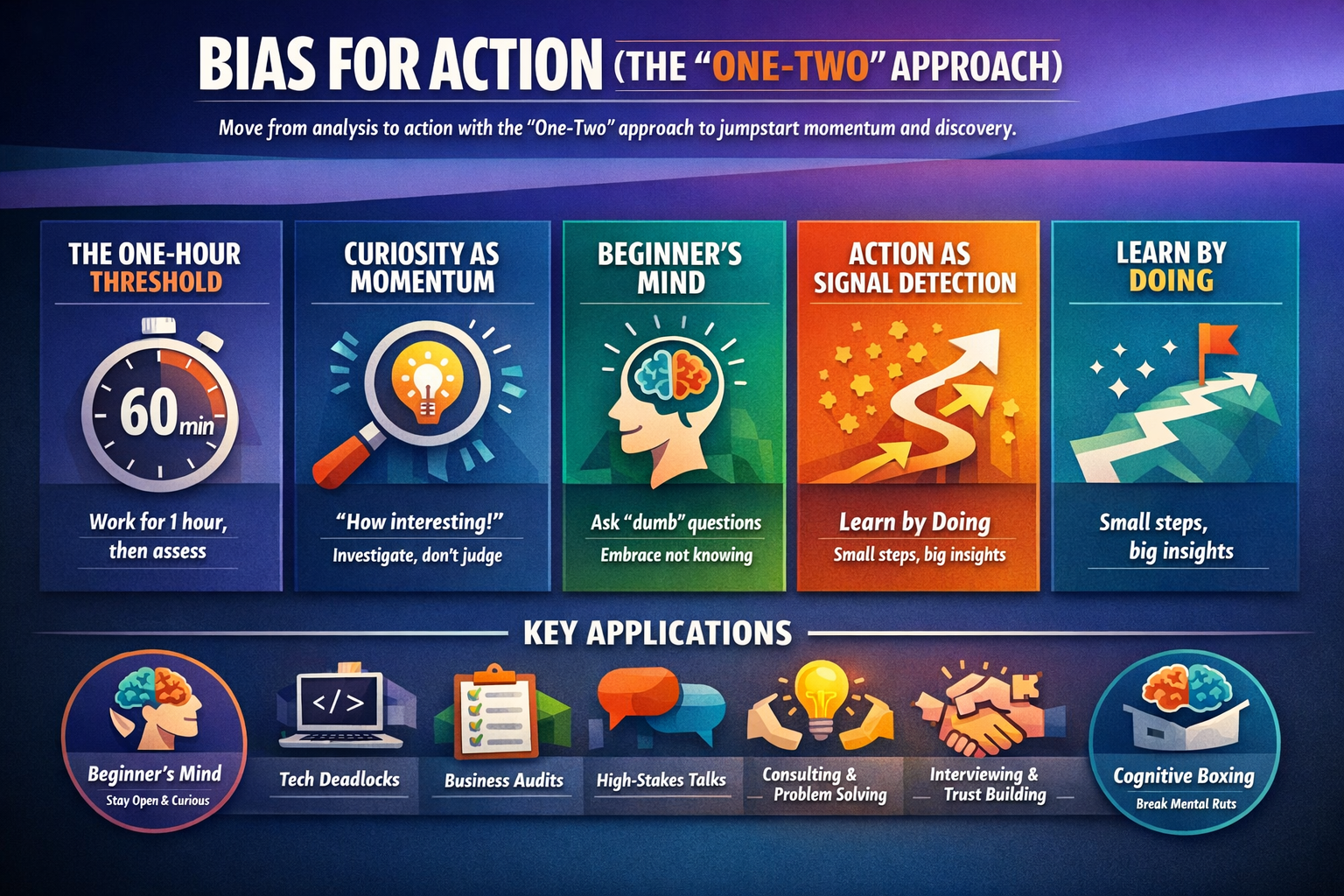
The "One-Two" Approach is a mental model designed to bridge the gap between analysis paralysis and aimless effort. At its core, it is a bias for action structured around a disciplined time-box. Instead of waiting for certainty or attempting to map out a perfect end-to-end solution, you commit to a focused, one-hour burst of activity aimed at discovery rather than completion.
This model rejects the notion that you must know the "absolute correct next step" before you begin. Instead, it posits that action is the most efficient form of data collection. By working for exactly one hour and then stopping to evaluate, you transform "work" into an "experiment." You are no longer just trying to finish a task; you are testing whether your current approach is viable or if you are simply spinning your wheels.
In Ray’s perspective, this isn't about working faster—it's about working smarter by capping your losses. It acknowledges that the biggest waste in any project isn't a mistake; it’s the hours or days spent grinding on a dead-end path because you were too proud or too stubborn to stop and re-evaluate. The "One-Two" approach builds a circuit breaker into your workflow.
Why It Matters
Without this mental model, people tend to fall into one of two traps: they either over-analyze until they are paralyzed, or they "brute-force" a problem long after it’s clear their current strategy isn't working. We often feel that if we just push a little harder or think a little longer, the solution will appear. In reality, this often leads to a massive sink of time and energy with zero ROI.
The "One-Two" Approach solves the problem of "invisible friction." Often, we don't realize we are stuck; we just feel busy. By imposing a hard one-hour limit, we force that friction into the light. It allows us to distinguish between a "hard problem" that requires more time and a "dead end" that requires a new perspective.
With this model, discovery becomes the priority. When you stop worrying about being right from the start, you lower the emotional stakes of taking action. This creates a culture of momentum. You become a person—and an organization—that moves quickly, learns fast, and pivots before resources are exhausted. It turns the fear of the "wrong step" into the data of the "next step."
How It Works
The mechanism of the "One-Two" approach is deceptively simple but requires high levels of discipline to execute effectively. It can be broken down into three distinct phases:
Phase 1: The One-Hour Sprint Pick the most immediate, tangible task related to your goal. Don't worry if it's the "best" task; just ensure it is a step forward. Set a timer for 60 minutes. During this hour, your only objective is to apply maximum effort to that specific task. You are in "discovery mode." Your goal is to see what happens when you actually touch the problem, rather than just thinking about it.
Phase 2: The Evaluation (The "Two") Once the timer goes off, you must stop. This is the hardest part. You take a step back and objectively look at your progress. You ask: "Am I closer to the solution than I was an hour ago? Is the path forward clearer, or am I more confused?" This is a binary check. If you have clear, measurable progress, you might grant yourself another hour. If not, you have hit the "Two" in the One-Two approach.
Phase 3: The Pivot or Seek If the progress isn't clear, you do not keep working. You stop. This is where the "Strategic Quitting" aspect comes in. You either change your tactic entirely or, more importantly, you seek help. By capping your solo struggle at 60 minutes, you ensure that you never waste more than an hour on a problem that someone else might be able to solve in five minutes. This phase is about recognizing that "not knowing" is a signal to gather more information, not a signal to work harder.
When to Apply
This model is most valuable in contexts of high ambiguity or technical complexity. If you are facing a "known-known" (like data entry or a routine report), you don't need the One-Two approach; you just need to do the work. However, in any situation where the "how" or the "what" is unclear, this is your primary tool.
Specific scenarios include:
- Debugging or Technical Troubleshooting: When a piece of code isn't working and you aren't sure why. Don't spend a whole afternoon on it; spend an hour, then ask a teammate.
- Drafting Strategy or Creative Work: When you’re staring at a blank page. Commit to writing anything for an hour to see what emerges.
- Researching a New Tool or Market: Don't try to find the "perfect" solution. Spend an hour looking at the top three, then evaluate if you need more info or if you're ready to pick one.
- Onboarding or Learning a New Skill: Use the hour to find the "edges" of your current understanding.
Common Traps
The most frequent mistake is ignoring the "stop" signal. People often feel that stopping after an hour when they haven't "won" yet is a sign of failure. They think, "I'm almost there, just ten more minutes," and suddenly three hours have passed. This violates the model. The one-hour limit is a boundary designed to protect your most valuable asset: time.
Another trap is failing to "get help" after the hour. Some use the One-Two approach to justify stopping work altogether without seeking the next step. The goal isn't to stop working; it's to stop ineffective working. Stopping without seeking help or a new tactic is just procrastination.
Finally, people often over-complicate the "evaluation" phase. You don't need a complex rubric. You just need to be honest about whether you are making "clear progress." If you have to talk yourself into believing you made progress, you probably didn't.
How It Connections
While not explicitly linked to other models in the source material, the Bias for Action (One-Two Approach) is a fundamental building block for several high-level concepts:
- Feedback Loops: This model creates a rapid, internal feedback loop. Instead of waiting for a project review at the end of the week, you are reviewing your own efficacy every 60 minutes.
- Iterative Discovery: It aligns with the idea that the "right" path is rarely found through thinking, but rather through trial and error. Each one-hour block is an iteration.
- Low-Stakes Testing: By limiting the "effort" to one hour, you reduce the cost of failure. This makes it psychologically easier to start, as you aren't committing to a massive undertaking, but rather a small, manageable experiment.
Evidence from Sources
The Philosophy of Starting
"Don't worry about finding the absolute correct next step" — NCO Talk (6/23)
The Mechanism of the Time-Box
"Work on something for one hour" — NCO Talk (6/23)
The Objective Evaluation
"After an hour, evaluate progress" — NCO Talk (6/23)
The Strategic Pivot
"If not making clear progress, stop and get help" — NCO Talk (6/23)
The Goal of Action
"Use small efforts to learn and discover next steps" — NCO Talk (6/23)
In Practice
Scenario 1: The Stuck Developer
A developer is trying to integrate a new API. After reading the documentation for ten minutes, they aren't quite sure how the authentication flow works. Instead of spending the next four hours reading every forum post and trial-and-erroring different headers, they apply the One-Two approach. They set a timer for one hour and try to get a single successful "ping" to the API. At the 60-minute mark, they still have an error message. Following the model, they stop. They realize the documentation is outdated. They immediately message a senior dev who has used this API before. Total time "wasted": 1 hour. Time saved: Potentially the rest of the day.
Scenario 2: The Content Marketer
A marketer needs to write a sequence of five emails for a new launch. They are worried about the tone and the "correct" hook. Instead of brainstorming for two days, they use the One-Two approach. They commit to drafting the first two emails in one hour—no matter how rough they are. After an hour, they evaluate. They see that the second email's hook is actually much stronger than the first. They now have "clear progress" and a discovery of the right direction. They decide to continue for another hour.
Scenario 3: The New Manager
A manager is tasked with creating a new reporting structure for their team. It’s an ambiguous task with no clear template. They spend one hour sketching out three different options on a whiteboard. At the end of the hour, they look at the board and realize they aren't sure which one the VP would prefer. Instead of polishing one of them into a full slide deck, they stop. They take a photo of the whiteboard and send it to the VP with the note: "Spent an hour on these three directions, do any of these align with your vision?" They have used "small effort to learn and discover next steps" rather than wasting hours on a "perfect" deck that might be rejected.
Have questions about Bias for Action (The "One-Two" Approach)?
Ask the AI Mentor — free, 10 questions/month
See This Model in Action
Real sessions where Ray teaches Bias for Action (The "One-Two" Approach) live.
Integrating Webflow and Wiz for Responsive Mobile Experiences
Exploring Python Cloud Deployment Alternatives to AWS Lambda
Integrating Xano with Azure for Microsoft Support
Join State Change to watch full sessions and access 1,000+ more.
Go Deeper
Mental models are just the beginning. Here’s what members get:
Live Office Hours
Ray teaches this model in real time — with your real problems, real code, and real breakthroughs.
Session Vault
1,000+ recorded sessions searchable by topic. Find exactly the moment this model clicks.
AI Skills & MCP Tools
Your AI assistant learns these models too — Skills and MCP servers that bring Ray's thinking to your workflow.
Builder Community
Ask questions, share breakthroughs, get unstuck with 500+ builders who think in models, not just code.