Bias Toward Motion
What It Is
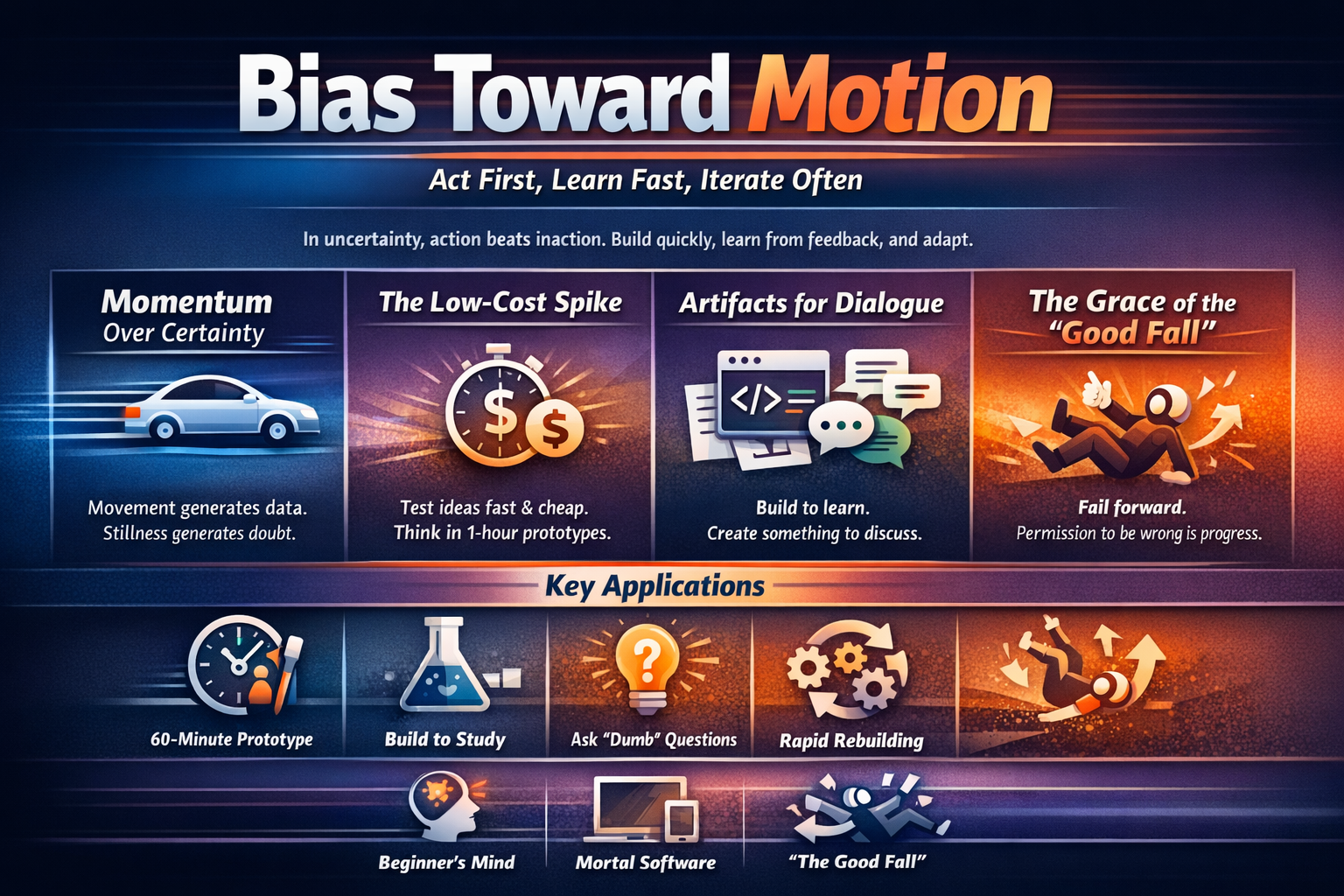
Bias Toward Motion is the strategic preference for action over deliberation. In the context of building systems and scaling businesses, it is the refusal to let uncertainty become an anchor. This mental model suggests that when you are faced with multiple paths—none of which are clearly "correct"—the most expensive thing you can do is stand still. Instead of waiting for perfect information or the "right" next step, you choose to move, even if the movement is small.
This is not a call for reckless behavior or mindless "busy work." Rather, it is an acknowledgment that in complex environments, clarity is a byproduct of action, not a prerequisite for it. Ray’s perspective on this is rooted in the reality of building: the map is not the territory, and the only way to understand the territory is to start walking. It involves adopting a low-cost approach to testing hypotheses, ensuring that the friction to start is as low as possible.
At its core, Bias Toward Motion is about overcoming inertia. It transforms the internal dialogue from "What if this is wrong?" to "How quickly can I find out if this is wrong?" By prioritizing building and shipping over theorizing, you create tangible artifacts—software, prototypes, or sales pitches—that provide the feedback necessary to make the next decision.
Why It Matters
Without a Bias Toward Motion, most projects die in the "thinking" phase. This is known as analysis paralysis—a state where the fear of making a wrong move prevents any move from being made. In a no-code or high-speed development environment, time is often your most precious resource. Every hour spent debating a feature that hasn't been tested is an hour of potential learning lost.
When you wait for perfect information, you are operating under the illusion that such a thing exists. In reality, the most valuable data is hidden behind the act of implementation. You cannot know how a user will interact with a tool, or how two APIs will truly talk to each other, until you connect them. Without this mental model, you risk building massive, complex "solutions" to problems that don't exist, or worse, building nothing at all while your competitors or your own internal deadlines pass you by.
Applying this principle shifts the power dynamic from the problem to the builder. It creates momentum. Momentum has a psychological compounding effect: small wins lead to bigger risks, which lead to faster progress. By moving, you generate the heat and energy required to sustain a long-term project.
How It Works
The mechanism of Bias Toward Motion is built on lowering the stakes of any single action. If an action is expensive, you will naturally hesitate. Therefore, the framework requires you to break down your uncertainty into low-cost experiments.
1. The One-Hour Constraint If you are stuck on a technical problem or a strategic direction, give yourself exactly one hour to "try it." This constraint forces you to stop looking for the perfect architecture and start building a "dirty" version that proves or disproves the concept. If it works, you have a foundation; if it fails, you’ve only lost an hour, and you’ve gained the certainty that that path is a dead end.
2. Artifact Creation Motion must result in something visible. A meeting is not motion; a prototype is. An email thread is not motion; a landing page is. The goal is to produce an "artifact" that can be discussed and critiqued. It is much easier for a team (or a client) to give feedback on a mediocre version of something that exists than on a "perfect" version of something that is still in your head.
3. "Just Sell Something" This is the ultimate application of motion in a business context. Instead of spending months building a product in a vacuum, you attempt to sell the result immediately. This forces you to confront the market's reality. Selling is a form of motion that provides the highest fidelity of feedback. If someone is willing to pay, you have a reason to keep moving. If they aren't, the motion has saved you months of wasted effort.
4. Embracing the "Rightish" Step In a state of uncertainty, there is rarely a single "right" step. There are usually several "rightish" steps. Bias Toward Motion dictates that you pick one and go. If you are 60% sure, that is often enough to warrant a low-cost trial. The momentum gained from taking a "rightish" step often provides the visibility needed to find the truly "right" step later.
When to Apply
This mental model is most valuable during the "fog of war" phases of a project.
Early-Stage Development: When you are starting a new build or a new business, the unknowns outweigh the knowns. This is the time to experiment rapidly with low-cost tools and "just sell something" to see what sticks.
Technical Deadlocks: When you or your team are stuck debating between two different software stacks or integration methods. If the debate has lasted longer than it would take to build a small proof-of-concept for both, you have failed to apply a Bias Toward Motion. Trigger the "One-Hour Rule" here.
Market Validation: When you aren't sure if a feature is actually needed. Instead of running more surveys, build a "smoke test"—a button that leads to a "coming soon" page, for example. The data from that motion is worth more than a thousand survey responses.
Recovery from Failure: When a project hits a major roadblock, the instinct is to huddle and talk. While some reflection is necessary, the best way to regain confidence is to find the smallest possible piece of the problem you can solve and move on it immediately.
Common Traps
The most dangerous misconception about Bias Toward Motion is confusing it with "High-Cost Chaos."
Motion vs. Progress: Just because you are moving doesn't mean you are getting anywhere. If your motion involves high-cost commitments—like signing a multi-year lease or hiring a full team before you have a product—you aren't applying a Bias Toward Motion; you are gambling. The motion must be "low cost to try."
Ignoring Feedback: The point of motion is to generate feedback. If you are moving so fast that you aren't stopping to look at the data your motion is generating, you are just running in a circle. Each "one-hour" burst or "just sell something" attempt must be followed by a moment of assessment.
The "Busy-ness" Trap: Filling your calendar with meetings and "strategic planning" can feel like motion, but it rarely produces the artifacts necessary for progress. If your motion doesn't result in something a user can touch or a system can execute, it might just be a sophisticated form of procrastination.
Lack of Direction: You still need a North Star. Bias Toward Motion is the engine, but you still need a steering wheel. You don't need a perfect 10-step plan, but you do need to know why you are taking the next step.
How It Connects
Bias Toward Motion functions as a foundational principle that enables several other mental models to work. It is the antithesis of Analysis Paralysis. While Analysis Paralysis locks you in a loop of "what-ifs," Bias Toward Motion breaks that loop by introducing external data through action.
It is also deeply connected to Iterative Learning. You cannot iterate if you do not move. Iteration requires a starting point—a Version 0.1. Bias Toward Motion is what gets you to Version 0.1 as quickly as possible. Once that first artifact is created, you can then apply other models like Feedback Loops or Root Cause Analysis to refine it.
Furthermore, it supports the concept of "Lowering the Stakes." By normalizing small, frequent actions, you reduce the psychological weight of any single failure. This builds a culture—either personally or within a team—where experimentation is the default and "failure" is just seen as a specific type of information.
Evidence from Sources
The Importance of Momentum
"Momentum matters. Keep moving even when you're uncertain about the 'right' next step." — Ray's Mental Model: Core Principles for Building with No-Code
The Cost of Action
"Low cost to try (just 1 hour)" — Mental Model Map from Miro
Managing Uncertainty
"Builds momentum even when uncertain" — Mental Model Map from Miro
Market Engagement
"'Just sell something' - emphasis on getting to market" — Mental Model Map from Miro
Learning through Doing
"The tendency to take action and experiment rather than overthinking or waiting for perfect information. This promotes learning through iteration and faster progress towards goals." — Mental Model Map from Miro
Overcoming Stagnation
"Prioritize taking action and building momentum, even when uncertain about the best course. This involves adopting a low-cost approach to trying different options, preventing analysis paralysis, and creating artifacts for discussion and feedback." — Mental Model Map from Miro
In Practice
Scenario 1: The Integration Dilemma
A developer is building an automation between a CRM and an invoicing tool. They are unsure whether to use a third-party connector like Zapier or to write a custom script using the tools' APIs. Instead of spending two days reading API documentation and pricing tiers, they apply a Bias Toward Motion. They set a timer for one hour and attempt to build a single "hello world" connection using Zapier. If it works easily, they have their answer. If they hit a wall, they spend the next hour attempting a basic API call via a script. By lunch, they have concrete evidence of which path is more viable, rather than just theories.
Scenario 2: Validating a New Service
An entrepreneur wants to launch a high-end technical coaching service. They are tempted to spend a month building a website, setting up a specialized booking system, and filming intro videos. Remembering to "just sell something," they instead send a direct message to five people in their network who might need the service, offering a single paid session. If three people say yes, they have immediate validation and cash flow to build the infrastructure. If everyone says no, they have saved a month of work and can pivot their offering immediately.
Scenario 3: Breaking Team Deadlock
A product team is arguing over the layout of a new dashboard. The discussion has stalled because two stakeholders have different visions. The lead applies a Bias Toward Motion by ending the meeting and tasking a designer with creating two "ugly" wireframes—one for each vision—within two hours. These artifacts are then sent to three power users for a 5-minute gut-check. The motion of creating the artifacts and seeking feedback resolves the conflict faster and more effectively than another hour of internal debate.
Have questions about Bias Toward Motion?
Ask the AI Mentor — free, 10 questions/month
Synthesized Essay
Bias Toward Motion
Category: Principle Related Concepts: Analysis Paralysis, Iterative Learning, Momentum, Low-Cost Experimentation
What It Is
Bias Toward Motion is the strategic preference for action over deliberation. In the context of building systems and scaling businesses, it is the refusal to let uncertainty become an anchor. This mental model suggests that when you are faced with multiple paths—none of which are clearly "correct"—the most expensive thing you can do is
This is a preview. State Change members get the full essay, all infographics, audio, and unlimited AI mentoring.
Songs About This Model

Bias Toward Motion
Upbeat indie pop with a driving drum beat and bright acoustic guitar

Bias Toward Motion
Upbeat indie pop with a driving drum beat and bright acoustic guitar
Core Insight
Momentum matters. Keep moving even when you're uncertain about the "right" next step.
Mindset Shift
From "I need to know the right answer first" to "I'll discover the right answer by doing"
Go Deeper
Mental models are just the beginning. Here’s what members get:
Live Office Hours
Ray teaches this model in real time — with your real problems, real code, and real breakthroughs.
Session Vault
1,000+ recorded sessions searchable by topic. Find exactly the moment this model clicks.
AI Skills & MCP Tools
Your AI assistant learns these models too — Skills and MCP servers that bring Ray's thinking to your workflow.
Builder Community
Ask questions, share breakthroughs, get unstuck with 500+ builders who think in models, not just code.