Curiosity
What It Is
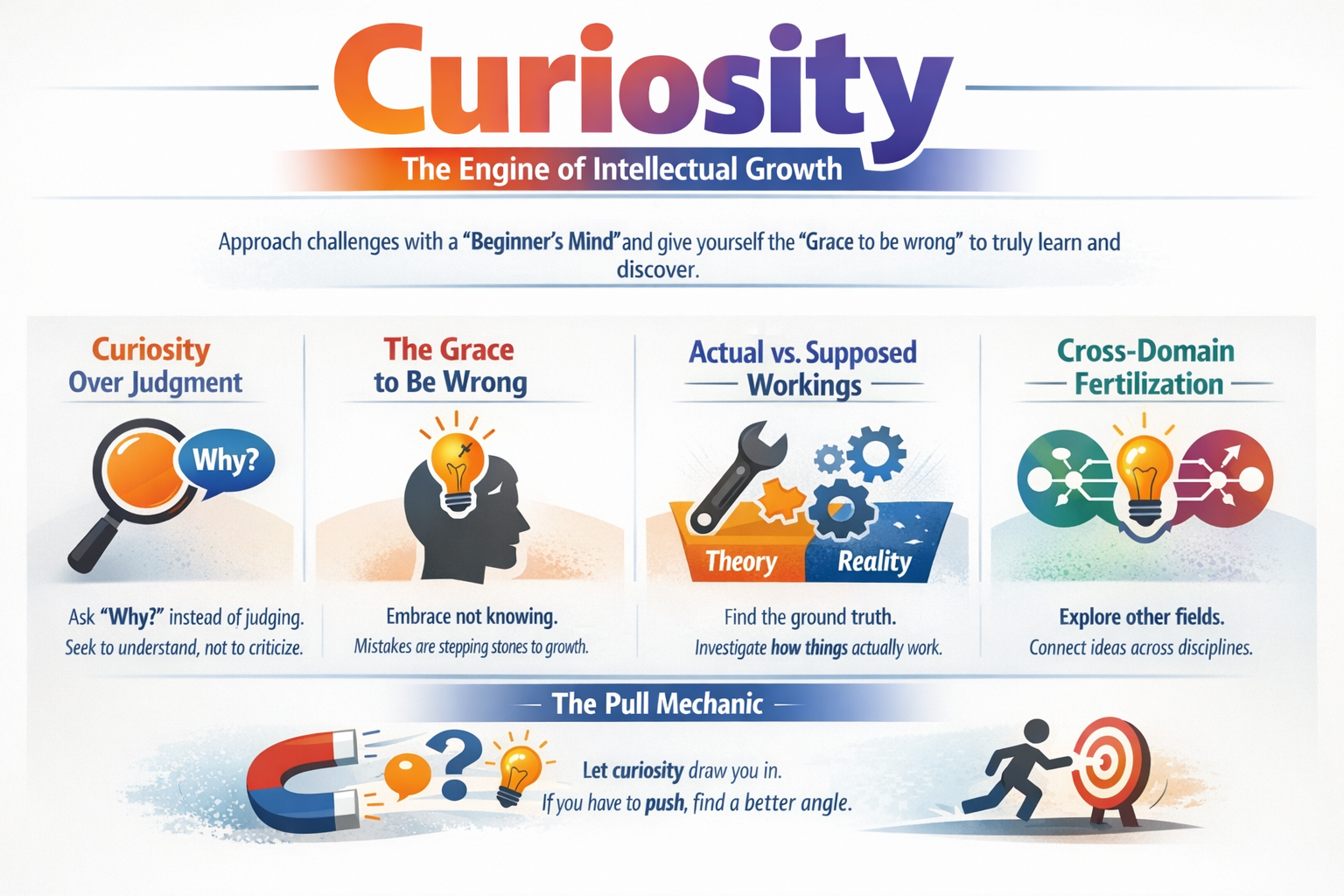
Curiosity, within the State Change framework, is not a passive personality trait or a casual interest in trivia. It is a high-stakes foundational mental model—an active, aggressive stance toward reality. It is the refusal to accept the surface-level explanation of a problem and the commitment to uncovering the ground truth of how a system actually functions.
In practice, this model manifests as a deliberate pivot from judgment to investigation. When a problem arises, the natural human reaction is to assign blame, feel frustration, or judge the situation as "wrong" because it doesn't align with expectations. Curiosity is the discipline of suspending that judgment to ask: "What are the components here, and how are they interacting?" It is a forensic approach to life and work, requiring you to strip away your biases about how things should be so you can see how they are.
This is a "foundation" model because everything that follows—problem-solving, strategy, leadership, and innovation—relies on the quality of the data you are working with. If your data is corrupted by judgment or a reliance on theoretical manuals rather than observed reality, your solutions will be fundamentally flawed. Curiosity is the filter that ensures your understanding of the world is high-fidelity.
Why It Matters
The primary problem curiosity solves is the "Reality Gap"—the distance between the way a process is designed on paper and the way it actually executes in the field. Without curiosity, leaders and operators become trapped in a hall of mirrors, making decisions based on idealized versions of their organizations or their problems. When things go wrong, the lack of curiosity leads to "judgmentalism," where energy is wasted on why people "should" have known better or why a machine "shouldn't" have broken. This fixes nothing.
With curiosity, you gain the ability to bypass the ego. When you are curious, you aren't threatened by a failure; you are intrigued by it. This shift in perspective allows for a much faster OODA loop (Observe-Orient-Decide-Act). Instead of spending three days being angry that a project missed a deadline, a curious leader spends three hours investigating the specific friction points that caused the delay.
Furthermore, curiosity is the antidote to "domain myopia." Most people only look for answers within their own immediate silo. If you’re a coder, you look for coding solutions; if you’re a marketer, you look for marketing solutions. Curiosity forces you to look outside your immediate domain, allowing you to engage in "intellectual arbitrage"—taking a proven solution from an unrelated field and applying it to your own. Without this, you are limited to the incremental improvements of your own industry. With it, you can achieve exponential leaps.
How It Works
Curiosity functions through three specific operational principles: the suspension of judgment, the investigation of "The Real," and cross-domain pollination.
1. The Suspension of Judgment The first step is emotional regulation. When a problem hits, the brain wants to categorize it as "bad" or "stupid." Judgment is a shortcut that stops the thinking process. To apply the curiosity model, you must consciously halt that shortcut. Instead of saying "This process is broken," you ask "What are the specific inputs and outputs of this process as it exists right now?" By removing the moral or emotional weight from a problem, you can analyze its mechanics objectively.
2. Investigating the "Actual" vs. the "Supposed To" There is always a "formal system" (the SOP, the manual, the official plan) and an "informal system" (what people actually do, the workarounds, the actual code execution). Curiosity demands that you ignore the "supposed to" and investigate the "actual." This involves:
- Direct Observation: Going to the place where the work happens (the "Gemba").
- Mechanistic Inquiry: Asking "how" something works, step-by-step, rather than "why" it failed.
- Contextual Mapping: Understanding the environment in which the problem exists. What pressures are the people under? What are the physical constraints of the hardware?
3. Cross-Domain Scavenging The third principle is the deliberate search for external ideas. This is not about wait-and-see; it is an active hunt. You must maintain a "scavenger" mindset, looking at how biology solves communication problems, how the military solves logistics, or how artists solve creative blocks. The mechanism here is analogy: identifying the structural similarities between your problem and a solution in a completely different field.
When to Apply
Curiosity is most valuable in three specific contexts:
When You Encounter a "Persistent" Problem If a problem keeps happening despite repeated "fixes," it means you don't actually understand the problem. You are solving the "supposed to" version of the issue. This is the trigger to stop all "fixing" and start a deep-dive investigation into how the system is actually operating.
During Post-Mortems or Failure Analysis After a setback, the atmosphere is often thick with judgment and defensiveness. This is the time to lead with curiosity. By focusing on the "how" of the failure rather than the "who," you lower the stakes and allow the truth to surface. It turns a painful failure into a valuable data-gathering exercise.
When Entering New Territory When you start a new role, launch a new product, or enter a new market, your existing domain knowledge can actually be a hindrance. You will be tempted to project your old "how things work" onto the new situation. Applying the curiosity model means assuming you know nothing and investigating the new context from the ground up, looking for ideas that have worked for others in similar (but not identical) positions.
Common Traps
The "Academic" Trap People often mistake curiosity for "endless learning" without application. This model does not mean reading books for the sake of reading. It is a tool for action. If your curiosity doesn't lead to a deeper understanding that informs a better decision, it isn't the State Change model of curiosity; it’s just procrastination or "productive-feeling" distraction.
The "Interrogation" Trap There is a fine line between being curious and interrogating your team. If you ask "How does this work?" with a judgmental tone, people will smell the judgment and get defensive. Curiosity requires a genuine lack of ego. If you are using "questions" to lead people to a pre-determined conclusion or to point out their mistakes, you are being judgmental, not curious.
The "SOP" Blindness The most dangerous trap is believing the manual. Many people think they are investigating "how things work" when they are actually just reviewing the documentation. Documentation is an aspiration; reality is what’s happening on the ground. Never mistake the map for the territory. Curiosity is about the territory.
How It Connects
While no specific related concepts were listed in the source material, Curiosity serves as the primary "input" for almost all other mental models.
It is the precursor to effective Problem-Solving. You cannot solve what you have not accurately diagnosed. By investigating how things actually work, you provide the raw material for diagnostic models. It also connects deeply to Leadership and Management. An "NCO" (Non-Commissioned Officer) style of leadership depends on knowing the reality of the front line. A leader who lacks curiosity is effectively blind, relying on filtered reports from subordinates rather than a direct understanding of the friction points in the organization. Finally, it is the driver of Innovation, as looking outside your immediate domain is the only way to find the novel perspectives required for creative breakthroughs.
Evidence from Sources
On Suspending Judgment
"Be curious rather than judgmental about problems" — NCO Talk (6/23)
On Ground Truth and Reality
"Investigate how things actually work, not just how they're supposed to work" — NCO Talk (6/23)
On Domain Arbitrage
"Keep looking outside your immediate domain for ideas" — NCO Talk (6/23)
In Practice
Scenario 1: The Logistics Bottleneck
A warehouse manager notices that shipping times have increased by 20%. The "judgmental" response is to blame the new staff or assume people are being lazy. The manager applying the Curiosity model ignores the "supposed to" (the digital dashboard) and goes to the floor. They watch the actual movement of boxes. They discover that while the "official" path is clear, a new safety rack was installed that forces workers to take a 40-foot detour every time they move a pallet. By investigating how things actually work rather than how the floor plan says they should work, the manager identifies the physical friction point and moves the rack, solving the problem immediately.
Scenario 2: The Software Bug
A senior developer is faced with a recurring bug in a legacy codebase. Instead of just "patching" the error as it appears (treating the symptom), they become curious about the underlying architecture. They look outside their domain—perhaps looking at how mechanical engineers design fail-safes in physical systems—and realize their software lacks "circuit breakers." They implement a pattern from electrical engineering into the code, not only fixing the bug but making the entire system more resilient.
Scenario 3: The Stalled Marketing Campaign
A marketing team is seeing declining engagement. Instead of judging the creative team or the audience, the lead adopts a curious stance. They stop looking at their own industry’s "best practices" and start looking at how casino designers or video game developers keep people engaged. They find a concept in game design—"intermittent variable rewards"—and apply it to their email cadence. By looking outside their domain for ideas, they break out of the industry-standard "local maximum" and see a massive spike in engagement.
Have questions about Curiosity?
Ask the AI Mentor — free, 10 questions/month
Go Deeper
Mental models are just the beginning. Here’s what members get:
Live Office Hours
Ray teaches this model in real time — with your real problems, real code, and real breakthroughs.
Session Vault
1,000+ recorded sessions searchable by topic. Find exactly the moment this model clicks.
AI Skills & MCP Tools
Your AI assistant learns these models too — Skills and MCP servers that bring Ray's thinking to your workflow.
Builder Community
Ask questions, share breakthroughs, get unstuck with 500+ builders who think in models, not just code.