Cut the Frog Up First
What It Is
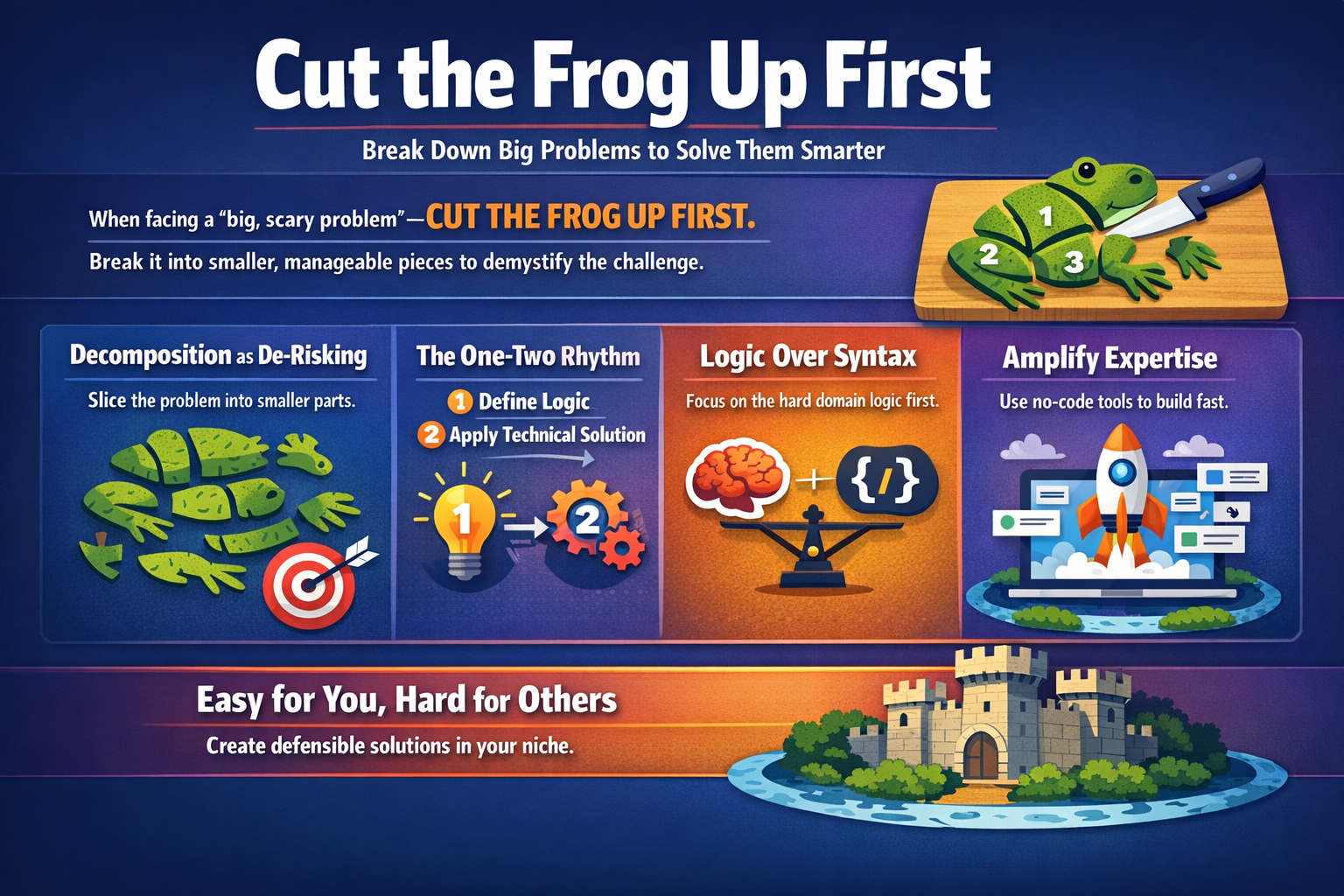
"Cut the Frog Up First" is a mental model designed to eliminate the paralysis that comes from facing a complex, intimidating technical challenge. In the world of building—especially when working with no-code and low-code tools—we often encounter "the frog": a monolithic, multi-faceted problem that feels too big to tackle, too complex to understand, and too "scary" to start.
The model is a tactical evolution of the "eat the frog" productivity advice. While the traditional advice suggests doing the hardest thing first, "Cut the Frog Up First" recognizes that some "frogs" are simply too large to swallow whole. If you try to eat a giant problem in one go, you’ll choke. You’ll get stuck in analysis paralysis, or you’ll spend hours building a convoluted solution that breaks because you tried to account for twenty variables at once. This mental model dictates that you must first apply a "dissection" phase. You take that scary, monolithic problem and surgically break it down into the smallest, most granular pieces possible.
Only once the problem is reduced to a series of bite-sized, non-intimidating tasks do you begin the actual work. It transforms a daunting architectural feat into a series of minor, solvable logic steps.
Why It Matters
This matters because complexity is the primary killer of momentum in any build. When a problem is "big and scary," it creates psychological friction. You find reasons to check your email, tweak your UI, or research new tools instead of solving the core issue. This friction exists because your brain hasn't yet figured out the path through the woods, so it views the entire forest as a threat.
Without this model, builders often attempt "monolithic builds." They try to build the entire checkout flow, the API integration, and the database schema update all in one sitting. When it inevitably doesn't work, they have no idea which part of the "frog" is causing the indigestion. Debugging a monolith is a nightmare.
When you apply "Cut the Frog Up First," you achieve two things:
- Reduced Cognitive Load: You only have to think about one small piece of logic at a time. This allows for deeper focus and fewer mistakes.
- Increased Velocity: Because each piece is small, you can finish it quickly. This creates a "win" state, generating dopamine and momentum that carries you into the next piece. It turns a week-long "stuck" period into a series of thirty-minute sprints.
How It Works
The mechanism of this model follows a specific sequence of dissection and execution.
1. Identify the "Frog" Recognize when you are procrastinating or feeling overwhelmed. If a task on your list is "Build the Stripe Integration," that’s a frog. It’s too big. It contains webhooks, price IDs, customer creation, and success redirects.
2. The Dissection (The "Cut") Break the big task down until the pieces are no longer "scary." A good rule of thumb is that if a task takes more than an hour or requires you to hold more than three variables in your head, it’s still too big.
- Example: "Build Stripe Integration" becomes:
- Create a test product in Stripe.
- Trigger a simple API call to fetch that product.
- Map that product data to a text element in the app.
- Create a "Check Out" button that creates a session.
3. Apply the "One-Two" Approach Each small piece you’ve cut away is then handled using the "One-Two" rule. This involves a rapid cycle of:
- One: Isolate the specific goal for this piece and build the simplest possible version of it.
- Two: Test it, verify it works, and then move to the next "cut" piece.
By treating each "piece" as a "one-two," you ensure that you aren't just moving fast, but you’re moving with stability. You aren't building a house of cards; you're laying individual bricks, each one leveled and set before the next one is placed.
When to Apply
This model is most valuable when you hit a "No-Code Wall." This usually happens during the transition from basic UI building to complex logic or data manipulation.
- API Integrations: Don't try to map 50 fields at once. Map one. Get the 200 OK response first.
- Complex Workflows: If a workflow has ten steps and logic branches, don't build it in the workflow editor all at once. Build the first two steps, test them with real data, and then add the third.
- Database Migrations: When moving or restructuring data, don't try to transform the whole set. Do it for one record type, verify the relationships, and then scale.
- Fear-Based Procrastination: Any time you find yourself staring at the screen not knowing where to click, you are looking at a frog. Stop trying to "click" and start trying to "cut."
Common Traps
The "Incomplete Cut" Trap Builders often think they’ve broken a problem down, but they’ve only broken it into medium-sized problems that are still too complex. If you still feel a sense of dread when looking at a sub-task, the frog isn't cut small enough. Keep cutting until the task feels almost "too easy."
The "Frankenstein" Trap Sometimes, in the process of cutting the frog into pieces, builders lose sight of how those pieces need to connect. While you focus on the small pieces, you must ensure you have a "skeleton" (an architectural plan) that these pieces will eventually hang on. The goal isn't just to have 50 small solved problems; it's to have 50 pieces that fit back together into a working whole.
Skipping the "One-Two" The biggest mistake is cutting the frog up, but then trying to swallow five pieces at once anyway. The power of this model is the discipline of finishing one piece completely—testing it and validating it—before touching the next one. If you build five small pieces without testing, and the system fails, you've just created a "distributed frog" that is just as hard to debug as the original one.
How It Connects
This model is a foundational Practice that supports your overall building strategy. It sits directly alongside the One-Two Rule. If the One-Two Rule is the "how" of execution (Identify/Solve), "Cut the Frog Up First" is the "how" of preparation. It sets the stage so the One-Two Rule can be applied effectively.
It also connects to the concept of Cognitive Load Management. By reducing the size of the problem, you are essentially "right-sizing" the challenge to fit the bandwidth of the human brain. It acknowledges that as builders, our greatest bottleneck isn't the software’s capability, but our own ability to track complex interactions. By "cutting the frog," we are managing our own internal resources to ensure we don't burn out or check out before the build is done.
Evidence from Sources
On Decomposition
"Break big scary problems into small pieces" — Ray's Mental Model: Core Principles for Building with No-Code
On Manageability
"Much easier to 'swallow' that way" — Ray's Mental Model: Core Principles for Building with No-Code
On Integration with Other Models
"Each piece can be a one-two" — Ray's Mental Model: Core Principles for Building with No-Code
In Practice
Scenario 1: The Complex API Integration
A builder needs to sync data between a CRM (like HubSpot) and a custom app. The "Frog" is the entire sync engine.
- The Cut: Instead of building the whole engine, the builder first cuts it down to: "Can I get HubSpot to send a single webhook to my app when a contact is updated?"
- The One-Two: Step one is setting up the webhook URL. Step two is hitting "Test" in HubSpot and seeing the data hit the logs. Once that "piece" is swallowed, they move to the next cut: parsing just the email address from that webhook.
Scenario 2: The Multi-Step User Onboarding
A builder is struggling with a 5-step onboarding wizard that involves file uploads, profile creation, and subscription selection. It keeps breaking.
- The Cut: The builder stops working on the wizard. They isolate "Step 3: The File Upload." They create a blank page with nothing but a file uploader and a "Submit" button.
- The One-Two: They solve the file upload in total isolation (Step One), verify the file lands in the database (Step Two), and then—and only then—reintegrate that logic back into the larger "frog" of the onboarding wizard.
Scenario 3: The "Scary" Database Refactor
An app has grown messy, and the developer needs to move data from a "flat" structure to a "relational" structure. The task feels impossible because the app is live.
- The Cut: The developer identifies one single relationship—perhaps "Users to Company."
- The One-Two: They create the new "Company" table and a single link field on the "User" record. They manually update three test users to ensure the data displays correctly on the front end. They don't touch the other 15 tables until this "bite" is fully digested and working.
Have questions about Cut the Frog Up First?
Ask the AI Mentor — free, 10 questions/month
Synthesized Essay
Cut the Frog Up First
Category: Practice Related Concepts: One-Two Rule, Reducing Friction, Cognitive Load Management
What It Is
"Cut the Frog Up First" is a mental model designed to eliminate the paralysis that comes from facing a complex, intimidating technical challenge. In the world of building—especially when working with no-code and low-code tools—we often encounter "the frog": a monolithic, multi-faceted problem that feels too big to tackle, too complex to understand,
This is a preview. State Change members get the full essay, all infographics, audio, and unlimited AI mentoring.
Songs About This Model
Cut the Frog Up First
Upbeat indie-rock with a driving rhythm and bright synths

Cut the Frog Up First
Upbeat indie-rock with a driving rhythm and bright synths
Core Insight
Conquer the overwhelming by slicing daunting problems into bite-sized, actionable steps.
Mindset Shift
From being paralyzed by a massive obstacle to being empowered by small, solvable pieces.
Go Deeper
Mental models are just the beginning. Here’s what members get:
Live Office Hours
Ray teaches this model in real time — with your real problems, real code, and real breakthroughs.
Session Vault
1,000+ recorded sessions searchable by topic. Find exactly the moment this model clicks.
AI Skills & MCP Tools
Your AI assistant learns these models too — Skills and MCP servers that bring Ray's thinking to your workflow.
Builder Community
Ask questions, share breakthroughs, get unstuck with 500+ builders who think in models, not just code.