Domain Expertise + Technical Knowledge
What It Is
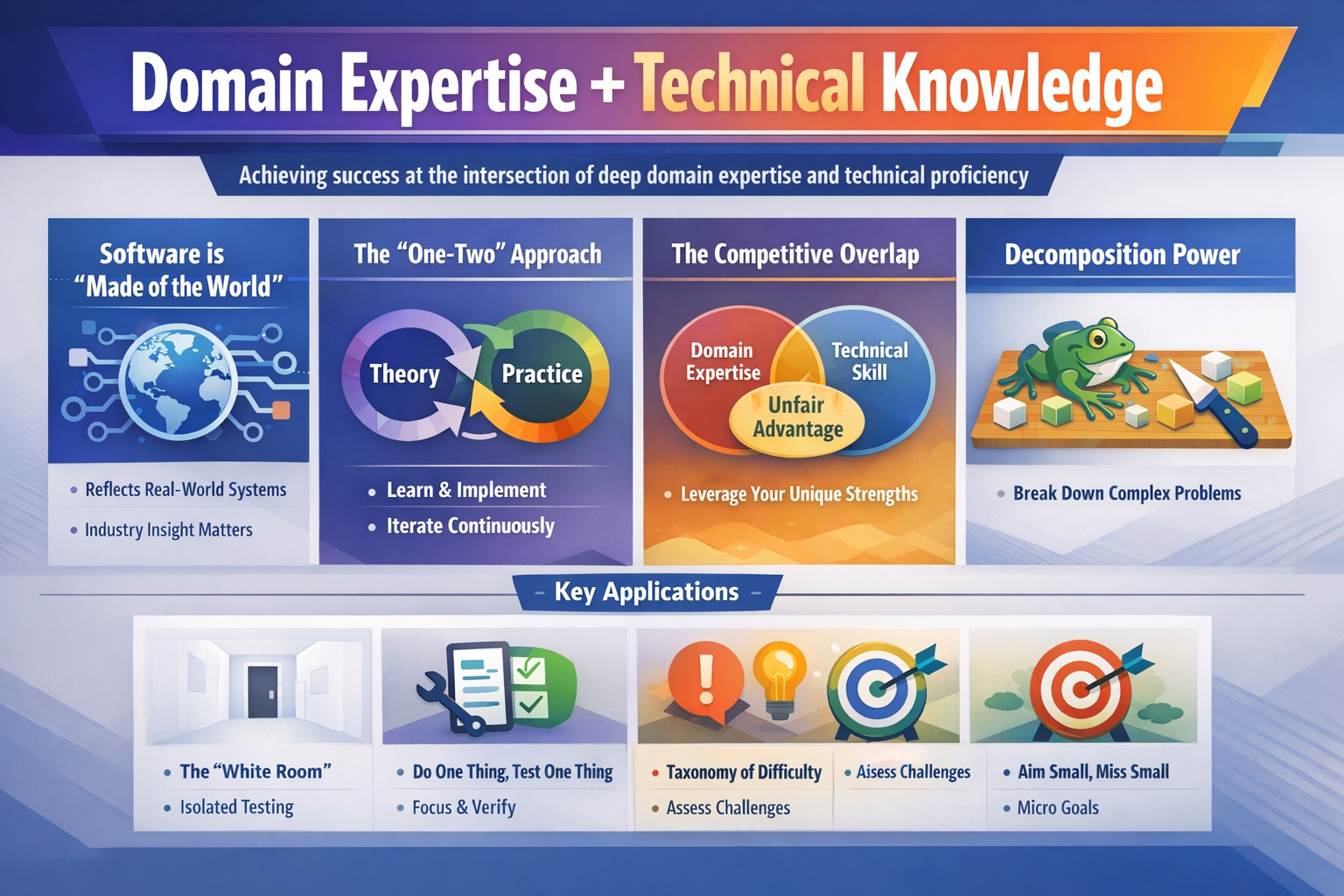
The mental model of Domain Expertise + Technical Knowledge is the recognition that high-leverage software development is no longer just about writing code; it is about the synergistic fusion of "the how" (technical skills) and "the what" (the specific real-world field the software serves). In the State Change philosophy, we don’t view software as an isolated digital artifact. Instead, we see it as a functional mirror of a specific industry, process, or human activity.
This principle dictates that your value as a developer or founder isn't found in your ability to use a specific framework or language—those are commodities. Your true value is found at the intersection where your technical ability meets a deep, nuanced understanding of a particular domain. This isn't about being a "generalist" who knows a little of everything; it is about being a "specialist in the intersection." It is the intentional pairing of your ability to build with your deep understanding of what needs to be built and why it matters to the end user.
Why It Matters
The primary problem this model solves is the "Building for Nowhere" trap. When you have technical skill without domain expertise, you build tools that are technically sound but practically useless. They lack the "connective tissue" to the real world. Conversely, when you have domain expertise without technical knowledge, you are a "visionary" who can't execute, often left at the mercy of expensive agencies or off-the-shelf tools that don't quite fit your needs.
Software today is "made of the world." It is no longer just calculators or word processors; it is the infrastructure for healthcare, logistics, law, and education. Because software is deeply integrated into these fields, the complexity has shifted from the syntax of the code to the logic of the domain. If you don't understand the domain, you cannot possibly build the right logic.
When you combine these two, you unlock an "unfair advantage." You stop competing on price or speed and start competing on efficacy. You are able to see opportunities that a pure technologist would miss because they don't understand the industry's pain points, and that a domain expert would miss because they don't know what is technologically possible.
How It Works
The mechanism of this mental model operates on three distinct levels: The Foundation, The Intersection, and The Moat.
The Foundation: Software as World-Mirroring The first step is accepting that software is an expression of a real-world system. To build a successful application for insurance, you must first understand the "world" of insurance—the regulations, the risk models, and the specific ways people interact with claims. Technical skill allows you to build the mirror, but domain expertise provides the "silvering" that allows the mirror to actually reflect reality. Without that domain knowledge, your software is just a piece of glass.
The Intersection: "Hard for Others, Easy for You" This is the core operational framework of the model. You are looking for problems that are technically solvable but require a deep understanding of a niche to execute correctly. These are the "Sweet Spot" opportunities. If a problem is easy for everyone (low technical bar, low domain knowledge), it’s a commodity. If it’s hard for everyone, it’s a research project. But if a problem is "hard for others" (because they lack the domain context) but "easy for you" (because you've lived that domain), you have found your highest leverage point.
The Synthesis: Continuous Feedback The model doesn't work if the two skills are siloed. It requires a tight loop. Your technical knowledge should inform your domain expertise by revealing new ways to solve old problems. Simultaneously, your domain expertise should prioritize your technical learning, ensuring you aren't wasting time on features or tools that don't move the needle for the actual users in that specific world.
When to Apply
This model is most valuable when you are in the "selection" phase of a project or career move.
- Product Selection: When deciding what to build, don't just look for what is trending on GitHub or Product Hunt. Look for the intersection. Ask: "Where do I have 10,000 hours of context that most developers don't have?"
- Troubleshooting a Failing Product: If a tool is technically working but has no adoption, you have a domain expertise deficit. You need to apply this model by immersing yourself back in the "world" the software is supposed to serve.
- Career Positioning: Instead of being "the React guy," use this model to become "the person who builds automated compliance systems for fintech using React." The latter is significantly more valuable and harder to replace.
- No-Code/Low-Code Integration: This model is especially critical for those using tools like Xano, WeWeb, or FlutterFlow. Since the technical barrier to entry is lower, the differentiator is almost entirely domain expertise.
Common Traps
The most frequent mistake is the Technologist’s Arrogance. This is the belief that "code is code" and that a talented developer can build anything for any industry without getting their hands dirty in the domain logic. This leads to features that look great in a demo but fail in the field because they don't account for the "messiness" of the real world.
The second trap is The Domain Specialist’s Proxy. This occurs when a domain expert tries to "hand off" the technical side entirely to someone else without maintaining a bridge of understanding. You cannot simply throw domain requirements over a wall and expect a technical person to translate them perfectly. The magic happens in the combination—ideally within the same head, or at the very least, within a very tight partnership where both parties are learning the other's language.
Finally, do not mistake General Knowledge for Domain Expertise. Reading three blog posts about real estate does not make you a domain expert. Domain expertise is the result of experiencing the frictions, contradictions, and "unwritten rules" of a specific field. It is the stuff that isn't in the documentation.
How It Connections
This model is a primary driver for The Wheel. In State Change, "The Wheel" often represents the iterative cycle of learning, building, and gaining momentum. Domain expertise acts as the "grease" for the wheel.
When you have domain expertise, your technical iterations (the turns of the wheel) are more accurate. You waste fewer cycles building things that don't matter. This efficiency allows the wheel to spin faster, building more momentum and creating a feedback loop: your technical successes in a domain give you deeper insights into that domain, which in turn leads to even more sophisticated technical applications. This creates a "flywheel effect" where your competitive advantage grows exponentially over time.
Evidence from Sources
The Synergistic Relationship
"Success comes from combining domain knowledge with technical skills" — Nicky Taylor Podcast Interview 11/23
Software as a Reflection of Reality
"Software is 'made of the world' now - domain expertise matters as much as technical expertise" — Nicky Taylor Podcast Interview 11/23
The Competitive Advantage (The Moat)
"Look for what's 'hard for others but easy for you' as your opportunity" — Nicky Taylor Podcast Interview 11/23
In Practice
Scenario 1: The Logistics Specialist
Imagine a developer who spent five years working in warehouse management before learning to code. When they decide to build a custom inventory management tool, they don't just build a database with "In" and "Out" buttons. They understand that "In" involves specific scanning hardware protocols, "Out" involves specific shipping carrier lead times, and "Inventory" must account for "shrinkage" and "spoilage" in a way a pure dev wouldn't think of. The resulting tool is "easy for them" to conceptualize but "hard for others" to replicate because the "others" don't know the nuances of the warehouse floor.
Scenario 2: The Legal Automation Pivot
A founder is trying to build a generic document automation tool. It’s struggling because they are competing with every other generic tool. They apply this mental model and decide to focus exclusively on "Construction Lien Waivers" in the state of Florida. Suddenly, their technical task is simpler (narrower scope), but their domain knowledge—knowing exactly which statutes apply and what the contractors are afraid of—makes their product indispensable. They have moved from a commodity to a high-value solution by leaning into domain expertise.
Scenario 3: The "Hard/Easy" Filter
A State Change member is looking for a new project. Instead of looking at "what's hot in AI," they look at their own background in high-end culinary management. They realize that managing food costs across five locations is a nightmare that currently requires three different spreadsheets and a prayer. For a typical AI dev, building a solution for this is "hard" because they don't understand the relationship between "yield," "prep waste," and "invoice variance." For the member, it's "easy" to define the logic. They have found their opportunity.
Have questions about Domain Expertise + Technical Knowledge?
Ask the AI Mentor — free, 10 questions/month
Synthesized Essay
Domain Expertise + Technical Knowledge
Category: Principle Related Concepts: The Wheel
What It Is
The mental model of Domain Expertise + Technical Knowledge is the recognition that high-leverage software development is no longer just about writing code; it is about the synergistic fusion of "the how" (technical skills) and "the what" (the specific real-world field the software serves). In the State Change philosophy, we don’t view software as an isolated digital artifact. In
This is a preview. State Change members get the full essay, all infographics, audio, and unlimited AI mentoring.
Songs About This Model

The One-Two Step (Made of the World)
Upbeat synth-pop with a driving, rhythmic beat and clean electric guitar

The One-Two Step (Made of the World)
Upbeat synth-pop with a driving, rhythmic beat and clean electric guitar
Core Insight
Successful software development increasingly requires both understanding the technical aspects and having a deep understanding of the domain the software operates within.
Go Deeper
Mental models are just the beginning. Here’s what members get:
Live Office Hours
Ray teaches this model in real time — with your real problems, real code, and real breakthroughs.
Session Vault
1,000+ recorded sessions searchable by topic. Find exactly the moment this model clicks.
AI Skills & MCP Tools
Your AI assistant learns these models too — Skills and MCP servers that bring Ray's thinking to your workflow.
Builder Community
Ask questions, share breakthroughs, get unstuck with 500+ builders who think in models, not just code.