Early Shipping Philosophy
What It Is
Early Shipping Philosophy is a fundamental commitment to collapsing the distance between a developer’s keyboard and a user’s reality. In the State Change approach, this isn’t a suggestion to work faster or cut corners; it is an architectural decision to prioritize external feedback over internal assumptions. It is the refusal to build in a vacuum.
At its core, this mental model dictates that the value of your work is zero until it is interacted with by someone who isn't you. We operate under the belief that internal "polishing" is often just a sophisticated form of procrastination. Instead of waiting for a feature to be "finished"—a state that is largely mythical in software—we focus on getting a functional version of that feature in front of customers at the earliest possible moment. Even if the UI is sparse and the edge cases aren't handled, if it performs its core function, it belongs in the market.
Why It Matters
The primary problem this philosophy solves is "Founder Hallucination." It is incredibly easy to spend three months building a complex suite of features based on what you think the market needs, only to realize upon release that you solved a problem no one actually has. Without early shipping, you are essentially gambling with your most limited resource: time.
When you delay shipping, you accumulate "knowledge debt." You are making hundreds of tiny decisions—about UI, logic, and data structure—based on theoretical assumptions. If your initial premise is 10% off-base, those decisions compound into a product that is fundamentally misaligned with reality. By shipping early, you pay down that knowledge debt immediately. What becomes possible is a "trajectory correction" mechanism. You can afford to be wrong about the details if you find out you're wrong in week one rather than month six. It transforms development from a high-stakes "big reveal" into a low-risk series of incremental validations.
How It Works
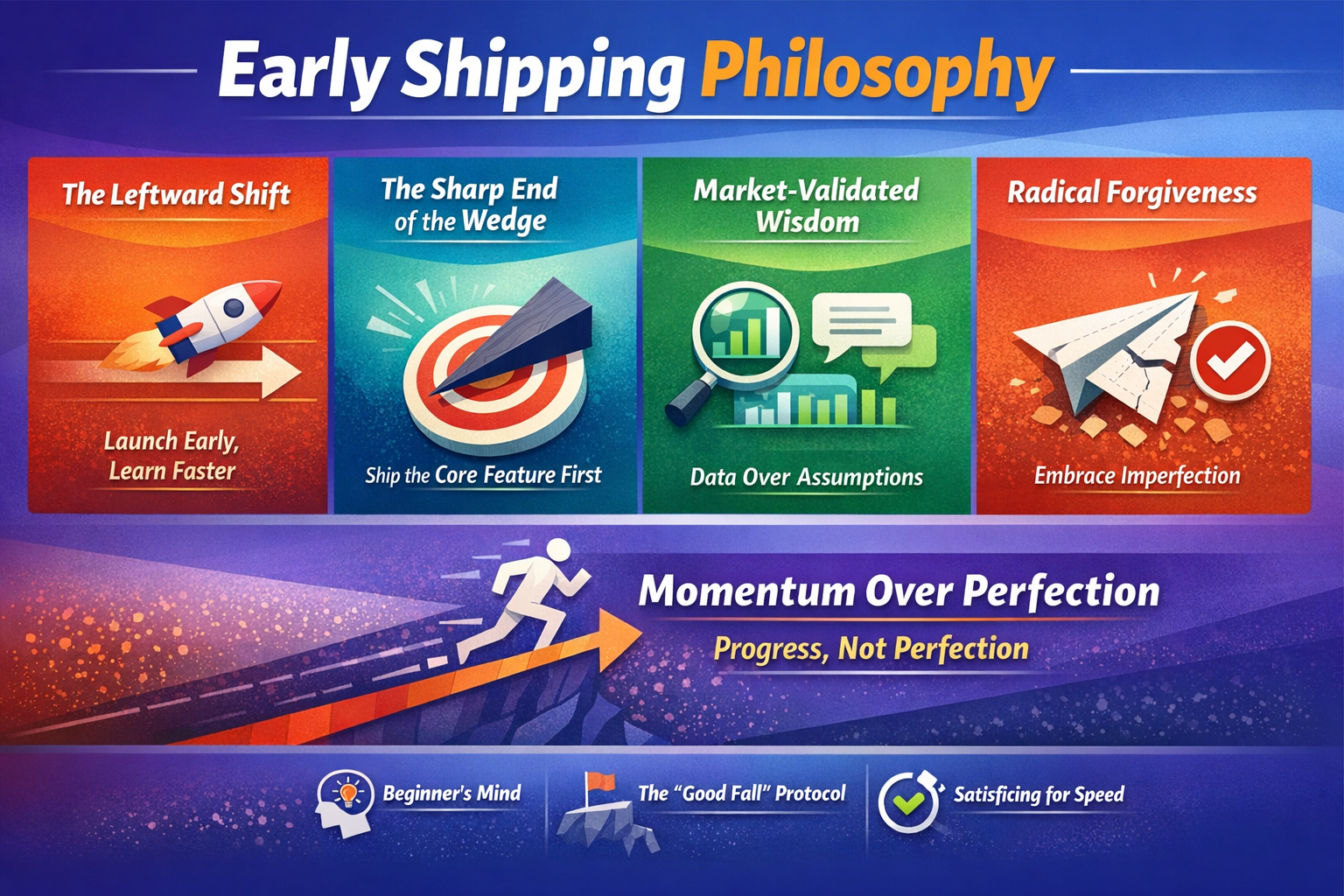
This mental model operates through three primary mechanisms: Shifting Left, The Sharp End of the Wedge, and Market Interaction.
1. Shifting Left In traditional development, deployment is the final stage of a long journey. Early Shipping Philosophy "shifts deployment left," moving it to the very beginning of the timeline. This means that setting up your production environment, your CI/CD pipeline, and your domain happens on day one or two. By making the act of "going live" trivial and early, you remove the psychological and technical barriers to getting work in front of users.
2. The Sharp End of the Wedge When faced with a complex project, the temptation is to build the foundations first—the user authentication, the settings page, the database architecture. Early Shipping Philosophy demands you start with the "sharp end of the wedge." This is the single highest-impact element of the feature; it is the specific thing that solves the user's problem. If you are building a tool to automate invoices, the "sharp end" is the code that generates the PDF. The login screen is the "butt end" of the wedge. You ship the sharp end first, even if you have to manually trigger it for the user behind the scenes.
3. Learning Through Interaction The philosophy recognizes that "perfection" is not an objective standard—it is a moving target defined by the market. Therefore, the "learning" phase of a project doesn't happen during the brainstorming or the coding; it happens during the interaction. The mechanism here is to treat the user’s friction, confusion, or delight as the primary data source for the next sprint. You aren't shipping to "be done"; you are shipping to "be taught."
When to Apply
This model is most valuable in high-uncertainty environments. If you are building a novel feature or a new product where the user's behavior isn't yet proven, you must ship early. It is the "trigger" for whenever you find yourself saying, "It's not ready yet because [X aesthetic or minor detail] isn't perfect."
Specifically, apply this when:
- Starting an MVP: You need to validate the core value proposition before building the supporting infrastructure.
- Introducing a "Big" Feature: Instead of building the whole module, ship the most critical function of that module as a standalone button or page.
- Stagnant Development: If a project has been "80% done" for three weeks, you are likely over-polishing. The fix is to ship the "80%" version today.
Common Traps
The most frequent misconception is that Early Shipping is an excuse for "sloppy" or "broken" software. There is a massive difference between a product that is incomplete and a product that is broken.
- Incomplete: The app only does one thing, but it does that one thing reliably. This is good.
- Broken: The app has ten features, but the buttons don't work or it crashes constantly. This is bad and destroys the trust necessary for valid feedback.
Another trap is the "Fear of Looking Bad." Founders often delay shipping because the UI is ugly or the workflow is clunky. This is a trap of ego. The market doesn't care if your CSS is perfect; it cares if its problem is solved. If a user won't use an "ugly" version of your tool that solves their problem, the problem probably wasn't that big to begin with.
Finally, don't confuse "shipping" with "marketing." You can ship a feature to three trusted users to get feedback without doing a public launch on Product Hunt. Early shipping is about the contact, not the fanfare.
How It Connects
This philosophy serves as the foundational "speed controller" for other mental models. It is the practical application of the "Sharp End of the Wedge" concept—identifying the point of maximum impact and leading with it.
It also integrates deeply with the concept of "Shift Left." While "Shift Left" is often used in security or testing circles to catch errors early, in the State Change context, we apply it to the entire business value chain. By shifting deployment and market interaction left, we ensure that the "testing" isn't just checking for bugs in the code, but checking for "bugs" in the business logic and user experience assumptions.
Evidence from Sources
On the Priority of Early Interaction
"Focus on getting something in front of customers as early as possible" — Founders Institute Talk (8/23)
On the Sequence of Development (The Wedge)
"Start with the 'sharp end of the wedge' - the highest impact element" — Founders Institute Talk (8/23)
On the Timing of Deployment
"Shift deployment earlier in the timeline ('to the left')" — Founders Institute Talk (8/23)
On the Source of Truth/Learning
"Learning comes from market interaction, not perfect execution" — Founders Institute Talk (8/23)
In Practice
Scenario 1: The AI Content Generator
A founder wants to build an AI platform that generates SEO-optimized blog posts, includes images, and auto-posts to WordPress. Instead of building the WordPress integration and the image generation API first, they apply the Early Shipping Philosophy. They build a simple text box where a user enters a topic and gets a plain-text response from the AI. They ship this "sharp end" to five users via a private link. They discover that users don't actually want blog posts; they want LinkedIn captions. Because they shipped early, the founder avoids building the useless WordPress integration entirely.
Scenario 2: The Internal Reporting Tool
A developer is tasked with building a complex dashboard for the sales team. Rather than spending weeks perfecting the charts and the data-refresh intervals, they "shift left." On day two, they deploy a single static table that shows the most critical metric: "Daily Leads." They give the URL to the Head of Sales immediately. The feedback is that the "Daily Leads" number is wrong because it doesn't filter out test accounts. The developer fixes the logic in hour 48 instead of week 4, ensuring the foundation of the dashboard is actually accurate before building the "pretty" charts.
Scenario 3: Breaking the "80% Done" Cycle
A team is building a new scheduling feature. It’s been "almost ready" for a month because they are trying to handle every possible timezone edge case and calendar sync conflict. They decide to apply the Early Shipping Philosophy. They strip the feature back to its "sharp end": a simple link that allows someone to book a time in a single timezone (UTC). They ship it to one power user. They realize the user doesn't care about the sync conflicts; they just wanted a way to send a link instead of back-and-forth emails. The team realizes they can launch the "simple" version to the whole user base tomorrow and handle the edge cases as they actually arise.
Have questions about Early Shipping Philosophy?
Ask the AI Mentor — free, 10 questions/month
Synthesized Essay
Early Shipping Philosophy
Category: Principle Related Concepts: Shift Left, The Sharp End of the Wedge, Market-Driven Learning
What It Is
Early Shipping Philosophy is a fundamental commitment to collapsing the distance between a developer’s keyboard and a user’s reality. In the State Change approach, this isn’t a suggestion to work faster or cut corners; it is an architectural decision to prioritize external feedback over internal assumptions. It is the refusal to build in a
This is a preview. State Change members get the full essay, all infographics, audio, and unlimited AI mentoring.
Songs About This Model

The Sharp End of the Wedge
Upbeat indie rock with a driving drum beat and bright, energetic electric guitars

The Sharp End of the Wedge
Upbeat indie rock with a driving drum beat and bright, energetic electric guitars
Core Insight
Market feedback is more valuable than internal perfectionism in early stages.
Go Deeper
Mental models are just the beginning. Here’s what members get:
Live Office Hours
Ray teaches this model in real time — with your real problems, real code, and real breakthroughs.
Session Vault
1,000+ recorded sessions searchable by topic. Find exactly the moment this model clicks.
AI Skills & MCP Tools
Your AI assistant learns these models too — Skills and MCP servers that bring Ray's thinking to your workflow.
Builder Community
Ask questions, share breakthroughs, get unstuck with 500+ builders who think in models, not just code.