Focus on Shipping
What It Is
Focus on Shipping is the discipline of prioritizing the delivery of functional software into the hands of real users above all other developmental activities. It is a mental model that shifts the definition of "progress" from "lines of code written" or "features completed" to "value made accessible." In this framework, software that exists only on a developer's machine or in a staging environment is essentially a liability—a collection of assumptions that haven't been tested by the harsh light of reality.
This principle is about closing the loop between a developer's hypothesis and the user's experience as quickly as possible. It is a bias toward action that recognizes that the most valuable information you can obtain is not found in a design document or a brainstorming session, but in the telemetry of a user interacting with a live product. Shipping is the "moment of truth" where theory meets practice.
Why It Matters
The primary problem this model solves is the "feedback gap." When you spend months building in a vacuum, you are essentially hallucinating. You are imagining what users want, how they will use the tool, and what problems they might encounter. The longer the time between the start of development and the first shipment, the more likely you are to build something that no one wants or that doesn't work in a real-world environment.
Without a focus on shipping, teams often fall into the trap of "infinite polish." They solve hypothetical edge cases that may never occur while ignoring the fundamental question of whether the core value proposition holds water. By making shipping the priority, you force yourself to confront the "hard parts" early—things like deployment pipelines, environment configurations, and user onboarding—rather than leaving them as a catastrophic surprise at the end of the project cycle. Ultimately, this focus generates velocity, which serves as a North Star for the health of any technical project.
How It Works
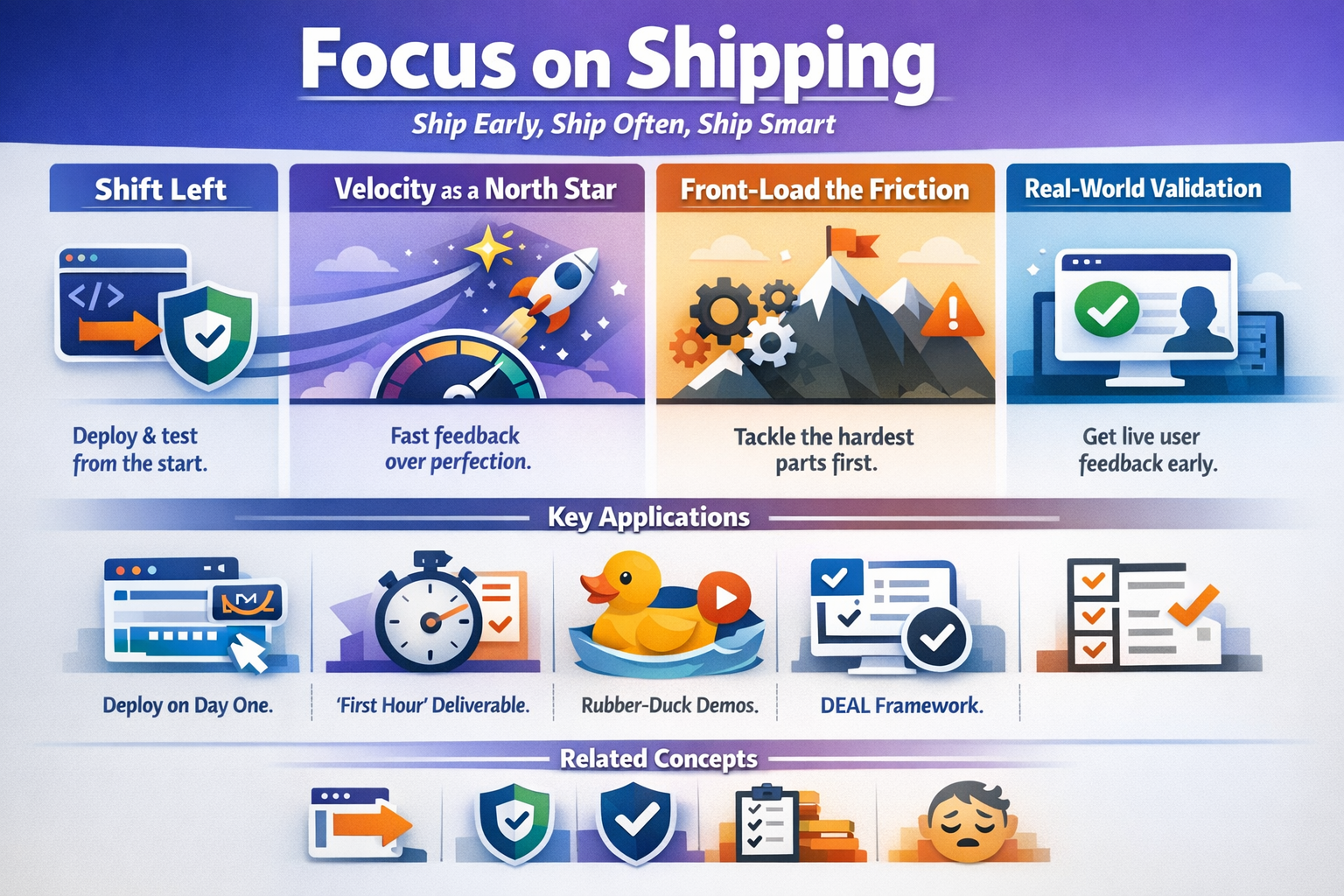
The mechanism of Focus on Shipping relies on a few key pillars: front-loading difficulty, prioritizing velocity, and applying the DEAL framework.
First, you must front-load the hard parts. In most projects, the technical "plumbing"—setting up the production server, configuring SSL, establishing a deployment pipeline—is treated as the final step. Focus on Shipping demands you do this first. If you can't ship a "Hello World" page to a production URL on day one, your project is already at risk. By solving the deployment hurdle immediately, you ensure that every subsequent update is just a matter of pushing code, not a week-long struggle with infrastructure.
Second, you treat velocity as your North Star. Velocity is not just about speed; it is about the rate of delivery. It is the measure of how quickly you can move an idea from a concept to a live feature. When velocity is the priority, you stop over-thinking the architecture of things that haven't been proven yet. You build what is necessary to ship, get the feedback, and then iterate.
Third, you apply the DEAL framework to clear the path for shipping:
- Delegate: Identify tasks that someone else (or another service) can do better so you can focus on the core product.
- Eliminate: Ruthlessly cut features that are not essential for the current release. If it doesn't help you ship today, it's noise.
- Automate: Automate your testing and deployment so that shipping becomes a low-friction event.
- Liberate: Free your mind from the "perfect" version of the product so you can be liberated to ship the "functional" version.
When to Apply
This mental model is most critical during the early stages of a project or when a team feels "stuck" in a cycle of endless refinement. If you find yourself saying, "It's almost ready, we just need to fix X, Y, and Z," but X, Y, and Z have been on the list for three weeks, you need to Focus on Shipping.
It is particularly valuable when you are dealing with high uncertainty. If you aren't sure if a feature will be popular, don't spend a month building the perfect version. Build the "good enough" version and ship it. The feedback you get in 48 hours will be worth more than the perfection you might have achieved in 30 days. It should also be applied whenever the "deployment dread" starts to set in; if the team is afraid to push to production, it’s a sign you haven't been shipping often enough.
Common Traps
The most dangerous misconception is that "shipping" means "shipping junk." Focus on Shipping is not an excuse for broken code or a complete lack of quality. It is about shipping functional software. If the user can't use it, it isn't "shipped"; it's just "out there." The goal is a Minimum Viable Product, not a Minimum Broken Product.
Another trap is treating the ship date as the finish line. In this mental model, the ship date is the starting line. People often make the mistake of shipping once and then disappearing for three months to work on the next big thing. True Focus on Shipping requires a commitment to iteration. You ship, you listen, you adjust, and you ship again.
Finally, don't confuse "activity" with "shipping." You can be very busy writing code, attending meetings, and refactoring databases, but if none of that results in a change that the user can see or feel, your velocity is zero.
How It Connects
Focus on Shipping is the operational arm of Just Do It (JFDI). While JFDI provides the psychological push to overcome procrastination and "analysis paralysis," Focus on Shipping provides the strategic framework for where to direct that energy. It ensures that your "doing" results in a tangible release rather than just circular activity.
It also requires a Beginner’s Mind. To ship early, you must be willing to put out work that isn't your "masterpiece" yet. You have to be humble enough to let the users show you where you are wrong. A developer who is too attached to their "expert" status will often refuse to ship until everything is perfect to protect their ego. The Beginner’s Mind allows you to see the first shipment as an experiment—a way to learn—rather than a final judgment on your skills.
Evidence from Sources
The Importance of Feedback
"Ship early to get real feedback" — SC Mental Model Talk 1 6/2023
Customer Centricity
"Put things in front of customers faster" — SC Mental Model Talk 1 6/2023
Strategic Ordering of Tasks
"Front-load the hard parts (like deployment)" — SC Mental Model Talk 1 6/2023
The Core Metric
"Focus on velocity as a North Star" — SC Mental Model Talk 1 6/2023
Operational Efficiency
"Remember the DEAL framework: Delegate, Eliminate, Automate, Liberate" — SC Mental Model Talk 1 6/2023
In Practice
Scenario 1: The Deployment First Approach
Imagine a developer starting a new SaaS project. Instead of spending the first week writing the authentication logic or the database schema on their local machine, they spend the first four hours setting up a basic "Under Construction" page and deploying it to a live URL using an automated CI/CD pipeline. By "front-loading the hard parts," they have cleared the technical hurdle of deployment. Now, every small feature they write can be "shipped" to the live site instantly, ensuring they never face a "deployment nightmare" on launch day.
Scenario 2: Pruning for Velocity
A team is building a new dashboard. They have a list of twelve widgets they want to include. Two weeks into the sprint, they realize that the data integration for the tenth widget is going to take another ten days of work. Instead of delaying the entire release, the team applies the "Eliminate" part of the DEAL framework. They remove the tenth widget from the scope, ship the nine working widgets to the users, and immediately begin receiving feedback on the core dashboard layout. They realize users actually only care about three of the widgets, saving them from ever having to finish the difficult tenth one.
Scenario 3: Real-World Feedback vs. Hallucination
An entrepreneur spends months perfecting an AI-driven scheduling tool. They are convinced that the "killer feature" is the ability to sync with five different calendar types. However, they follow the principle of "shipping early" and release a version that only syncs with Google Calendar. Within three days, users provide feedback that they don't care about other calendars; what they actually need is a way to send SMS reminders. Because the entrepreneur shipped early, they can pivot their development to the SMS feature immediately, rather than wasting another two months building calendar integrations that no one wanted.
Have questions about Focus on Shipping?
Ask the AI Mentor — free, 10 questions/month
Synthesized Essay
Focus on Shipping
Category: Principle Related Concepts: Just Do It (JFDI), Beginner's Mind
What It Is
Focus on Shipping is the discipline of prioritizing the delivery of functional software into the hands of real users above all other developmental activities. It is a mental model that shifts the definition of "progress" from "lines of code written" or "features completed" to "value made accessible." In this framework, software that exists only on a developer's machine or in
This is a preview. State Change members get the full essay, all infographics, audio, and unlimited AI mentoring.
Songs About This Model

The North Star of the Ship
Upbeat indie rock with a driving drum beat and bright, propulsive synthesizers

The North Star of the Ship
Upbeat indie rock with a driving drum beat and bright, propulsive synthesizers
Core Insight
Shipping is the only way to turn assumptions into evidence.
Mindset Shift
From building the perfect product in isolation to delivering functional value for immediate feedback.
Go Deeper
Mental models are just the beginning. Here’s what members get:
Live Office Hours
Ray teaches this model in real time — with your real problems, real code, and real breakthroughs.
Session Vault
1,000+ recorded sessions searchable by topic. Find exactly the moment this model clicks.
AI Skills & MCP Tools
Your AI assistant learns these models too — Skills and MCP servers that bring Ray's thinking to your workflow.
Builder Community
Ask questions, share breakthroughs, get unstuck with 500+ builders who think in models, not just code.