Future Self is Smarter
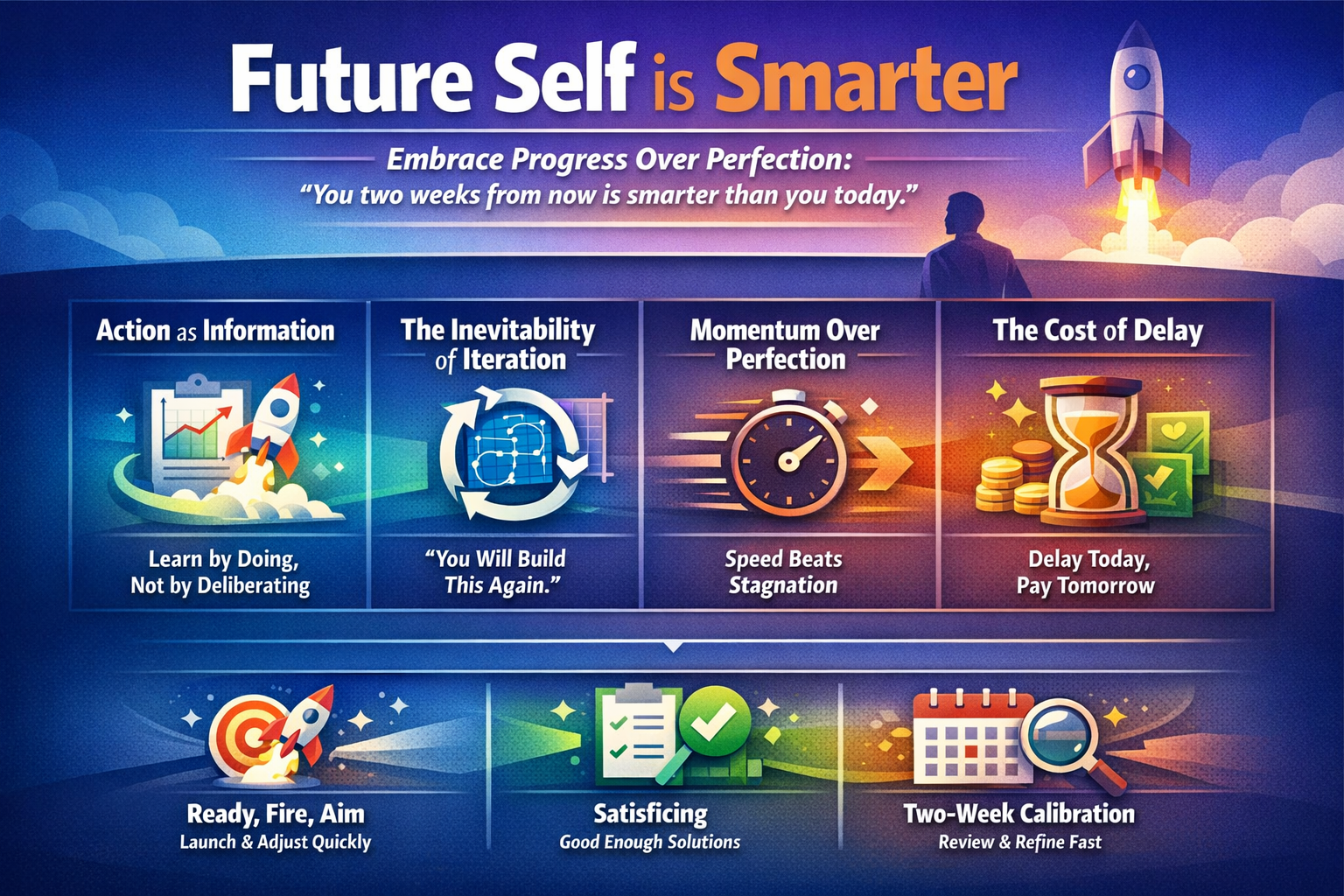
What It Is
The mental model Future Self is Smarter is a temporal shift in perspective that requires you to view your current knowledge, skills, and technical hurdles as a snapshot rather than a ceiling. In the context of solving complex problems—whether that is building a custom integration in Xano or architecting a front-end in WeWeb—there is a tendency to treat our current state of confusion as a permanent condition. This model rejects that premise.
At its core, this is an operational acknowledgement that learning is an inevitable byproduct of time and engagement. When we say "You two weeks from now is smarter than you today," we aren't talking about a different person; we are talking about the version of you that has spent 14 days absorbing feedback from the system, hitting walls, and synthesizing new information. It is a tool for managing the ego, forcing a level of humility regarding what you know now while maintaining a fierce optimism about what you will know shortly.
This model is not about passive waiting. It is a "proactive approach to personal and professional development." It means that while you may not have the solution to a technical bottleneck today, the very act of struggling with that bottleneck is the mechanism that "upgrades" your brain to the version capable of solving it in two weeks. It moves you from a "fixed" view of your own intelligence to a "fluid" view of your situational competence.
Why It Matters
The primary problem this model solves is the paralysis of the "God Complex." Developers and founders often feel they must have the entire architecture perfected before they lay the first stone. If they can’t see the final solution clearly today, they feel they are failing. This leads to over-engineering—building complex "just in case" features—because they don't trust their future selves to handle problems as they arise.
Without this mental model, you are prone to Analysis Paralysis. You stay stuck in the planning phase because your "Today Self" is terrified of making a mistake that the "Future Self" won't be able to fix. It creates a high-pressure environment where every decision feels terminal. You end up optimizing for a level of understanding you haven't even reached yet, which almost always results in brittle, overly complex systems that don't actually solve the problem.
When you adopt the belief that your future self is smarter, you unlock the ability to Iterate with Confidence. It becomes possible to build "just enough" for today, knowing that in two weeks, you will have more data, more skill, and a better perspective to handle the next layer of complexity. It transforms frustration into a recognized stage of the development cycle. Instead of thinking, "I'm stuck because I'm not good enough," you think, "I'm currently in the 'Today' phase, and the 'Two-Weeks-from-Now' version of me will find this trivial."
How It Works
The mechanism of this model functions through three primary components: Humility, The Two-Week Window, and Breadcrumbing.
1. The Humility Trigger The first step is acknowledging current ignorance. You must admit that your "Today Self" lacks the full picture. This isn't self-deprecation; it's a cold, hard assessment of the facts. By accepting that you are currently "less smart" than you will be, you stop trying to force solutions that you aren't ready to implement. This humility allows you to ship smaller, simpler pieces of work because you aren't trying to prove your genius all at once.
2. The Two-Week Window Why two weeks? In a high-intensity learning environment (like State Change), two weeks represents a significant feedback loop. It is enough time to try a solution, watch it fail, read the documentation, ask for help, and let the subconscious mind process the patterns. The "window" serves as a time-box for your current confusion. It reminds you that "smarter" isn't a destination you reach in years—it’s an incremental upgrade that happens in the short term through active engagement.
3. The Breadcrumbing Principle Since you know your future self is smarter, you have a responsibility to provide that smarter person with the data they need. This means documenting your current "Today" logic, even if it feels messy. Your future self will have more skill, but they won't have your current memory of why you made certain choices. How it works is simple: you work at the edge of your current ability, leave a trail (comments, logs, documentation), and trust that the "upgraded" version of you will be able to refactor and improve it when they arrive.
When to Apply
This model is most valuable in High-Uncertainty Environments. If you are working with a new API, a new software stack, or a business logic problem that has no clear precedent, you are in the "Today" zone. The model should be triggered the moment you feel the urge to "figure it all out" before starting.
Apply this during Technical Debt Discussions. When you see a piece of code that looks inefficient but works, ask: "Will my self two weeks from now have better context to fix this?" If the answer is yes, and the current version isn't breaking the system, move on. Trust the future version’s improved understanding.
Another critical trigger is Imposter Syndrome. When you feel like you don't belong in the room because you don't understand a concept, invoke the model. Remind yourself that your understanding is on a two-week lag. You aren't "bad" at the task; you are simply waiting for the feedback loop to complete the next "intelligence" installation.
Common Traps
The most dangerous trap is "Future Self as a Janitor." This is when people use this model as an excuse for laziness or procrastination. They leave a mess, don't write tests, and don't document their work, saying, "Future me is smarter, they'll fix it." This is a fundamental misunderstanding. The model says the future self is smarter (has better skills/context), not that they have more time or superpowers. If you don't do the "proactive" work today, the future self will spend all their time cleaning up your mess instead of using their superior skills to innovate.
Another trap is Passive Waiting. Improvement is not a function of time alone; it is a function of "continuous learning." If you stop working on the problem for two weeks and just watch Netflix, you will not be smarter when you return. You will just be two weeks older. The "Future Self" only gets smarter if the "Today Self" stays in the arena, struggling with the concepts.
Finally, don't mistake this for Perpetual Refactoring. Some people use the idea that they will be smarter tomorrow as a reason to never ship anything today. They think, "If I'll be smarter in two weeks, I should wait until then to start." This is the opposite of the model's intent. The future self only becomes smarter because the today self shipped something and learned from the results.
How It Connections
While no specific related concepts were listed in the source, this model clearly functions as a supporting pillar for Iterative Development. It provides the psychological safety needed to embrace a "Ship, then Fix" mentality. By de-risking the idea of being wrong today, it enables the "Optimism" required to maintain a high velocity in a technical build.
It also connects to the concept of Humility in Engineering. Most technical failures aren't caused by a lack of IQ, but by an excess of ego—the refusal to believe that one's current approach could be improved. This mental model bakes improvement into the schedule. It aligns with the idea that the best systems aren't built; they are grown through a series of "Today Selves" handing off better and better context to "Future Selves."
Evidence from Sources
The Balance of Ego
"The principle "You two weeks from now is smarter than you today" encourages both humility and optimism" — Mental Model Map from Miro
The Mechanism of Growth
"...it acknowledges that there's always room for growth while affirming that improvement is constant" — Mental Model Map from Miro
Professional Posture
"Recognizing that your understanding and skills will improve over time, encouraging humility and continuous learning." — Mental Model Map from Miro
The Resulting Action
"This perspective fosters a proactive approach to personal and professional development." — Mental Model Map from Miro
In Practice
Scenario 1: The API Bottleneck
A developer is trying to connect a complex external database to their app. They are overwhelmed by the 50+ endpoints and the confusing documentation. Instead of spending a week reading every page of the docs (and forgetting half of it), they apply Future Self is Smarter. They build the simplest possible connection to one endpoint today. They acknowledge they don't fully understand the auth flow yet, but they leave detailed notes on what they tried. Two weeks later, after seeing how that one endpoint behaves, they return. The documentation that was once gibberish now makes sense. Their "Future Self" easily builds the remaining 49 endpoints because they had the humility to start small.
Scenario 2: The Messy "V1" Architecture
A founder is building their first MVP in Bubble. They know their database structure is probably not "industry standard" and they feel a sense of shame about it, which is slowing them down. They use this model to realize that their "Today Self" only knows the current user requirements. They decide to ship the "messy" version. Fourteen days later, after 100 users have signed up, the founder has more data on how users actually interact with the app. Because they are now "smarter" about the actual use case, they can refactor the database with surgical precision, rather than guessing at a "perfect" structure two weeks prior.
Scenario 3: Learning a New Language
A low-code developer decides to learn JavaScript to extend their apps. On day three, they feel like they’ll never understand "Promises" or "Async/Await." Instead of quitting, they remind themselves: "I'm in the Two-Week Window." They continue to write "ugly" code that barely works. They stay proactive. By day 14, the patterns begin to click. The "Future Self" looks back at the day-three code and sees exactly where the misunderstanding was. The humility to be "dumb" on day three was the direct cause of being "smart" on day fourteen.
Have questions about Future Self is Smarter?
Ask the AI Mentor — free, 10 questions/month
Synthesized Essay
Future Self is Smarter
Category: Principle Related Concepts: None listed
What It Is
The mental model Future Self is Smarter is a temporal shift in perspective that requires you to view your current knowledge, skills, and technical hurdles as a snapshot rather than a ceiling. In the context of solving complex problems—whether that is building a custom integration in Xano or architecting a front-end in WeWeb—there is a tendency to treat our current state of confusion as a
This is a preview. State Change members get the full essay, all infographics, audio, and unlimited AI mentoring.
Songs About This Model

The Ranging Shot (Future Self is Smarter)
Upbeat indie pop with a driving drum beat and bright acoustic guitars

The Ranging Shot (Future Self is Smarter)
Upbeat indie pop with a driving drum beat and bright acoustic guitars
Core Insight
Today’s ceiling is your future self’s floor.
Mindset Shift
From being limited by current ignorance to being empowered by inevitable future expertise.
Go Deeper
Mental models are just the beginning. Here’s what members get:
Live Office Hours
Ray teaches this model in real time — with your real problems, real code, and real breakthroughs.
Session Vault
1,000+ recorded sessions searchable by topic. Find exactly the moment this model clicks.
AI Skills & MCP Tools
Your AI assistant learns these models too — Skills and MCP servers that bring Ray's thinking to your workflow.
Builder Community
Ask questions, share breakthroughs, get unstuck with 500+ builders who think in models, not just code.