Growth & Learning Mindset
What It Is
The Growth & Learning Mindset is the foundational operating system for anyone navigating the rapidly shifting landscape of technology and business. It isn't a "positive attitude" or a motivational slogan; it is a fundamental approach to reality that prioritizes the evolution of one’s own capabilities over the preservation of one’s current image as an expert. At its core, this mental model is built on the recognition that your current skills and understanding are merely a snapshot in time—a "Version 1.0" that is expected and required to receive continuous updates.
In practice, this means approaching every technical challenge, every platform shift, and every business pivot with a stance of openness. Rather than relying on a fixed set of "pre-conceived notions" or a static view of what you are capable of, you operate from the baseline assumption that you can, and will, learn what is necessary to solve the problem at hand. It is the shift from saying "I am a [Platform] Developer" to "I am someone who solves problems using the best tools available, and I am currently mastering this one."
Why It Matters
Without a Growth & Learning Mindset, you are professionally fragile. The shelf-life of technical knowledge is shrinking. If you view your abilities as fixed, every time a tool changes or a new framework emerges, it feels like a personal threat or a sign of your impending obsolescence. This leads to the "Expert Trap," where you spend more energy defending what you already know than acquiring what you need to know. You become resistant to better ways of working because they require you to be a "junior" again for a period of time.
When you adopt this mindset, you solve the problem of "stuckness." Most technical blocks aren't caused by a lack of intelligence; they are caused by the fear of looking like you don't know what you're doing. A Growth & Learning Mindset removes that friction. It makes it possible to engage with high-uncertainty projects because you aren't betting on your current knowledge—you are betting on your ability to close the gap between what you know now and what the project requires. It transforms a bug or a failed deployment from a "defeat" into "data," providing the foundation for both personal and professional scaling.
How It Works
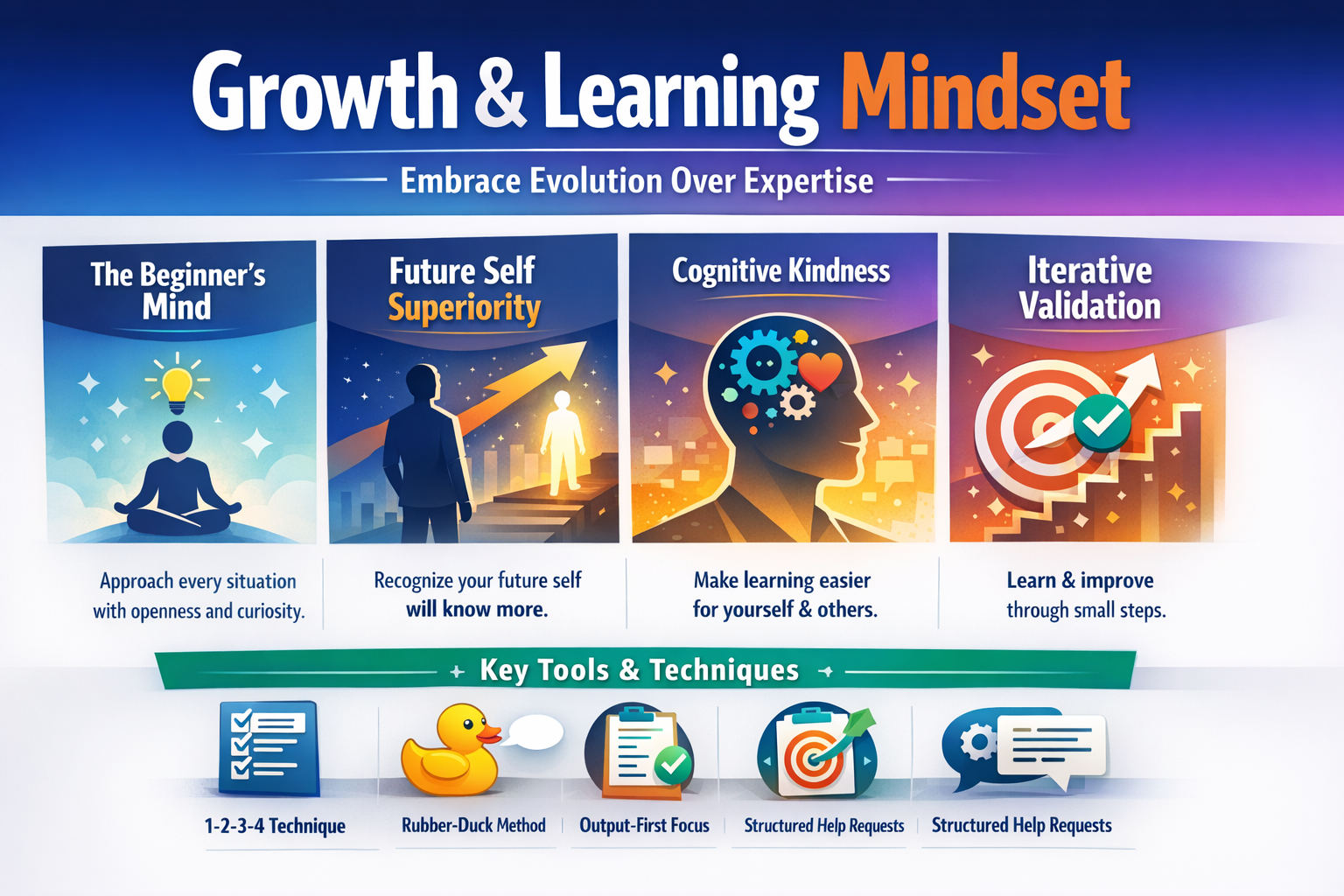
The mechanism of the Growth & Learning Mindset functions through three primary principles: Temporal Humility, Cognitive Reset, and the Investigative Drive.
1. Temporal Humility (The Future Self Recognition) The most powerful component of this model is the explicit recognition that your future self will be more knowledgeable than your current self. This creates a "long-term greedy" strategy for learning. When you encounter a problem you can’t solve, the growth mindset doesn't demand that you solve it instantly through sheer brilliance. Instead, it asks you to set up the conditions—research, testing, and documentation—so that the version of you that wakes up tomorrow has a better starting point. You are essentially an investor in your own future competence.
2. Cognitive Reset (The Beginner's Mind) This involves the deliberate practice of "maintaining a beginner's mind." To learn something new, you must first be willing to be "bad" at it. This requires a reset of your ego. In a technical context, this means being willing to read the documentation from the beginning, even if you’ve been coding for twenty years. It means asking the "stupid" question in a forum because you value the answer more than the appearance of expertise. You treat your existing knowledge as a toolbox, not a cage; you are willing to set aside old tools the moment they no longer serve the current objective.
3. The Investigative Drive (Curiosity) Curiosity is the engine of the growth mindset. It shifts your reaction to a "Null Pointer Exception" from frustration to "I wonder why that's happening?" Curiosity replaces the defensive posture with an offensive, exploratory one. Instead of trying to force the technology to fit your pre-conceived notions, you use curiosity to map the actual territory of the system you are working with.
When to Apply
This mental model is most valuable during Platform Shifts or Tool Migration. When you move from a traditional coding environment to a low-code tool like FlutterFlow or Weweb, or when you integrate AI into your workflow, your old mental models will fail you. This is the trigger to engage the Beginner's Mind. If you feel yourself saying "this tool is stupid because it doesn't work like [X]," you are in a fixed mindset. That is the moment to pivot to curiosity.
It is also critical during High-Stakes Debugging. When a system breaks and you have no idea why, the pressure to "just fix it" often leads to blind guessing. Applying the Growth & Learning Mindset here means slowing down to learn how the system is actually behaving, rather than how you assume it should behave. Use the situation as a forced learning opportunity.
Finally, apply this when Scaling a Career. As you move from individual contributor to lead or founder, the skills that made you successful previously (technical execution) are not the skills that will make you successful next (delegation, strategy). You must be willing to be a novice at these new disciplines.
Common Traps
The most common misconception is that a Growth Mindset means "trying harder." It does not. You can work 80 hours a week with a fixed mindset and simply burn yourself out against a wall of your own making. Growth is about strategy and openness, not just effort. It’s about working smarter by being willing to change your approach when the current one isn't working.
Another trap is Performative Curiosity. This is when someone asks questions or "learns" as a way to delay taking action or making a decision. True growth mindset is biased toward application. You learn so that you can do, and you do so that you can learn more.
Finally, don't confuse this with Toxic Positivity. A growth mindset doesn't mean pretending a failure doesn't suck. It means acknowledging the failure is a temporary state of your "current self" while your "future self" is already busy extracting the lessons from it. It is an objective assessment of skills, not a delusional avoidance of reality.
How It Connects
This model is the "hub" for several other key concepts. It is directly supported by Beginner's Mind, which provides the tactical methodology for staying open. Without the Beginner's Mind, the Growth Mindset is just an abstract goal; with it, it becomes a daily practice of "emptying the cup."
It is also intrinsically linked to the command to Be Curious. Curiosity is the fuel. If the Growth & Learning Mindset is the vehicle that moves you toward mastery, curiosity is what you put in the tank. These models together create a feedback loop: curiosity leads to learning, learning leads to growth, and growth expands the horizon of what you can be curious about. This fits into the bigger State Change picture by ensuring that the "human element" of the technical stack is as upgradeable and resilient as the software itself.
Evidence from Sources
Foundational Nature
"Looking at this mental model mind map, I can identify several key thematic clusters and important principles: Growth & Learning Mindset" — Mental Model Map from Miro
Tactical Approach
"Maintain a beginner's mind and curiosity" — Mental Model Map from Miro
Temporal Humility
"Recognition that your future self will be more knowledgeable" — Mental Model Map from Miro
Defining the Approach
"This is a fundamental approach that emphasizes continuous learning, curiosity, and the recognition that one's understanding and skills will evolve over time." — Mental Model Map from Miro
Openness vs. Fixed Views
"It's about approaching new situations with openness and a willingness to learn, rather than relying on pre-conceived notions or a fixed view of one's abilities." — Mental Model Map from Miro
In Practice
Scenario 1: The Platform Pivot
A veteran developer who has spent a decade in JavaScript is tasked with building a complex backend in a no-code tool like Xano. A fixed mindset developer would spend their time complaining about the lack of a traditional IDE and trying to "code" around the tool's limitations. A developer with a Growth & Learning Mindset acknowledges they are a "beginner" in this specific environment. They set aside their "pre-conceived notions" of how a database should be managed and spend the first two days deep-diving into the Xano documentation and community patterns. They recognize that their "future self" will understand the logic of this tool, and they embrace the temporary discomfort of being a novice.
Scenario 2: The "Impossible" Bug
A founder is facing a production-level bug that only happens in certain edge cases. They’ve tried every trick they know, and nothing works. Instead of spiraling into "I'm not cut out for this," they trigger their Investigative Drive (Curiosity). They stop trying to "fix" it and start trying to "observe" it. They add exhaustive logging and build a reproduction environment. They act on the "recognition that their future self will be more knowledgeable" once the data comes in. By shifting from a state of "I must be right" to "I must be curious," they eventually find a pattern they previously ignored.
Scenario 3: The Career Transition
An expert engineer is promoted to a Product Manager role. Initially, they struggle because they keep trying to solve technical problems instead of defining product requirements. Using the Growth & Learning Mindset, they realize they are relying on a "fixed view of their abilities" as an engineer. They pivot, explicitly adopting a Beginner's Mind regarding product management. They seek out mentors, read the foundational texts of the new discipline, and accept that they will make "rookie" mistakes in communication and strategy, viewing these mistakes as the necessary "foundation to learn and grow" in their new professional chapter.
Have questions about Growth & Learning Mindset?
Ask the AI Mentor — free, 10 questions/month
Synthesized Essay
Growth & Learning Mindset
Category: Foundation Related Concepts: Beginner's Mind, Be Curious
What It Is
The Growth & Learning Mindset is the foundational operating system for anyone navigating the rapidly shifting landscape of technology and business. It isn't a "positive attitude" or a motivational slogan; it is a fundamental approach to reality that prioritizes the evolution of one’s own capabilities over the preservation of one’s current image as an expert. At its core, t
This is a preview. State Change members get the full essay, all infographics, audio, and unlimited AI mentoring.
Songs About This Model

The Bridge to My Future Self
Upbeat indie pop with driving acoustic guitar, handclaps, and a bright, rhythmic vocal delivery

The Bridge to My Future Self
Upbeat indie pop with driving acoustic guitar, handclaps, and a bright, rhythmic vocal delivery
Core Insight
Stay curious: your future self is always smarter than you are today.
Mindset Shift
From defending what you already know to discovering what you have yet to learn.
Go Deeper
Mental models are just the beginning. Here’s what members get:
Live Office Hours
Ray teaches this model in real time — with your real problems, real code, and real breakthroughs.
Session Vault
1,000+ recorded sessions searchable by topic. Find exactly the moment this model clicks.
AI Skills & MCP Tools
Your AI assistant learns these models too — Skills and MCP servers that bring Ray's thinking to your workflow.
Builder Community
Ask questions, share breakthroughs, get unstuck with 500+ builders who think in models, not just code.