Growth Mindset on Technology Change
What It Is
Growth Mindset on Technology Change is the fundamental psychological shift from viewing technical skills as static assets to viewing them as temporary tools for perpetual value creation. In the context of State Change, this isn't just about being "open-minded." It is a rigorous commitment to prioritizing progress over protection. It is the refusal to tether one’s professional identity to a specific language, platform, or methodology.
At its core, this mental model challenges the "Expertise Trap"—the common tendency for builders and developers to become emotionally and professionally attached to the tools they have spent years mastering. When you have a growth mindset regarding technology, you recognize that your value does not lie in your ability to write a specific line of code or manage a specific database, but in your ability to leverage whatever technology is currently most effective to solve a problem. It is a transition from being a "defender of the old way" to an "architect of the new possibility."
Why It Matters
The pace of technological evolution—particularly in the realms of AI, low-code, and no-code—is faster than the human ability to maintain "expert" status through traditional means. If you operate from a fixed mindset, every new tool feels like a personal threat. If a new platform can do in five minutes what used to take you five days, a fixed mindset sees job displacement and the erasure of your hard-earned value. This leads to burnout, obsolescence, and a defensive posture that prevents you from seeing the next opportunity.
With a Growth Mindset on Technology Change, that same shift is viewed as an expansion of your leverage. When the "how" becomes easier, the "what" and "why" become more important. This mental model allows you to stay ahead of the curve by removing the friction of ego. It transforms anxiety into curiosity. Instead of asking, "Will this replace me?" the growth-minded individual asks, "What can I build now that I couldn't build yesterday?" Without this mindset, you are essentially trying to protect a candle-making business in the age of the lightbulb; with it, you are the one figuring out how to wire the city.
How It Works
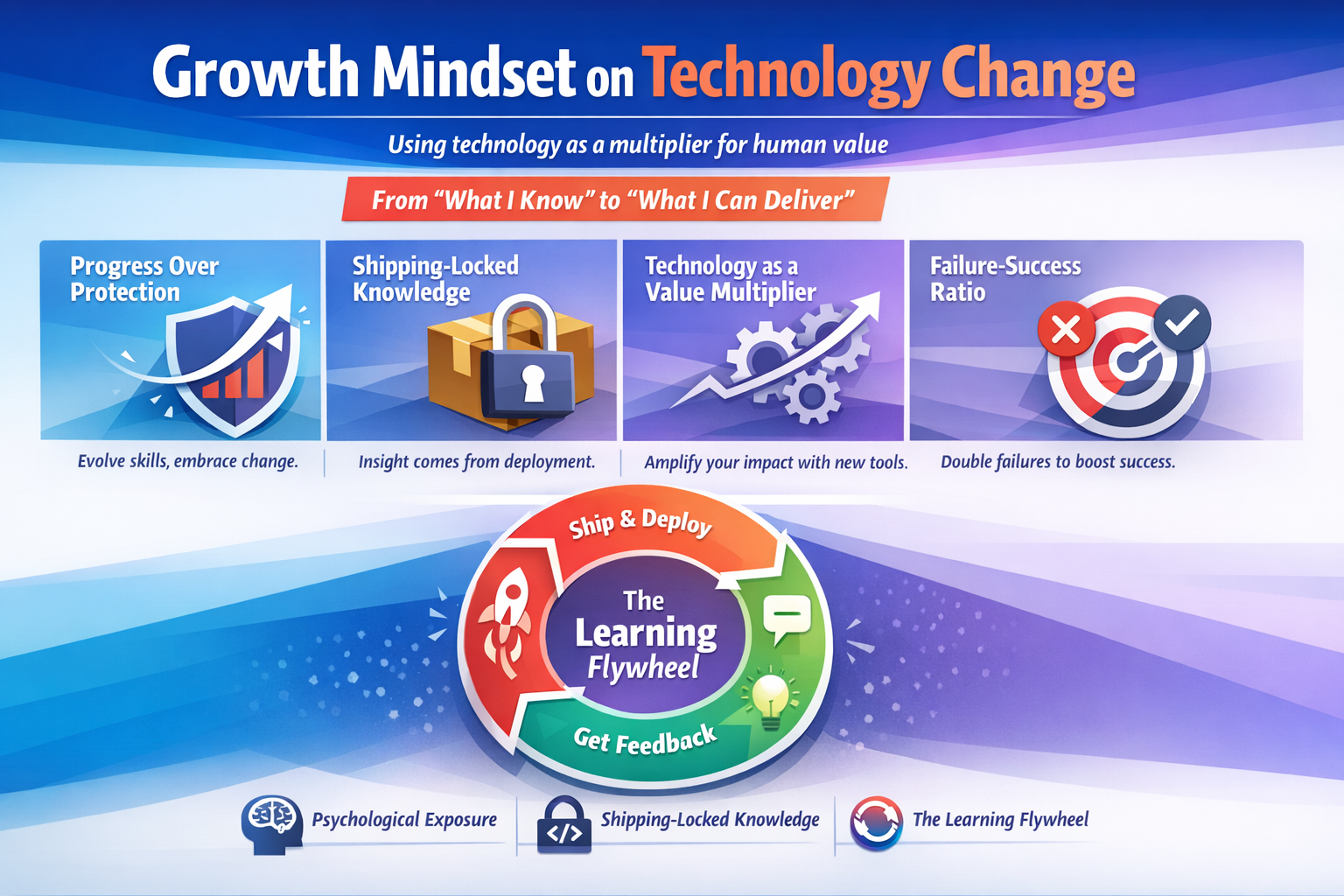
This mental model operates through three primary pillars: Skill Liquidity, the Value-First Lens, and the Failure Multiplier.
1. Skill Liquidity vs. Skill Protection Most professionals treat their skills like a fortress to be guarded. They focus on "protecting current skills" because those skills represent their status and income. Growth mindset requires you to treat skills as "liquid." You invest in them, use them for as long as they provide the highest ROI, and then you are willing to liquidate them to move into a more effective asset class. You don’t protect the skill; you protect the continual progress toward the goal.
2. The Value-First Lens The mechanism here is to decouple "labor" from "value." In a displacement mindset, technology is a competitor that steals labor. In a growth mindset, technology is an enabler of more value creation. To apply this, you must constantly ask: "If this tool handles the grunt work, what higher-level problem am I now free to solve?" The focus shifts from the efficiency of the process to the impact of the outcome.
3. The Failure Multiplier Learning new technology requires a high tolerance for being "bad" at something again. The framework suggests that to increase your success rate in a rapidly changing environment, you must "double your failure rate." This is a mathematical approach to learning: if 1 in 10 experiments with a new tool yields a breakthrough, the only way to get more breakthroughs is to churn through the 9 failures faster. You embrace mistakes as the "tax" you pay for staying at the cutting edge.
When to Apply
This model is most valuable during technological inflection points. When a new category of software (like Generative AI) enters your workflow, that is the trigger to apply this mindset. If your first instinct is to find reasons why the tool "isn't that good" or "won't work for my complex use case," you are in a fixed/protectionist mode.
It should also be applied during project post-mortems. If a project failed because you insisted on using a familiar tool that wasn't the best fit, you are failing to prioritize progress. Use this model to evaluate whether you chose your stack based on the problem's needs or your own comfort.
Finally, apply this when planning your personal development. If your "to-learn" list is just deeper versions of what you already know, you are protecting. If your list includes things that make your current skills look obsolete, you are growing.
Common Traps
The most dangerous trap is "False Adaptation." This is when someone says they have a growth mindset because they are learning a new tool, but they are only learning it to prove it's inferior to their old way. They aren't looking for value; they are looking for confirmation that their existing skills are still safe.
Another trap is "The Expert’s Ego." The more experienced you are, the harder this model is to implement. Experts have the most to lose from technological change. They often mistake their mastery of a process for mastery of the domain. For example, a master of manual data entry might think they are an expert in "data," when they are actually just an expert in "entry." When automation arrives, they fight to protect the entry rather than evolving the data analysis.
Finally, do not mistake this for "Shiny Object Syndrome." Growth mindset doesn't mean jumping to every new tool that appears on Product Hunt. It means being willing to jump if the new tool enables more value. The differentiator is the focus on continual progress toward an objective, not the novelty of the technology itself.
How It Connections
While not explicitly listed in the source, this model acts as the Foundation for several other State Change principles. It is the prerequisite for Iterative Development. You cannot iterate effectively if you are afraid of the mistakes that come with trying new configurations.
It also connects deeply to the concept of Agency. A builder who fears technology change has low agency; they are at the mercy of the market. A builder with a growth mindset has high agency because they believe they can adapt to any environment. They don't need the world to stay the same; they just need the ability to keep learning. This creates a feedback loop: more learning leads to more successful value creation, which reinforces the belief that change is an opportunity rather than a threat.
Evidence from Sources
On Prioritizing Evolution over Preservation
"Focus on continual progress rather than protecting current skills" — Nicky Taylor Podcast Interview 11/23
On the Economic Shift of Automation
"View technology as enabling more value creation rather than job displacement" — Nicky Taylor Podcast Interview 11/23
On the Tactical Necessity of Error
"Embrace mistakes as part of learning: 'double your failure rate to increase success'" — Nicky Taylor Podcast Interview 11/23
In Practice
Scenario 1: The Transition to AI-Assisted Coding
A veteran software engineer who has spent fifteen years mastering syntax feels threatened by AI code assistants. Instead of spending their energy debunking the AI's hallucinations or complaining about code quality, they apply the growth mindset. They realize that their "skill" isn't just typing syntax—it's system architecture and problem-solving. They "liquidate" their pride in manual typing and focus on how the AI can help them build three apps in the time it used to take to build one. They focus on the value (the completed app) rather than the protection (their manual coding speed).
Scenario 2: The Low-Code Pivot
A business analyst is used to running complex processes via massive, brittle Excel spreadsheets. A new low-code platform like Glide or Airtable is introduced. Instead of protecting their status as the "Excel Wizard" (the protectionist trap), they intentionally "double their failure rate" by trying to rebuild their process in the new tool. They expect it to be messy and for their first few versions to break. By embracing those mistakes, they eventually create an automated system that provides 10x more value to the company than the spreadsheet ever did.
Scenario 3: Learning Through "Failure"
A founder is trying to integrate a new API. It’s frustrating, and nothing is working. In a fixed mindset, they would take this as a sign that they aren't "technical enough" and give up. Using the "Growth Mindset on Technology Change," they reframe the frustration. They realize that every error message is a piece of data that narrows the path to success. They lean into the struggle, intentionally trying different configurations—even ones they suspect might fail—to map out how the technology works. They view the "failures" as the necessary fuel for eventual success.
Have questions about Growth Mindset on Technology Change?
Ask the AI Mentor — free, 10 questions/month
Synthesized Essay
Growth Mindset on Technology Change
Category: Foundation Related Concepts: Value Creation, Iterative Learning, Skill Liquidity
What It Is
Growth Mindset on Technology Change is the fundamental psychological shift from viewing technical skills as static assets to viewing them as temporary tools for perpetual value creation. In the context of State Change, this isn't just about being "open-minded." It is a rigorous commitment to prioritizing progress over protection. It is the
This is a preview. State Change members get the full essay, all infographics, audio, and unlimited AI mentoring.
Songs About This Model

The Shipping Key
Upbeat indie-pop with a driving synth beat and energetic acoustic guitar

The Shipping Key
Upbeat indie-pop with a driving synth beat and energetic acoustic guitar
Core Insight
Embracing change and viewing technology as a tool for empowerment facilitates continuous learning and adaptation in a rapidly evolving landscape.
Mindset Shift
From fearing technological disruption to embracing change as an opportunity for growth and value creation.
Go Deeper
Mental models are just the beginning. Here’s what members get:
Live Office Hours
Ray teaches this model in real time — with your real problems, real code, and real breakthroughs.
Session Vault
1,000+ recorded sessions searchable by topic. Find exactly the moment this model clicks.
AI Skills & MCP Tools
Your AI assistant learns these models too — Skills and MCP servers that bring Ray's thinking to your workflow.
Builder Community
Ask questions, share breakthroughs, get unstuck with 500+ builders who think in models, not just code.