Just Do It (JFDI)
What It Is
Just Do It (JFDI) isn't just a motivational slogan for athletes; in the context of building and problem-solving, it is a foundational principle that prioritizes kinetic energy over potential energy. It is the tactical rejection of analysis paralysis. When we talk about JFDI, we are talking about the discipline of taking action and shipping something functional sooner rather than later. It is a commitment to the belief that the fastest way to learn about a problem is to touch it, and the fastest way to validate a solution is to put it in front of a user.
At its core, JFDI is about reducing the distance between an idea and its execution. It demands that you stop looking at the mountain as a whole and start moving the first rock. This mental model assumes that your initial assumptions are likely incomplete, if not outright wrong. Therefore, the goal isn't to build the "final" version of a product in one go, but to establish a feedback loop as quickly as humanly possible. It involves a ruthless focus on the core value proposition, stripping away the "nice-to-haves" that often serve as hiding places for people who are afraid to launch.
Why It Matters
The primary problem JFDI solves is the "Big Bang" failure—the scenario where a builder spends months or years in a vacuum, constructing a massive, complex system, only to find out upon release that the market doesn't want it or the technical assumptions were flawed. Without the JFDI mindset, projects suffer from scope creep and "perfectionism," which is usually just procrastination in a fancy suit. When you don't ship, you don't learn. When you don't learn, you waste resources building the wrong things.
By adopting JFDI, you make the leap from theoretical planning to empirical evidence. It changes the psychology of a project from "we are preparing to solve this" to "we are currently solving this." This shift creates momentum. In the world of low-code, no-code, and rapid development, speed is your greatest competitive advantage. JFDI allows you to occupy the problem space before your competitors have even finished their slide decks. It ensures that your development is guided by reality rather than by your own internal biases or fantasies about how a user might behave.
How It Works
JFDI operates through a series of specific tactical maneuvers designed to bypass the friction of starting.
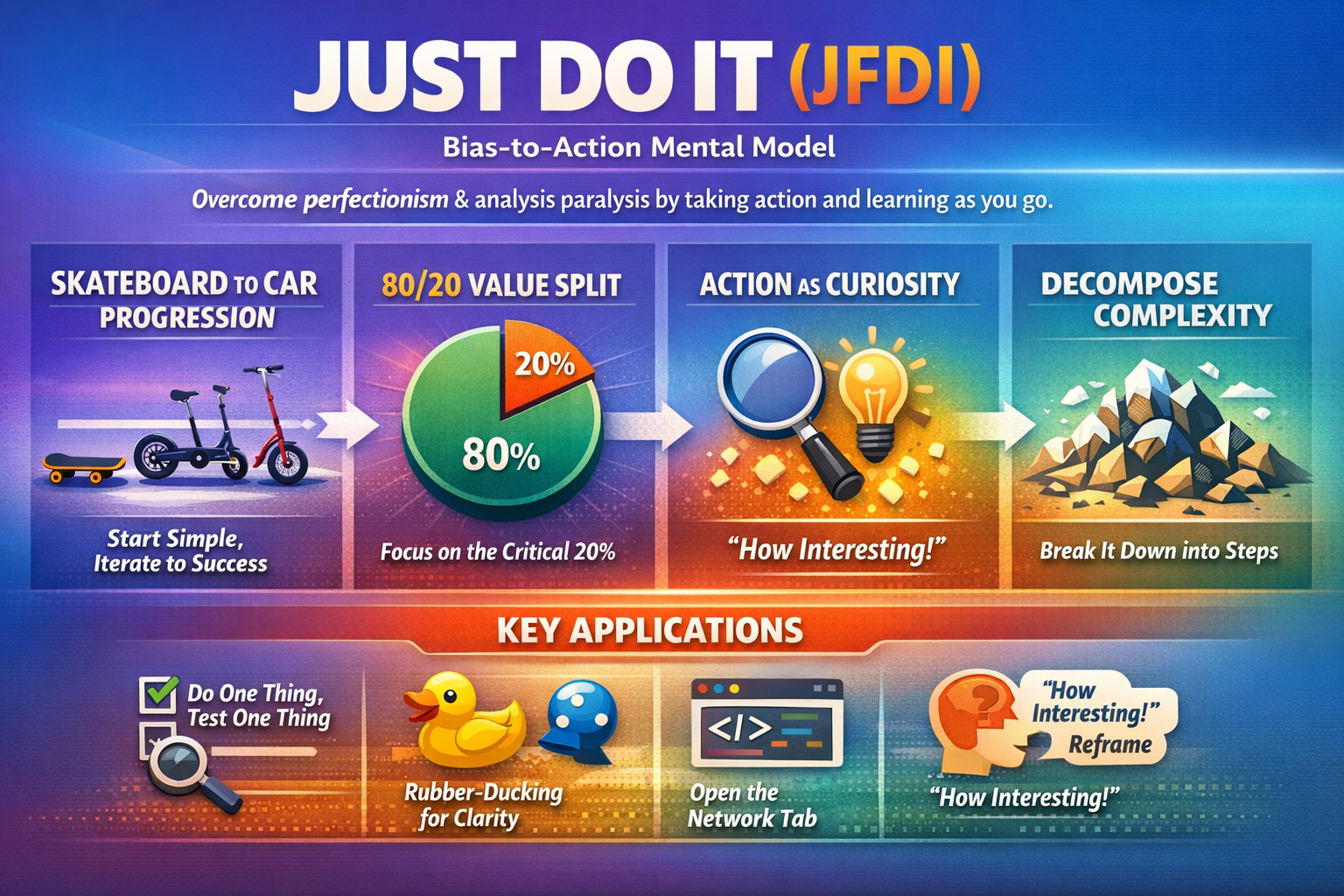
First, it requires Decomposition. You must break down massive, intimidating problems into smaller pieces that can be tackled immediately. If the problem is "Build a SaaS," JFDI says that’s too big. You break it down until you find a piece you can finish by Friday. You look for the smallest unit of work that provides a tangible result.
Second, it utilizes the "Skateboard to Car" Progression. This is a framework for iterative development. If the goal is a car (a complex transportation system), don’t start by building a wheel. A wheel doesn't get you anywhere; it’s useless in isolation. Instead, build a skateboard. It’s simple, it lacks a motor and a steering wheel, but it moves you from A to B. By building the skateboard first, you validate that there is a need for movement. Once the skateboard works, you add a handle (scooter), then a seat and pedals (bicycle), then a motor (motorcycle), and eventually, you have a car. At every stage, the product is functional and useful.
Third, it applies the Pareto Principle (80/20 Rule). JFDI practitioners understand that 80% of the value of a solution usually comes from 20% of the effort or features. The JFDI approach is to identify that 20% and aim for it exclusively in the first iteration. You aren't looking for a 100% solution; you are looking for the "sharp end of the wedge."
The Sharp End of the Wedge represents the specific, unique thing your solution does that makes it special. Every product has a lot of "generic" surface area—things like login screens, password resets, and profile settings. JFDI dictates that you ignore the generic fluff and focus on the "sharp end"—the core logic or utility that actually solves the user's pain point. If you are building a tool that uses AI to summarize legal documents, the "sharp end" is the summarization engine, not the user dashboard.
When to Apply
JFDI is most valuable when the path forward is obscured by uncertainty or complexity. If you find yourself in a meeting discussing "what if" scenarios for the third time this week, it is time to trigger the JFDI model. It is particularly useful in the early stages of a project (the 0 to 1 phase) where the primary goal is validation.
Specific triggers include:
- Prototyping: When you need to see if a specific integration or API call is even possible.
- Feature Validation: When you aren't sure if users actually care about a proposed piece of functionality.
- Technical Roadblocks: When you are stuck choosing between two different architectures. JFDI suggests you pick one and build a small test case for it immediately rather than debating it further.
- MVP Development: When you are tempted to add "one more thing" before the launch.
Common Traps
The most dangerous misconception about JFDI is that it is an excuse for "shoddy" work. JFDI does not mean "Just Do It Poorly." There is a significant difference between a simple, functional skateboard and a broken car. A skateboard is a high-quality version of a simple tool; it shouldn't fall apart when you stand on it. JFDI practitioners must maintain high standards for the small things they ship.
Another trap is the "infinite pivot." Because JFDI emphasizes shipping fast and learning, some people use it as an excuse to never commit to a direction. They ship a "skateboard," then immediately abandon it for a "pogo stick" without actually analyzing the feedback. JFDI requires disciplined observation of the results of your actions.
Finally, people often mistake JFDI for a lack of planning. JFDI is a plan—it is a plan to learn through iteration. It doesn't mean you don't have a vision for the "car" at the end; it just means you refuse to let the complexity of the car stop you from building the skateboard today.
How It Connections
While JFDI stands as a primary principle, it draws heavily from the Pareto Principle. Without the 80/20 insight, JFDI can become aimless activity. By understanding that most value is concentrated in a few areas, JFDI becomes a targeted strike.
It also connects deeply to the concept of Iterative Development. JFDI is the "start" button for an iterative loop. Once you "Just Do It" the first time, you enter a cycle of shipping, measuring, and adjusting. This aligns with modern agile methodologies but is more aggressive; it prioritizes the initial action that many agile processes get bogged down in during "Sprint 0" or planning phases.
Evidence from Sources
On the Core Philosophy
"Focus on shipping something sooner rather than later" — SC Mental Model Talk 1 6/2023
On Problem Decomposition
"Break down problems into smaller pieces you can tackle now" — SC Mental Model Talk 1 6/2023
On Iterative Progression
"Follow the 'skateboard to car' progression - start simple but useful" — SC Mental Model Talk 1 6/2023
On Efficiency and Value
"Aim for 80% of value in 20% of time (Pareto Principle)" — SC Mental Model Talk 1 6/2023
On Competitive Advantage/Core Value
"Focus on the 'sharp end of the wedge' - what makes your solution special" — SC Mental Model Talk 1 6/2023
In Practice
Scenario 1: The AI Content Generator
Imagine a founder who wants to build an AI platform for marketing teams. The "Car" is a full-suite platform with team permissions, billing, a custom text editor, and multiple AI model integrations. Instead of spending months building the "Car," the founder applies JFDI. They identify the "sharp end of the wedge": the specific prompt engineering that generates high-performing headlines. They build a "skateboard"—a single web page with one input box and one "generate" button. It has no login and no database. They "Just Do It" and send the link to five marketers. Within 24 hours, they know if the "sharp end" is actually sharp enough to cut through the noise.
Scenario 2: The Internal Automation
A business owner wants to automate their entire lead intake process, connecting Facebook Ads to a CRM, then to Slack, then to a custom-generated PDF proposal. This is a complex multi-step car. Applying JFDI, the owner focuses on the "20% of effort for 80% of value." They realize the biggest pain point is just knowing a lead came in. They "Just Do It" by setting up a simple Zapier flow that sends an email notification. It doesn’t have the PDF or the Slack integration yet, but it solves the immediate problem of missing leads. They shipped it in 15 minutes instead of planning a three-week automation project.
Scenario 3: The Data Migration
A developer is tasked with migrating 100,000 records from a legacy SQL database to a modern NoSQL structure. Instead of writing a massive, all-encompassing migration script (the Car) that handles every edge case perfectly, they apply JFDI. They break the problem down. They "Just Do It" by migrating 10 records manually or with a very simple script to see if the data mapping even works. This "skateboard" migration reveals that three of the fields have unexpected formatting. Because they shipped a tiny version immediately, they didn't waste hours writing a complex script based on a false assumption of data cleanliness.
Have questions about Just Do It (JFDI)?
Ask the AI Mentor — free, 10 questions/month
Go Deeper
Mental models are just the beginning. Here’s what members get:
Live Office Hours
Ray teaches this model in real time — with your real problems, real code, and real breakthroughs.
Session Vault
1,000+ recorded sessions searchable by topic. Find exactly the moment this model clicks.
AI Skills & MCP Tools
Your AI assistant learns these models too — Skills and MCP servers that bring Ray's thinking to your workflow.
Builder Community
Ask questions, share breakthroughs, get unstuck with 500+ builders who think in models, not just code.