Knowledge Transfer Approach
What It Is
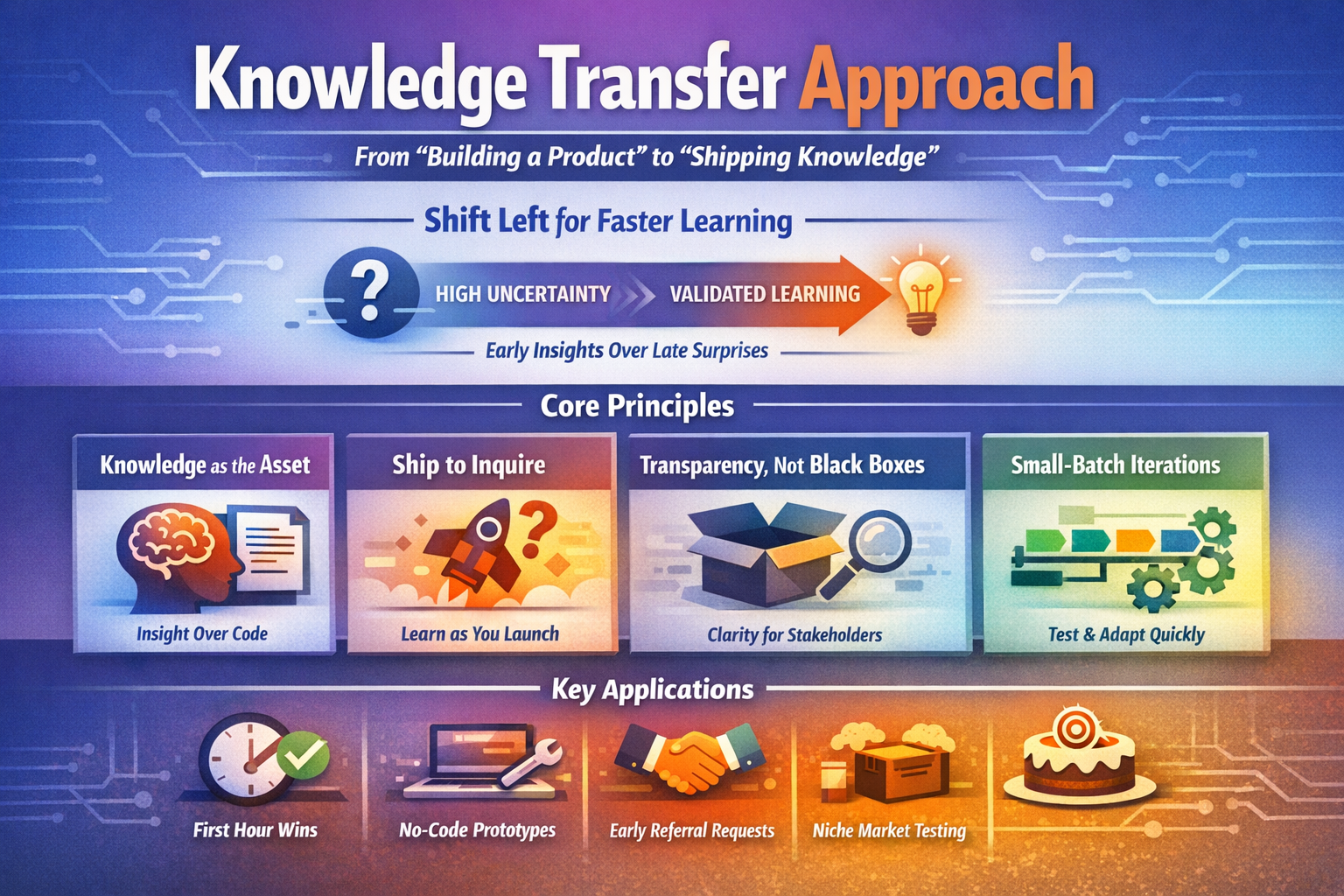
The Knowledge Transfer Approach is a fundamental shift in how you view the output of your development process. Most founders and product managers view their development pipeline as a factory that produces features. They put requirements in one end and get a "product" out of the other. This mental model rejects that factory-style thinking. Instead, it frames the primary output of development not as code, but as knowledge.
In this framework, you aren't just building a tool; you are "shipping knowledge." This means that with every release, every sprint, and every bug fix, the organization’s collective understanding of two specific areas—the market and the technology—must increase. If you have a working feature but you don’t understand why it works or how it serves the user better than the last version, you haven't actually progressed; you’ve just added complexity. This model demands that knowledge be treated as a first-class deliverable, just as important as the compiled binary or the live URL.
Why It Matters
The Knowledge Transfer Approach solves the "Black Box" problem. Many startups find themselves in a position where they have a functioning product but no internal capacity to change it, improve it, or even explain why it’s successful. They have delegated the "thinking" to an external agency, a solo freelancer, or even a siloed internal team. This creates a dangerous dependency where the founder owns the equity but the "knowledge" of how the business actually functions technically and behaviorally resides elsewhere.
Without this approach, you are building on sand. You might hit a "Product-Market Fit" milestone, but if you don't understand the technical trade-offs made to get there, or the specific market insights that made the feature resonate, you cannot defend that position. You become a victim of your own success, terrified to touch the "black box" for fear of breaking it. When you prioritize knowledge transfer, you ensure that the company’s value is contained within the organization’s brains and documentation, not just in a repository of code that no one understands. It transforms development from a cost center into an appreciating asset of institutional intelligence.
How It Works
The Knowledge Transfer Approach operates on three core pillars:
1. Shipping Knowledge, Not Just Features
Every deployment is a learning event. When you "ship knowledge," you are asking: "What do we know now that we didn't know two weeks ago?" This requires a feedback loop where the results of development are synthesized back into the team's strategy. If a feature is delivered but the team can't explain the logic behind the implementation or the data-driven reason for the UI choices, the "knowledge" hasn't been shipped.
2. The Dual-Track Understanding
Every iteration must increase understanding in two parallel tracks:
- Market Understanding: Deepening the insight into user behavior, pain points, and "jobs to be done." Each feature should test a hypothesis about the market.
- Technical Understanding: Clarifying how the system handles scale, how the data flows, and where the bottlenecks are. You cannot sacrifice one for the other. A product that users love but the team doesn't understand technically is a liability; a technical masterpiece that no one uses is a waste.
3. Ownable Solutions vs. Black-Box Deliverables
The goal is "ownability." An ownable solution is one where the internal team understands the "why" and "how" well enough to modify, fix, or pivot it without external help. A "black-box deliverable" is a finished product handed over with no context—it works today, but it is a "dead" asset because it cannot evolve without the original creator. This approach forces developers to build with the intention of making their work understandable to others.
When to Apply
This model is most critical during the Early-Stage Development (Seed to Series A) phase. This is when the ratio of "what we don't know" to "what we do know" is at its highest. If you aren't shipping knowledge during this phase, you are likely building the wrong thing very efficiently.
It is also the essential framework for Vendor or Agency Management. If you are hiring an outside firm to build your MVP, your contract shouldn't just be for a list of features; it should be for the transfer of knowledge. You need to ensure that by the end of the engagement, your internal team (even if it’s just the founder) understands the architecture and the market feedback gathered during the build.
Finally, apply this during Pivots. When a product isn't working, the only thing of value you have left is the knowledge you gained. If you treated the previous six months as "building a product," you have nothing. If you treated it as "shipping knowledge," you have the insights necessary to make the next version successful.
Common Traps
The most frequent mistake is confusing documentation with knowledge. You can have a 50-page technical manual (a "black box" with a manual) and still have zero knowledge transfer. Knowledge is the ability to act and evolve the system. If the team can't explain the system's logic without reading the manual, the knowledge hasn't truly been transferred.
Another trap is the "Velocity Illusion." Teams often think they are moving fast because they are closing Jira tickets and shipping code. However, if that code is adding complexity without adding understanding, the team’s actual velocity (the speed at which they move toward a successful, sustainable business) is decreasing. You are moving fast toward a cliff.
Finally, don't mistake "Technical Understanding" for "Technical Perfection." This model isn't an excuse for over-engineering or gold-plating code. It’s about clarity. Sometimes the most "ownable" solution is a simple, slightly messy script that the founder understands perfectly, rather than a complex, "perfect" microservice architecture that requires a PhD to maintain.
How It Connections
This model is the bridge between Product Management and Technical Architecture. It connects the "Why" (Market Understanding) with the "How" (Technical Understanding).
It also reinforces the concept of Ownability. If a solution is ownable, it is by definition a result of successful knowledge transfer. This approach ensures that as the codebase grows, the team’s "Development Velocity" remains high because they aren't constantly slowed down by parts of the system they don't understand. It turns "Technical Debt" from a mysterious bogeyman into a conscious, documented choice made to gain market knowledge faster.
Evidence from Sources
The Core Objective
"The goal isn't just to build something, but to 'ship knowledge'" — Founders Institute Talk (8/23)
The Dual-Track Learning
"Each iteration should increase both market and technical understanding" — Founders Institute Talk (8/23)
Ownability vs. Dependency
"Focus on ownable solutions rather than black-box deliverables" — Founders Institute Talk (8/23)
In Practice
Scenario 1: The Agency Handover
A startup hires an agency to build their initial version. Using the Knowledge Transfer Approach, the founder doesn't just wait for a demo at the end of the month. They insist on bi-weekly "knowledge syncs" where the agency explains the why behind the database schema and shares raw user interview notes. When the contract ends, the founder doesn't just have an app; they have the mental map required to hire their first in-house dev and explain exactly how the system works.
Scenario 2: The Failed Feature
A team spends three weeks building a complex recommendation engine. After launch, the data shows no one is using it. Under a "feature-outcomes" model, this is a total loss. Under the Knowledge Transfer Approach, the team conducts a post-mortem to "ship the knowledge." They realize the market doesn't want recommendations; they want better search filters. They also realize their data structure makes search filters easy to implement. The "product" failed, but the "knowledge" gained allows them to ship the right feature in three days instead of three weeks.
Scenario 3: The "Legacy" Code Prevention
A senior developer is building a critical integration. Instead of "disappearing" for a week and emerging with a perfect but complex "black box," they use the Knowledge Transfer Approach. They build a simpler version and walk the junior developers through the logic. They prioritize code readability and clear architectural patterns over clever "one-liners." They are shipping the knowledge of how to handle that integration to the rest of the team, ensuring the company isn't at risk if that senior developer leaves.
Have questions about Knowledge Transfer Approach?
Ask the AI Mentor — free, 10 questions/month
Synthesized Essay
Knowledge Transfer Approach
Category: Principle Related Concepts: Ownability, Iterative Development, Technical Debt reduction.
What It Is
The Knowledge Transfer Approach is a fundamental shift in how you view the output of your development process. Most founders and product managers view their development pipeline as a factory that produces features. They put requirements in one end and get a "product" out of the other. This mental model rejects that factory-style thinking.
This is a preview. State Change members get the full essay, all infographics, audio, and unlimited AI mentoring.
Songs About This Model

Ship to Know
Upbeat indie pop with a driving rhythm, bright synths, and an energetic tempo

Ship to Know
Upbeat indie pop with a driving rhythm, bright synths, and an energetic tempo
Core Insight
The primary output of software development should be an increase in knowledge, not just code.
Go Deeper
Mental models are just the beginning. Here’s what members get:
Live Office Hours
Ray teaches this model in real time — with your real problems, real code, and real breakthroughs.
Session Vault
1,000+ recorded sessions searchable by topic. Find exactly the moment this model clicks.
AI Skills & MCP Tools
Your AI assistant learns these models too — Skills and MCP servers that bring Ray's thinking to your workflow.
Builder Community
Ask questions, share breakthroughs, get unstuck with 500+ builders who think in models, not just code.