The Lego Building Block Analogy
What It Is
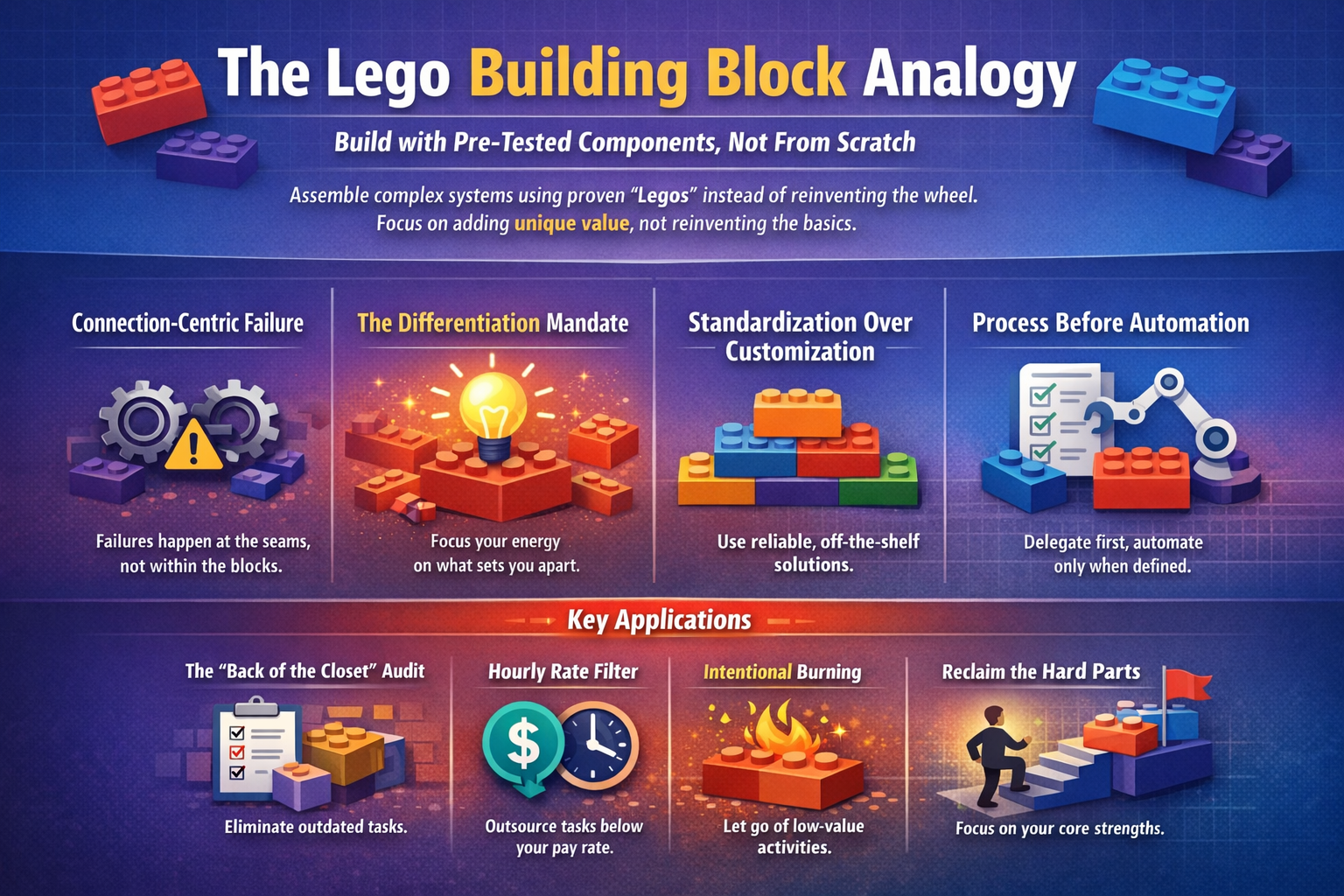
The Lego Building Block Analogy is a mental model for system design and problem-solving that prioritizes assembly over invention. In a world where software and business processes are increasingly commoditized, this principle argues that your primary job isn't to manufacture every individual part of your solution. Instead, your job is to identify high-quality, pre-built, and well-tested components—the "Legos"—and focus your intellectual capital on how they fit together to solve a specific problem.
At its core, this is a rejection of the "Not Invented Here" syndrome. It assumes that for 90% of what any system needs to function (authentication, database management, payment processing, notification routing), there is already a "Lego" that is better, more secure, and more reliable than anything you could build from scratch. The mental model shifts the focus from "How do I build this feature?" to "Which existing block satisfies this requirement so I can focus on the 10% that actually matters?"
This isn't just about saving time; it’s about a fundamental shift in where value is created. In the Lego framework, value is not found in the bricks themselves—anyone can buy the same bricks. The value is found in the architecture and the unique logic that connects those bricks into a configuration that has never existed before.
Why It Matters
The primary problem this model solves is the misallocation of finite resources. Every hour you spend building a custom user-login system is an hour you are not spending on the unique value proposition that makes your project worth existing. Most builders fall into the trap of "reinventing foundations," believing that custom-built means "better." In reality, custom-built often means "fragile" and "untested."
Without this mental model, you end up with "The Wheel" problem: you spend your highest-leverage energy solving solved problems. This leads to slower time-to-market, higher maintenance costs, and a much higher surface area for bugs. When you build the foundation yourself, you are responsible for every crack in the cement. When you use a Lego—like a well-documented API or a standard library—you are leveraging the collective testing and bug-fixing of thousands of other developers.
With this model, the impossible becomes possible because the "floor" of what you can achieve is raised. If you don't have to build the engine, the chassis, or the tires, you can focus entirely on the aerodynamics and the driver experience. It allows small teams to punch way above their weight class by standing on the shoulders of the giants who built the components.
How It Works
The mechanism of the Lego Building Block Analogy operates on three specific layers: Identification, Integration, and Innovation.
First, you must Identify the Foundations. You look at your project and strip away everything that is a "table stake." If a feature is something a customer expects to work but won't pay extra for because it's standard (like a "Forgot Password" link), that is a foundation. Foundations should always be Legos. You look for components that are "well-tested"—meaning they have a track record, a community, or a provider whose entire business depends on that one block working perfectly.
Second, you focus on Integration (The Connections). This is the most critical technical insight of the model: complex systems fail at the connections, not the components. When you use Legos, you aren't worried about whether the "Stripe block" or the "Airtable block" works; you know they work. You focus your testing and design energy on the data flow between them. The "glue code" or the "no-code automation" that moves information from Block A to Block B is where the risk lives. By using Legos, you move your focus from the "what" to the "how they talk to each other."
Third, you apply Innovation to the Unique Value. Once the foundations are handled by Legos and the connections are secured, you are left with a vacuum. That vacuum is where your unique value lives. This is the "special sauce" that cannot be bought off the shelf. Because you haven't exhausted your team building the boring stuff, you have the mental and financial runway to iterate on the unique logic that actually differentiates your product.
When to Apply
This model is most valuable during the Architectural Phase of any project. Before a single line of code is written or a process is mapped, you should ask: "Which parts of this are Legos?" This is especially true for MVPs (Minimum Viable Products) where speed and validation are more important than theoretical infinite scalability.
It is also a vital "trigger" mental model when you hit a Resource Constraint. If you find yourself saying "We don't have enough developers" or "This is taking too long," the Lego analogy is the diagnostic tool. It forces you to ask: "Are we building something custom that we could just buy or integrate?"
Specific situations that trigger its use include:
- Feature Creep: When a new requirement is added, your first instinct should be to find a Lego for it rather than expanding your custom codebase.
- System Refactoring: When a part of your system is constantly breaking, replace that custom-built "foundation" with a standardized "Lego."
- Entering New Markets: When you need to add a capability (like international shipping or multi-currency support) that is outside your core expertise.
Common Traps
The biggest misconception is that using Legos means you are "less of a builder" or that your system is "just a wrapper." This is an ego trap. In reality, the most sophisticated systems in the world—from SpaceX rockets to high-frequency trading platforms—rely heavily on standardized components. The trap is thinking that "custom" equals "quality." Usually, "custom" just equals "proprietary debt."
Another trap is the Neglect of Connections. People assume that because they are using high-quality Legos, the resulting system is indestructible. As the evidence notes, the failure happens at the junctions. If you don't deeply understand how your Legos interface with each other, your system will be a collection of perfect parts that produce a broken result.
Finally, there is the Black Box Trap. You cannot use a Lego if you don't understand its limitations. Leveraging a well-tested component doesn't mean you don't have to read the documentation. You need to know the "shape" of the Lego—its inputs, outputs, and failure modes—to connect it properly.
How It Connects
The Lego Building Block Analogy is a practical application of the Don't Repeat Yourself (DRY) principle, but expanded from the level of code functions to the level of entire business systems. While DRY tells you not to write the same logic twice in your own file, the Lego analogy tells you not to write logic that has already been written perfectly by someone else in the ecosystem.
It is also the antidote to Reinventing the Wheel. While "The Wheel" is a cautionary tale about wasted effort, the Lego analogy is the proactive strategy for what to do instead. It suggests that the world is now a massive warehouse of "wheels" of all shapes and sizes; your job is to build the vehicle that uses them in a way no one else has thought of. It turns the "Not Reinventing the Wheel" mantra into a constructive framework for building complex systems at high velocity.
Evidence from Sources
Leveraging the Well-Tested
"Better to leverage well-tested 'Legos' than build everything custom" — Nicky Taylor Podcast Interview 11/23
The Locus of Failure
"Complex systems fail at the connections, not the components" — Nicky Taylor Podcast Interview 11/23
Prioritizing Unique Value
"Focus energy on the unique value you're adding rather than reinventing foundations" — Nicky Taylor Podcast Interview 11/23
In Practice
Scenario 1: The Modern SaaS Startup
Imagine a founder building a new AI-driven project management tool. Instead of building a custom database, a custom file uploader, and a custom billing system, they use the Lego approach. They use Supabase for the database/auth (Lego 1), Stripe for payments (Lego 2), and OpenAI for the intelligence (Lego 3). They spend 90% of their time designing the unique way these blocks interact to automate project scheduling. Because the "components" are rock solid, they only have to debug the "connections"—the specific API calls and data transformations between the tools.
Scenario 2: The Internal Process Automation
A marketing team needs a way to track leads from an event. A "custom builder" might try to hire a freelancer to write a custom web app and database. The "Lego builder" uses a Tally form, connected via Make.com to an Airtable base, with notifications sent via Slack. The "Legos" here are the individual apps. The "unique value" is the specific workflow and scoring logic the marketing team created in Make.com. If the team needs to scale, they can swap the Airtable "Lego" for a more robust database without rebuilding the form or the notification logic.
Scenario 3: Legacy System Modernization
A company has an old, monolithic piece of software that handles everything from inventory to payroll. It keeps breaking. Using the Lego analogy, the CTO doesn't try to "fix" the monolith. They identify a foundational piece—payroll—and replace that specific "chunk" of the monolith with a Lego like Gusto via an API. They focus all their engineering effort on the connection between the old inventory system and the new payroll Lego. Bit by bit, the custom, fragile foundation is replaced by standardized, reliable blocks until the only thing left of the original system is the unique business logic that actually runs the company.
Have questions about The Lego Building Block Analogy?
Ask the AI Mentor — free, 10 questions/month
Go Deeper
Mental models are just the beginning. Here’s what members get:
Live Office Hours
Ray teaches this model in real time — with your real problems, real code, and real breakthroughs.
Session Vault
1,000+ recorded sessions searchable by topic. Find exactly the moment this model clicks.
AI Skills & MCP Tools
Your AI assistant learns these models too — Skills and MCP servers that bring Ray's thinking to your workflow.
Builder Community
Ask questions, share breakthroughs, get unstuck with 500+ builders who think in models, not just code.