Low Code as an Evolution of Abstraction
What It Is
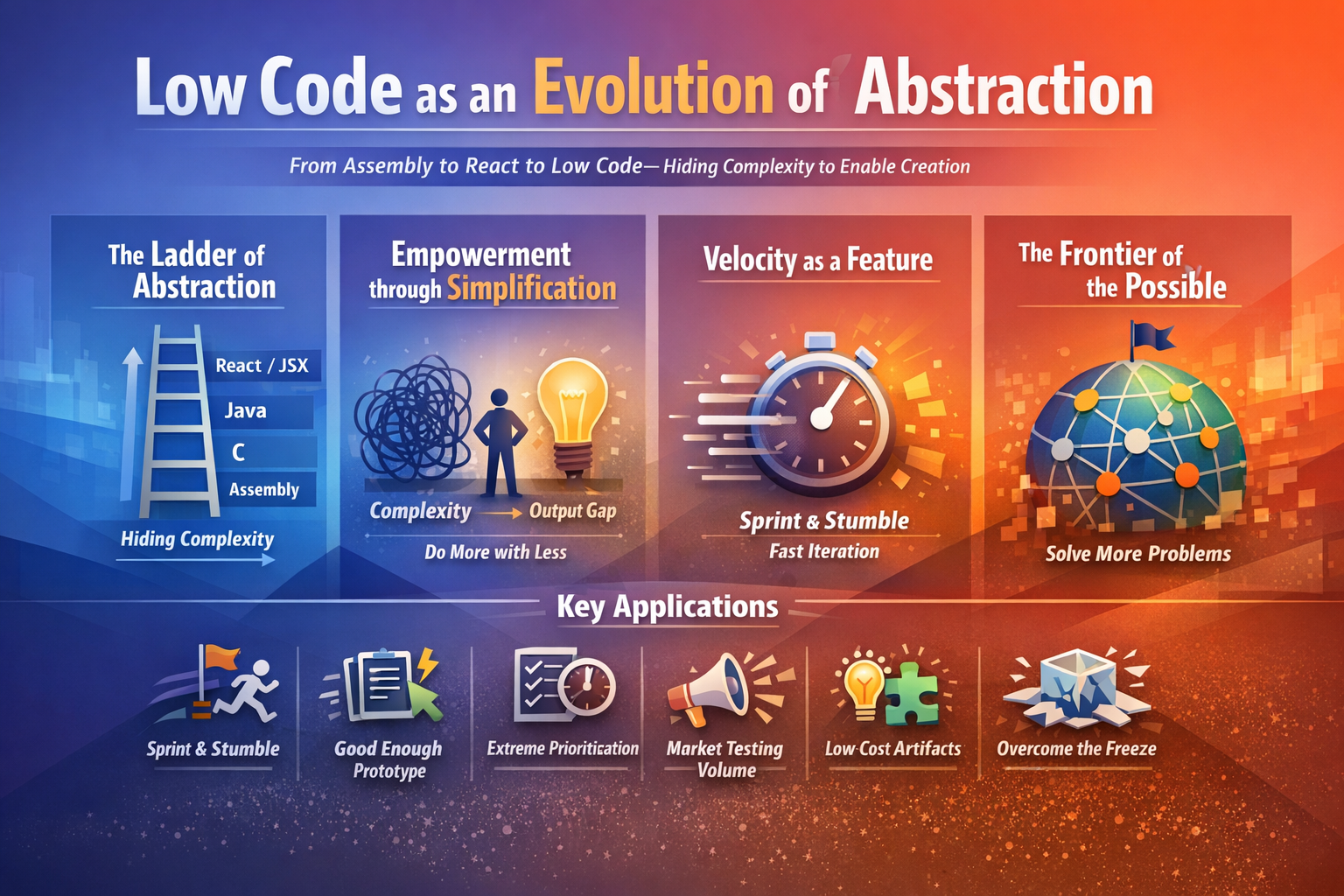
The mental model of "Low Code as an Evolution of Abstraction" reframes how we view modern visual development tools. Rather than seeing them as a shortcut for the "non-technical" or a "dumbed-down" version of programming, this model positions low-code as the latest inevitable step in a multi-decade journey of computer science.
At its core, this model suggests that the history of software development is not a history of "real coding" vs. "fake coding," but a continuous process of hiding complexity to increase leverage. We move from the granular to the conceptual. We shift from telling the computer how to manage its memory and registers to telling the computer what we want the business logic to accomplish. Low code is simply the current "frontier" of this progression. It follows the same trajectory that took us from writing C to Java, from Java to JavaScript, and from JavaScript to declarative frameworks like React and JSX. Each step was met with resistance by the "purists" of the previous era, yet each step became the standard because it allowed developers to achieve more with less specialized training.
Why It Matters
Without this mental model, developers and founders often fall into a trap of false binaries. They view low-code tools as "toys" or "limited," believing that "real" work requires writing lines of text in a terminal. This leads to massive inefficiencies: companies over-hire specialized talent for tasks that don't require it, projects take months instead of days, and the "gatekeepers" of code become bottlenecks for innovation.
When you adopt this model, you realize that the goal of software isn't the code itself—it's the output. By viewing low code as an evolution, you stop worrying about whether you are "really coding" and start focusing on whether you are maximizing your leverage. It solves the problem of the "talent gap" by acknowledging that we can now do extraordinary things with less training. This isn't about lowering standards; it’s about raising the ceiling of what a single human can build by standing on top of higher and higher piles of abstraction.
How It Works
The mechanism of this mental model is the Line of Abstraction. To understand how low code fits in, you have to look at the historical layers:
- The Low-Level Layer (C/Assembly): At this stage, the developer is responsible for everything—memory management, hardware interrupts, and manual optimization. It is powerful but extremely slow and error-prone.
- The Managed Layer (Java/C#): The abstraction moves up. The system handles memory (garbage collection). The developer focuses more on object-oriented structures and less on the hardware.
- The Scripting/Web Layer (JavaScript/Python): The abstraction moves higher. We stop worrying about compilation types as much and focus on rapid execution and the "glue" between systems.
- The Declarative Layer (React/JSX): Instead of telling the browser exactly which pixels to change (imperative), we describe what the UI should look like based on a state (declarative).
- The Low-Code Layer (State Change approach): This is the current frontier. We are now abstracting the "plumbing" of APIs, database schemas, and state management into visual or configuration-based interfaces.
The principle is that at each point in history, the "frontier" is the layer that makes the previous layer’s "hard parts" feel like "plumbing." Low code does to React and Node.js what Java did to C: it takes the common patterns that everyone repeats and bakes them into the environment so the builder can focus on the unique value of their specific application.
When to Apply
This mental model is most valuable during the Tool Selection and Architecture phases of a project.
- When Speed of Iteration is Paramount: If you are in the "discovery" phase of a product, using the highest level of abstraction available (the frontier) allows you to test hypotheses faster.
- When Facing Resource Constraints: When you have a "extraordinary" goal but lack a team of 20 senior engineers, this model reminds you that you can bridge the gap by using tools that require "less training" to achieve the same functional outcome.
- When Managing Technical Debt: It helps in deciding whether to "build or buy." If a low-code tool abstracts a problem that is not core to your unique value proposition (like authentication or basic CRUD operations), this model suggests you should move up the abstraction layer rather than building it from scratch in "pure" code.
Common Traps
The most dangerous trap is the "No-Code is Magic" Fallacy. Just because a tool is an abstraction doesn't mean the underlying principles of logic, data structures, and systems thinking disappear. While you need "less training" in syntax, you still need "the right training" in how software works. An evolution in abstraction doesn't excuse a builder from understanding how data flows between a front-end and a back-end.
Another trap is The Elitism Trap. Experienced developers often dismiss the latest abstraction because it "hides what's actually happening." This has been the complaint of every generation of programmers. The C programmers mocked the Java programmers; the Java programmers mocked the Ruby on Rails developers. If you find yourself dismissing a tool because it feels "too easy," you are likely falling into this trap and missing out on significant leverage.
Finally, there is the Edge Case Trap. Abstractions always have "leaks." When you move to the frontier, you gain speed but occasionally lose the ability to tweak the smallest details. This mental model doesn't say "low code is always better"; it says "low code is an evolution." You must still know when you've hit the boundary of the abstraction and need to drop down a level.
How It Connects
This mental model is the foundational "why" behind the shift toward "citizen development" and "fractional engineering." It connects deeply to the concept of Leverage. If programming is a lever for the mind, then the evolution of abstraction is the process of making that lever longer.
It also connects to the concept of The Frontier. In any technology, the frontier is where the most friction exists. As we "solve" a layer through abstraction, the frontier moves. Yesterday's frontier was making a website responsive; today's frontier is integrating LLMs and complex data workflows without writing 5,000 lines of boilerplate.
Evidence from Sources
Low Code as a Historical Continuum
"Views low code tools as part of a historical progression of abstracting complexity (C → Java → JavaScript → React/JSX)" — Nicky Taylor Podcast Interview 11/23
The Concept of the Frontier
"Low code represents 'what's on the frontier at each point in history'" — Nicky Taylor Podcast Interview 11/23
Democratic Productivity
"Focuses on letting people 'do more extraordinary things with less training'" — Nicky Taylor Podcast Interview 11/23
In Practice
Scenario 1: The Solo Founder
A founder wants to build a marketplace. Ten years ago, they would have needed to learn Objective-C or Java to build a mobile app, plus SQL and PHP for the backend. They would have spent six months just learning syntax. Today, using this mental model, they recognize that tools like FlutterFlow or Xano are simply the "evolution of abstraction." They focus on the logic of the marketplace—how buyers and sellers interact—and use the "frontier" tools to launch in three weeks. They have achieved an "extraordinary thing" (a functional marketplace) with "less training" in traditional syntax.
Scenario 2: The Enterprise "Plumbing" Problem
An internal dev team is tasked with building a tool to sync CRM data with an inventory system. The "old school" approach is to write custom Node.js scripts, manage cron jobs, and handle error logging manually. Using this mental model, the Lead Architect realizes that these tasks are now "solved problems" in the current era of abstraction. They use a low-code integration platform. This isn't "lazy"; it's an acknowledgment that the "frontier" has moved. By using a higher level of abstraction, they free up their senior engineers to work on the proprietary algorithms that actually drive the business.
Scenario 3: The Career Pivot
A business analyst realizes that their knowledge of "how the business works" is actually more valuable than "how to write a loop in Python." By viewing low code as an evolution, they don't feel intimidated by "not being a real coder." They adopt tools that allow them to express their business logic directly into functional software. They are able to produce results that previously required a dedicated dev team, proving that the abstraction has allowed them to reach the frontier of what's possible in their role.
Have questions about Low Code as an Evolution of Abstraction?
Ask the AI Mentor — free, 10 questions/month
Synthesized Essay
Low Code as an Evolution of Abstraction
Category: Principle Related Concepts: The Frontier of Development, Leverage, Abstraction Layers
What It Is
The mental model of "Low Code as an Evolution of Abstraction" reframes how we view modern visual development tools. Rather than seeing them as a shortcut for the "non-technical" or a "dumbed-down" version of programming, this model positions low-code as the latest inevitable step in a multi-decade journey of computer science.
At
This is a preview. State Change members get the full essay, all infographics, audio, and unlimited AI mentoring.
Songs About This Model

The Ladder of the New Frontier
Upbeat synth-pop with a driving, rhythmic beat and inspirational vocals

The Ladder of the New Frontier
Upbeat synth-pop with a driving, rhythmic beat and inspirational vocals
Core Insight
New technologies build upon existing ones by abstracting away complexity, increasing accessibility and productivity.
Go Deeper
Mental models are just the beginning. Here’s what members get:
Live Office Hours
Ray teaches this model in real time — with your real problems, real code, and real breakthroughs.
Session Vault
1,000+ recorded sessions searchable by topic. Find exactly the moment this model clicks.
AI Skills & MCP Tools
Your AI assistant learns these models too — Skills and MCP servers that bring Ray's thinking to your workflow.
Builder Community
Ask questions, share breakthroughs, get unstuck with 500+ builders who think in models, not just code.