The One-Two Rule
What It Is
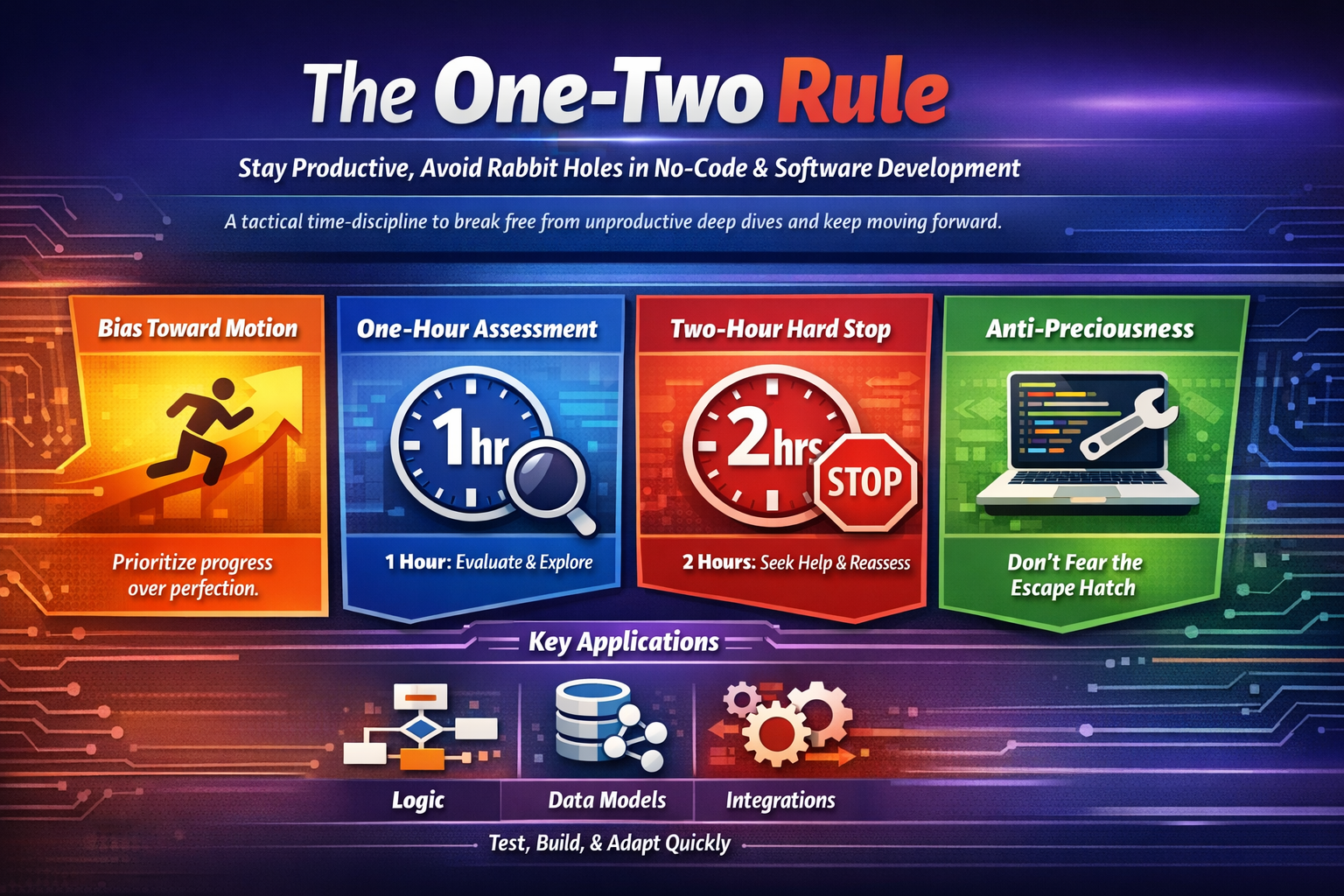
The One-Two Rule is a rigid time discipline designed to enforce a Bias Toward Motion. In the world of building—whether you are working with no-code tools, traditional code, or complex business logic—it is incredibly easy to lose hours to a single, stubborn problem that refuses to yield. This mental model acts as an automated "circuit breaker" for your focus. It prevents you from sinking an entire day into a rabbit hole that yields zero progress.
At its core, the One-Two Rule dictates a specific cadence for work: pick a task, dedicate exactly one hour to it, and then make a cold-blooded assessment. If you aren’t making progress after sixty minutes, you stop and switch to a different task. If you reach the two-hour mark and you are still stuck, the rule mandates that you stop working in isolation and seek external input. It transforms the vague intention of "working hard" into a structured protocol for maintaining momentum.
Why It Matters
Without a rule like this, builders fall victim to the "Sunk Cost Fallacy" and the "90/90 Rule" (where the first 90% of the work takes 10% of the time, and the remaining 10% takes the other 90% of the time). Without a time discipline, you might spend four hours trying to fix a minor CSS alignment or a buggy API call, only to realize at the end of the day that the core functionality of your project hasn't moved an inch. This leads to burnout, frustration, and project stagnation.
When you apply the One-Two Rule, you protect your most valuable asset: your momentum. By forcing yourself to switch tasks after one hour of non-progress, you ensure that even if one part of the project is blocked, the rest of the project continues to move forward. By forcing yourself to get help at the two-hour mark, you acknowledge that your internal perspective has reached its limit. This model turns "getting stuck" from a source of shame or frustration into a scheduled trigger for a new strategy.
How It Works
The mechanism of the One-Two Rule is broken down into three distinct phases: Selection, The Hour of Effort, and The Escalation.
First, you look at your list and pick a task. The rule specifically emphasizes that it "doesn't matter which one" you pick. This is a direct attack on analysis paralysis. We often waste thirty minutes just deciding what to work on. The One-Two Rule tells you to ignore the urge to find the "perfect" starting point. Just pick one and start the clock. The goal is motion, not perfect prioritization.
Second, you commit to one hour of focused work. During this hour, you are fully "in" the problem. However, the end of the hour is a hard checkpoint. You must honestly ask: "Am I making tangible progress?" If the answer is no—if you are just clicking the same buttons or staring at the same error message—the rule requires you to stop. You don't "try for five more minutes." You switch to a completely different task on your list. This refreshes your cognitive state and ensures that your "Bias Toward Motion" is applied to something that can actually move.
Finally, there is the two-hour limit. This is the absolute ceiling for working on a single problem in isolation. If you have spent two hours on a problem and it still isn't solved, the One-Two Rule dictates that you must get input from others. This could mean posting in a community, asking a mentor, or calling a teammate. The logic here is simple: if you haven't solved it in 120 minutes, you likely lack a specific piece of information or a perspective that only an external source can provide.
When to Apply
This model is most valuable when you are working on high-uncertainty tasks. In no-code development, for example, you might be integrating two platforms that don't want to talk to each other. Because the tools are "black boxes," you can't always see why things are breaking. This is the perfect environment for the One-Two Rule. Any time you find yourself saying "I'll just try this one more thing" for the tenth time, that is your trigger to implement the rule.
It is also highly effective when you have a long "to-do" list and feel overwhelmed. By picking anything and setting a one-hour limit, you lower the stakes of starting. You aren't committing to finishing the whole project; you are just committing to sixty minutes of motion. If that motion is productive, you keep going. If not, you pivot. This makes the rule a primary tool for overcoming the initial friction of a complex project.
Common Traps
The biggest trap in the One-Two Rule is the "Almost There" Delusion. This is the belief that you are just sixty seconds away from a breakthrough, which leads you to ignore the one-hour checkpoint. You tell yourself, "If I stop now, I'll lose the thread." The One-Two Rule is designed specifically to counter this feeling, because "almost there" often turns into three hours of wasted time. You must respect the clock more than your intuition.
Another common mistake is treating "switching to something else" as a failure. People often feel that if they don't finish the task they started, they've lost. Under the One-Two Rule, switching is a win. It is a proactive decision to reallocate your energy to a task where it can actually produce a result. The goal is to move the project forward, not necessarily to finish every task in the order you started them.
Finally, some builders fail the "Two-Hour Rule" because of ego. They feel that asking for help is an admission of incompetence. In reality, the most efficient builders are those who know exactly when their internal troubleshooting has reached the point of diminishing returns. The two-hour mark is not a judgment on your skill; it is a mathematical recognition of efficiency.
How It Connects
The One-Two Rule is the operational arm of the Bias Toward Motion. While "Bias Toward Motion" is the mindset—the preference for action over contemplation—the One-Two Rule provides the specific constraints that make that mindset sustainable. Without the One-Two Rule, a Bias Toward Motion can turn into "spinning your wheels"—lots of energy being expended without any actual change in position.
By enforcing a switch at one hour and an escalation at two, the rule ensures that your "motion" is always directed toward progress. It connects the high-level principle of staying active with the practical necessity of being productive. It ensures that your momentum isn't just fast, but that it is also hitting multiple points of your project rather than getting stuck on a single snag.
Evidence from Sources
Eliminating Analysis Paralysis
"Pick something from your list (doesn't matter which one)" — Ray's Mental Model: Core Principles for Building with No-Code
The Self-Assessment Checkpoint
"Work on it for 1 hour" — Ray's Mental Model: Core Principles for Building with No-Code
The Pivot Protocol
"Not working? → Stop, switch to something else" — Ray's Mental Model: Core Principles for Building with No-Code
The Hard Stop for External Input
"At two hours maximum, get input from others." — Ray's Mental Model: Core Principles for Building with No-Code
In Practice
Scenario 1: The API Authentication Loop
A builder is trying to connect a Webflow site to a specific API using a logic tool. They spend 45 minutes tweaking headers and API keys, but they keep getting a "401 Unauthorized" error. At the one-hour mark, they realize they haven't made a dent. Following the One-Two Rule, they stop. Instead of banging their head against the API for another hour, they switch to building the site's "About" page layout. This ensures the day isn't a total loss. Later, they return to the API; if they hit the two-hour total mark without success, they immediately post the error log in a developer forum to get fresh eyes on the problem.
Scenario 2: The Complex Spreadsheet Logic
A founder is building a financial model in Airtable. They get stuck on a complex formula that needs to calculate pro-rated subscriptions. They pick this task first because it's on the list. After one hour, the formula is still throwing errors. They abide by the One-Two Rule and switch to writing the copy for their onboarding emails. After an hour of productive writing, they feel a sense of accomplishment and return to the Airtable formula. They spend one more hour on it. It still doesn't work. Rather than continuing into a third hour, they stop and book a 15-minute call with a technical consultant or ask a peer.
Scenario 3: Managing the "To-Do" List Overwhelm
A builder has 15 small bugs to fix. Instead of agonizing over which is the "most important," they use the One-Two Rule to just "pick one." They spend an hour on Bug A. It’s fixed. They spend an hour on Bug B. It’s a nightmare and involves a deep database issue. At the one-hour mark, they aren't close to a fix. They stop, switch to Bug C, and fix it within 30 minutes. By the end of the morning, they have fixed five bugs and identified one that needs external help (Bug B), whereas without the rule, they might have spent the entire morning failing to fix Bug B and leaving the other four bugs untouched.
Have questions about The One-Two Rule?
Ask the AI Mentor — free, 10 questions/month
See This Model in Action
Real sessions where Ray teaches The One-Two Rule live.
Balancing Rapid Iteration and Technical Debt in Bubble Development
Customizing No-Code Platforms vs. Migrating to React

Calculating and Storing Maximum Measure Scores
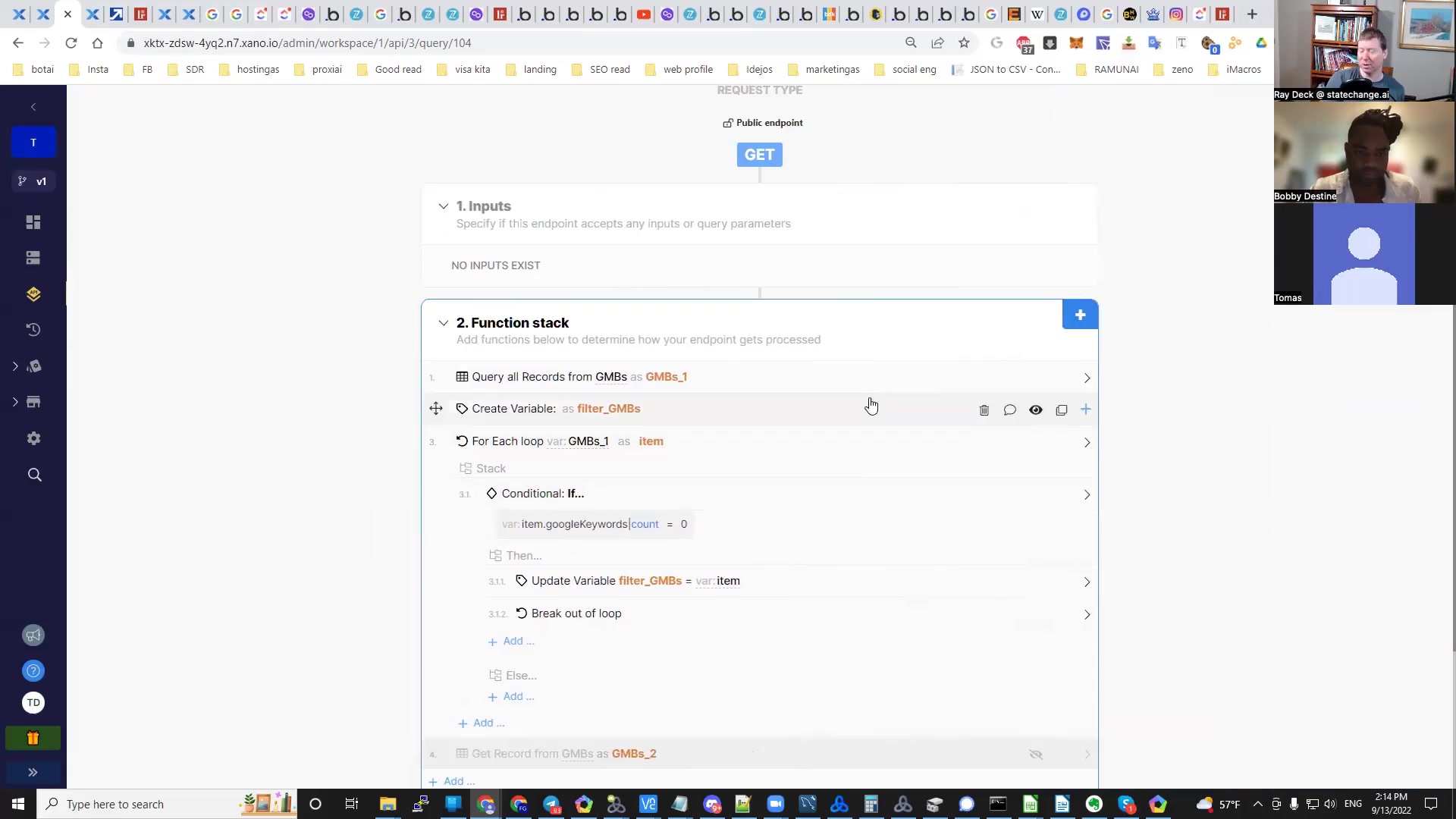
Optimizing Xano Database Queries and Integrating Upload Care
Join State Change to watch full sessions and access 1,000+ more.
Go Deeper
Mental models are just the beginning. Here’s what members get:
Live Office Hours
Ray teaches this model in real time — with your real problems, real code, and real breakthroughs.
Session Vault
1,000+ recorded sessions searchable by topic. Find exactly the moment this model clicks.
AI Skills & MCP Tools
Your AI assistant learns these models too — Skills and MCP servers that bring Ray's thinking to your workflow.
Builder Community
Ask questions, share breakthroughs, get unstuck with 500+ builders who think in models, not just code.