The One-Two Time Discipline
What It Is
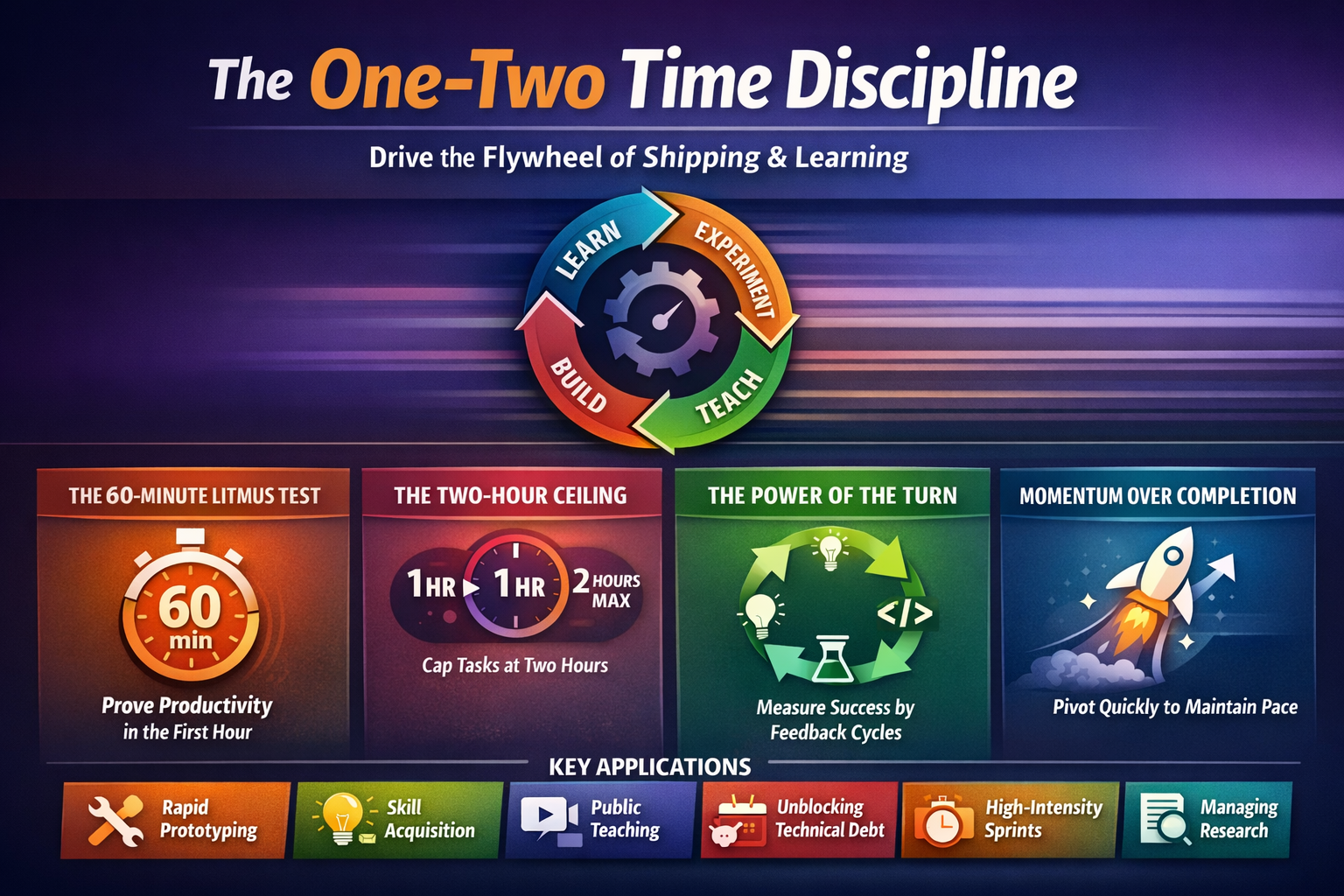
The One-Two Time Discipline is a rigid yet responsive framework for managing cognitive energy and task progression. At its core, it is a "go/no-go" system for productivity. It rejects the idea that more time spent on a problem automatically leads to a better solution. Instead, it treats time as a diagnostic tool to measure whether a specific path is worth pursuing or if it is a dead end that requires a pivot.
In the State Change context, this model is about maintaining "state." When you are working on a hard problem—whether it’s debugging a complex integration or drafting a strategic roadmap—you can easily fall into a trance of activity that feels like progress but is actually stagnation. The One-Two Time Discipline forces you out of that trance by imposing a mandatory check-in after sixty minutes and a mandatory termination of the task after one hundred and twenty minutes.
This is not a suggestion; it is a discipline. It acknowledges that the human brain has a point of diminishing returns. By limiting work to two-hour bursts with a pivot point in the middle, you ensure that you are either operating at peak efficiency or you are moving on to something else that allows you to reset. It is the tactical application of "failing fast" applied to your own daily schedule.
Why It Matters
The primary problem this model solves is the "Unproductive Grind." We have all been there: you spend four hours on a single task, and at the end of it, you’re no closer to the finish line than you were at hour one. You’re just more tired. Without a discipline like this, founders and developers fall victim to the Sunk Cost Fallacy. They feel that because they have already invested three hours into a problem, they must spend a fourth hour to justify the previous three.
This leads to a "death spiral" of productivity. As you get more frustrated, your cognitive ability drops. As your ability drops, the task becomes harder. As the task becomes harder, you spend more time on it. The One-Two Time Discipline breaks this cycle before it starts.
What becomes possible with this model is a high "velocity of iteration." If you are capped at two hours per task, you are forced to find smaller ways to win or faster ways to realize you are stuck. It prevents the "Founder’s Fog"—that state of being busy but not actually moving the needle. It ensures that even on your worst days, you are at least exploring four to five different avenues of progress rather than banging your head against a single wall for eight hours.
How It Works
The mechanism is deceptively simple, but its execution requires high levels of self-awareness and discipline. It functions through three distinct phases: The Diagnostic Hour, The Momentum Decision, and The Hard Stop.
1. The Diagnostic Hour You start by picking exactly one task from your list. Not a category of tasks, but a specific, actionable item. You set a timer for sixty minutes and work on that task with total focus. This first hour isn’t just about doing the work; it’s about diagnosing the viability of the task. Are you making headway? Do you understand the problem better than you did an hour ago? Is the solution within reach?
2. The Momentum Decision At the sixty-minute mark, you must make a cold-blooded assessment. If you are "in the zone," making visible progress, and the "state" of your work is positive, you grant yourself a second hour. This second hour is the "Momentum Phase." You are capitalizing on the "warm-up" you did in the first hour.
However, if at the sixty-minute mark you are frustrated, confused, or realize you lack the necessary tools or information to finish, you must switch tasks. You do not get a "ten more minutes to try and figure it out." You stop. You move to a different item on your list. This switch provides a "pattern interrupt" that can often lead to an epiphany later, or simply allows you to be productive on a different front.
3. The Hard Stop Regardless of how productive you are, the "Two" in the One-Two Discipline is an absolute limit. After two hours, you move to another task. Even if you are flying, you stop. Why? Because the brain requires a change of context to maintain long-term intensity. By stopping at two hours, you leave the task while you still have momentum, which makes it much easier to pick up later. If you grind for four hours until you are exhausted, you will dread coming back to that task tomorrow.
When to Apply
This model is most valuable in high-uncertainty environments—situations where the path from "Problem" to "Solution" is not a straight line.
Technical Debugging: When you encounter a bug that doesn't have an obvious fix. If you haven't narrowed it down in an hour, your current mental model of the bug is likely wrong. You need to switch tasks to clear your head. Strategic Planning/Writing: When the "blank page" is winning. If you’ve been staring at a slide deck for an hour and only have two bullet points, you are unproductive. Switch to a linear, low-cognition task (like email or admin) for an hour, then come back. Learning New Frameworks: When you are trying to ingest new information. The brain can only absorb so much before it needs to synthesize. The two-hour cap prevents information overload.
It is less applicable to routine "maintenance" work—tasks you could do in your sleep. If you have five hours of data entry, you don't necessarily need the One-Two Discipline; you just need coffee and a podcast. This model is for the work that moves your company or project.
Common Traps
The most common trap is the "Just Five More Minutes" lie. People reach the sixty-minute mark, realize they aren't productive, but believe they are just about to have a breakthrough. They stay for another twenty minutes, which turns into an hour, and they’ve officially broken the discipline. The rule is: if it isn't productive now, it won't be in ten minutes.
Another trap is the "False Productivity" trap during the second hour. Sometimes people continue for a second hour not because they are making progress, but because they like the feeling of being busy. You have to be honest: are you actually shipping code/text/decisions, or are you just "researching" (scrolling) to avoid the discomfort of a hard task?
Lastly, people often fail to prepare the "Switch" task. If you hit the one-hour mark and decide to switch, but you don't know what to switch to, you end up wasting twenty minutes deciding. You must have a list of tasks ready to go so the transition is instantaneous.
How It Connects
The One-Two Time Discipline is a foundational "State Change" practice because it manages the most finite resource a founder has: focused energy. It connects directly to the concept of Iteration Speed. By forcing a switch or a stop, you are naturally increasing the number of "at-bats" you have in a day.
It also ties into Decision Quality. We know that tired, frustrated people make poor decisions. By capping any single engagement at two hours, you ensure that you are never making critical decisions from a place of cognitive depletion. It forces you to stay in a "High State" where you are making active choices rather than reactive mistakes.
Evidence from Sources
The Core Rhythm
"Pick one task from your list and work on it for one hour" — Founders Institute Talk (8/23)
The Conditional Extension
"If it's productive, continue for a second hour" — Founders Institute Talk (8/23)
The Mandatory Pivot
"If unproductive, switch to something else after the first hour" — Founders Institute Talk (8/23)
The Absolute Limit
"After two hours maximum, move to another task" — Founders Institute Talk (8/23)
In Practice
Scenario 1: The Stubborn Bug
A developer is trying to fix a race condition in a database migration. They start their hour. At the 45-minute mark, they are deep in logs but haven't found the root cause. At the 60-minute mark, they realize they are just guessing. Following the One-Two Discipline, they stop. They switch to reviewing pull requests for an hour. While reviewing a PR, their subconscious processes the migration issue, and they realize they forgot to account for a specific environment variable. They return to the bug later with a fresh, successful "State."
Scenario 2: The Marketing Push
A founder is writing a series of investor updates. The first hour is incredibly productive; they find a flow and get through three updates. Because it is "productive," they exercise the option for a second hour. They finish the remaining two updates and start on a blog post. At the end of that second hour (the two-hour maximum), even though they feel they could keep writing, they stop. They switch to a physical task or a low-intensity meeting. This prevents the burnout that usually follows a high-intensity writing session.
Scenario 3: The Research Rabbit Hole
A product manager is researching competitor pricing. One hour in, they have fourteen tabs open and feel overwhelmed. They haven't synthesized anything. They recognize this as "unproductive" stagnation. They immediately close the tabs and switch to a task with a clear "Done" state—cleaning up the Jira backlog. The switch saves them from spending an entire afternoon lost in the "Research Rabbit Hole" with nothing to show for it.
Have questions about The One-Two Time Discipline?
Ask the AI Mentor — free, 10 questions/month
See This Model in Action
Real sessions where Ray teaches The One-Two Time Discipline live.
Deferring Custom Calendar Badges in Flutter Flow
Join State Change to watch full sessions and access 1,000+ more.
Go Deeper
Mental models are just the beginning. Here’s what members get:
Live Office Hours
Ray teaches this model in real time — with your real problems, real code, and real breakthroughs.
Session Vault
1,000+ recorded sessions searchable by topic. Find exactly the moment this model clicks.
AI Skills & MCP Tools
Your AI assistant learns these models too — Skills and MCP servers that bring Ray's thinking to your workflow.
Builder Community
Ask questions, share breakthroughs, get unstuck with 500+ builders who think in models, not just code.