The Reviewing-for-Clarity Effect
What It Is
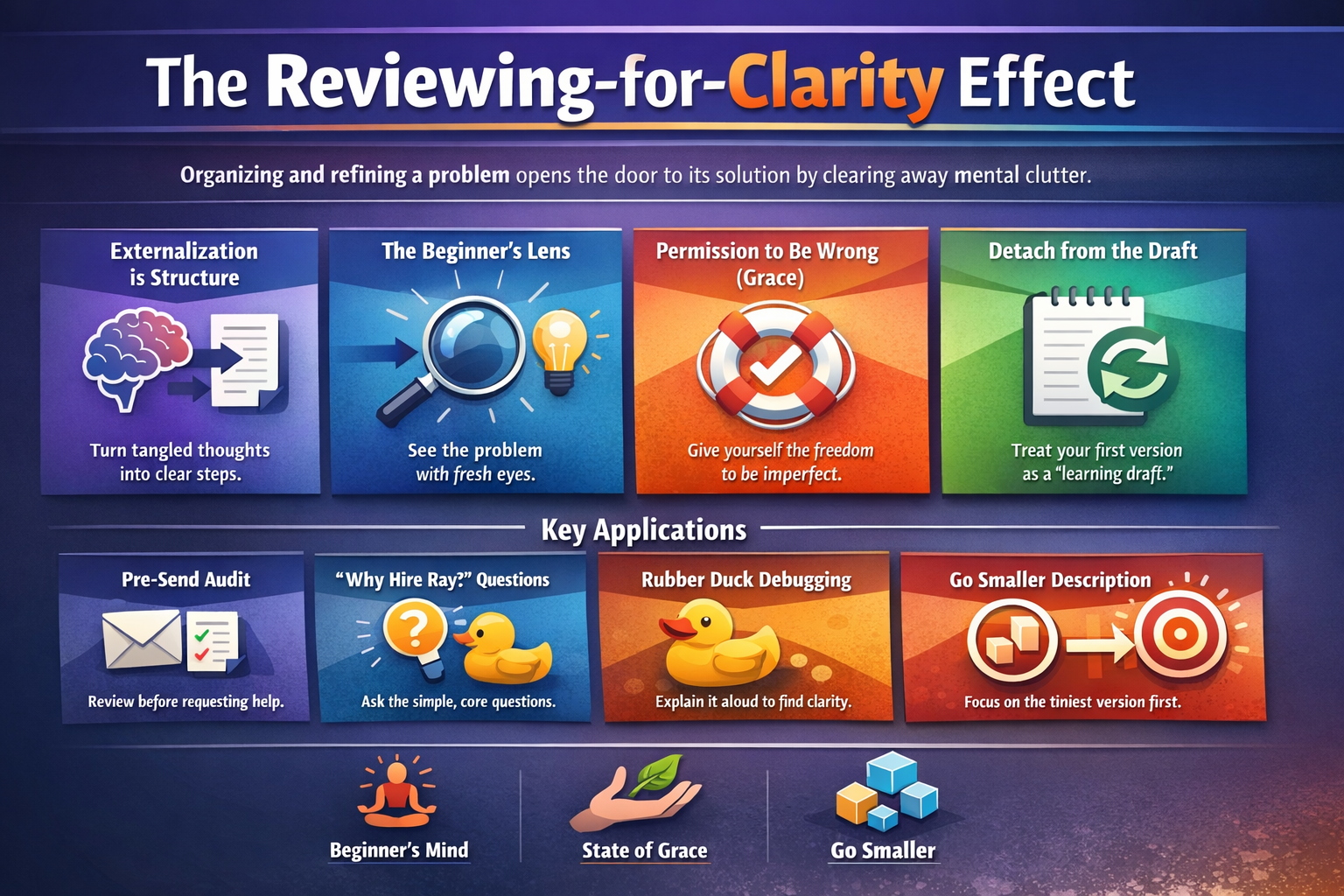
The Reviewing-for-Clarity Effect is a cognitive forcing function that occurs when you transition from "thinking about a problem" to "describing the problem for someone else." It is the phenomenon where the act of organizing your thoughts into a clear, concise, and structured format reveals the solution to you before you even submit the request for help.
In a technical or professional environment, we often operate in a state of "internalized chaos." We have a vague sense of what is wrong, a messy pile of symptoms, and a gut feeling about what might be broken. This internal model is usually fragmented and relies on mental shortcuts. The Reviewing-for-Clarity Effect kicks in when you stop trying to solve the problem directly and start trying to communicate it. By shifting your goal from "solving" to "explaining," you are forced to reconcile the gaps in your own logic.
This isn’t just about being polite to the person you’re asking for help; it is a rigorous diagnostic tool. It is the process of translating a subjective experience of "it’s not working" into an objective description of "what is happening vs. what should happen." In that translation process, the missing link or the overlooked variable often makes itself known.
Why It Matters
Without the Reviewing-for-Clarity Effect, most people engage in "low-signal" communication. They hit a wall and immediately offload their confusion onto a colleague or a forum. This creates noise, wastes the time of high-value resources, and—most importantly—stunts the individual's own problem-solving growth. When you skip the clarity phase, you are essentially asking someone else to do the basic cognitive labor of organizing your own thoughts.
When you embrace this effect, everything changes. You become a "high-signal" collaborator. You stop sending vague "Hey, this thing is broken" messages and start sending structured briefs. But the real value isn't just for the recipient; it’s for you. The effect provides a path to self-reliance. It allows you to catch your own mistakes, see your own blind spots, and realize when you haven't actually performed the basic troubleshooting steps required.
In short, this effect solves the problem of "The Illusion of Explanatory Depth"—the tendency to believe we understand something until we are asked to explain it. By forcing the explanation early, you bypass the illusion and get straight to the facts.
How It Works
The mechanism behind the Reviewing-for-Clarity Effect is the "Articulation Gap." When you think about a problem, your brain uses non-linear, fuzzy logic. You might think you understand the sequence of events, but your brain is actually "skipping" the boring parts. When you have to write it down or speak it clearly, you cannot skip those parts. The syntax of language and the logic of communication require a linear, step-by-step progression.
The process generally follows these steps:
- Contextualization: You have to define the environment. "I am working in [System X], trying to achieve [Outcome Y]." This forces you to re-orient yourself to the actual goal, which is often lost in the weeds of the struggle.
- Observation vs. Assumption: To describe a problem clearly, you have to separate what you know from what you assume. You find yourself writing, "I ran the script," and then pausing to check if you actually checked the output of that script. This is where the "hidden" aspects of the problem reveal themselves.
- Logical Sequencing: You must present the steps you took in order. In doing so, you often realize you missed a step or performed one in the wrong order.
- The "Expert Guest" Simulation: When you review your request for clarity, you are viewing your own work through the eyes of an outsider. This shift in perspective—from the frustrated participant to the objective reviewer—is what triggers the discovery of the solution.
This is essentially a "One-Two Rule" for problem-solving: One, attempt the fix; Two, attempt to explain the fix to someone else. Very often, the "Two" is where the breakthrough happens.
When to Apply
This mental model is most valuable in high-complexity environments where the temptation to "panic-ask" is high.
- The 15-Minute Wall: If you have been stuck on a problem for 15 minutes and haven't made progress, stop trying to fix it. Start writing a request for help. Even if you never intend to send it, the act of writing it will likely reveal the next step.
- Asynchronous Communication: Before hitting "send" on a Slack message, email, or Jira ticket, read it back from the perspective of someone who has zero context. If the request isn't crystal clear, refine it. The solution often hides in the refinement.
- Documentation: When writing docs or "how-to" guides, you will often find bugs in your own processes. The need for clarity reveals the fragility of the system you are documenting.
Common Traps
The biggest mistake people make with the Reviewing-for-Clarity Effect is confusing a "rant" with "articulation." Venting your frustration about a bug is not the same as organizing your thoughts. A rant is emotional and messy; a clear request is clinical and structured. If your description includes more than two adjectives about how "annoying" or "weird" the problem is, you aren't reviewing for clarity; you're just complaining.
Another trap is the "Mental Simulation" trap. You might think, "I'll just think through how I'd explain this." This rarely works. The human brain is too good at cheating. You must externalize the thoughts—either by writing them down or speaking them aloud (to a person or a "rubber duck"). The physical act of producing language is what creates the friction necessary to reveal the solution.
Finally, this effect does not mean you should never ask for help. It is not a justification for "lone-wolfing" a problem for eight hours. The goal is to maximize the quality of the request, not to eliminate requests entirely.
How It Connects
The Reviewing-for-Clarity Effect is the practical application of Rubber Duck Debugging. While Rubber Ducking is the tactic (talking to an inanimate object), the Reviewing-for-Clarity Effect is the underlying cognitive result. It’s why the duck works.
It also ties directly into First Principles Thinking. To describe a problem clearly, you often have to strip away the layers of "it seems like" and "usually it does this" to get to the fundamental truths of what is actually happening. You are breaking the problem down into its basic components so that someone else can understand it. In doing so, you are performing a first-principles analysis of your own situation.
Evidence from Sources
The Act of Articulation as a Discovery Tool
"Often, the process of clearly articulating the problem can lead to discovering the solution yourself." — How To Ask For Help 1/2024
The Power of Organization
"This happens because organizing your thoughts and presenting them clearly can reveal aspects of the problem you hadn't considered." — How To Ask For Help 1/2024
The Review as a Mandatory Step
"Review your own request" — How To Ask For Help 1/2024
The Objective Perspective
"...presenting them clearly can reveal aspects of the problem you hadn't considered." — How To Ask For Help 1/2024
In Practice
Scenario 1: The Slack Message Breakthrough
An engineer is struggling with a database query that keeps returning null values. They spend an hour tweaking the syntax with no luck. Frustrated, they start typing a message to the Lead Dev: "Hey, the user-query is broken." They stop and remember the Reviewing-for-Clarity Effect. They delete the message and start over: "I'm trying to pull the last login date from the 'users' table using the 'user_id' from the session. I've verified the session has the ID, and I've verified the table has the date..." As they type "verified the session has the ID," they realize they never actually checked if the session key was user_id or userID. They check the code, find the casing error, and fix it. The message is never sent.
Scenario 2: The Project Proposal
A manager is trying to explain why a project is behind schedule. Initially, they want to say "it's just complex and we hit roadblocks." Knowing they need to provide clarity to the stakeholders, they begin to list the specific roadblocks and the time each took to resolve. In the process of organizing this list, they realize that 80% of the delays came from a single third-party API. The "clarity" doesn't just explain the delay; it reveals the solution: replace the API or change how they interact with it.
Scenario 3: The Troubleshooting Ticket
A customer support representative is about to escalate a "weird bug" to the engineering team. The customer said "the button doesn't work." Before sending the ticket, the rep tries to write a clear, step-by-step reproduction guide. "Step 1: Log in. Step 2: Navigate to Settings. Step 3: Click 'Save'." In trying to document Step 2, the rep realizes they can't even get to the Settings page because the user's account type doesn't have permissions. The "bug" wasn't a broken button; it was a permission settings error. By reviewing for clarity, the rep solves the issue on the spot.
Have questions about The Reviewing-for-Clarity Effect?
Ask the AI Mentor — free, 10 questions/month
Go Deeper
Mental models are just the beginning. Here’s what members get:
Live Office Hours
Ray teaches this model in real time — with your real problems, real code, and real breakthroughs.
Session Vault
1,000+ recorded sessions searchable by topic. Find exactly the moment this model clicks.
AI Skills & MCP Tools
Your AI assistant learns these models too — Skills and MCP servers that bring Ray's thinking to your workflow.
Builder Community
Ask questions, share breakthroughs, get unstuck with 500+ builders who think in models, not just code.