The Sharp End of the Wedge
What It Is
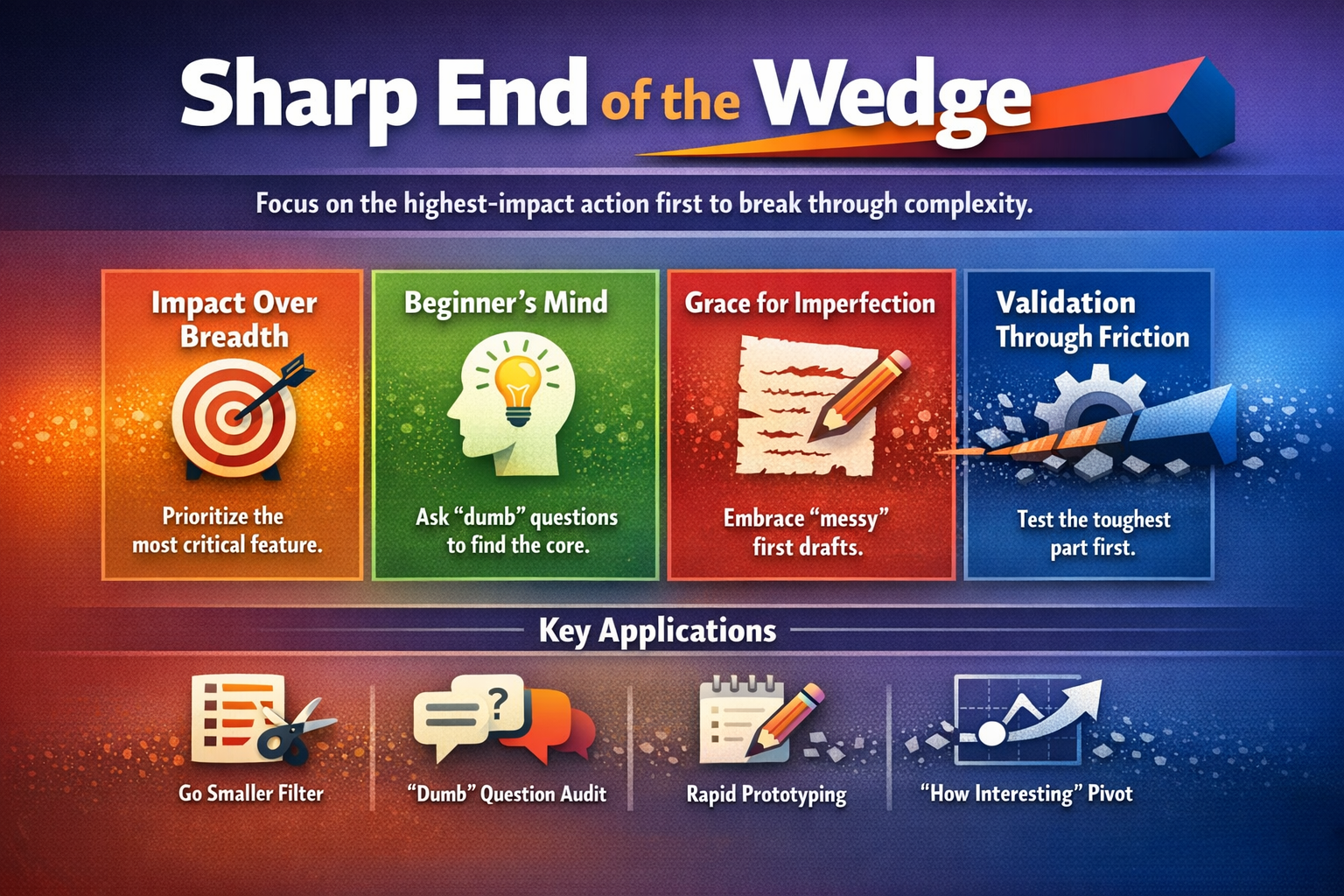
The Sharp End of the Wedge is a mental model for sequencing work, specifically tailored for founders and builders who need to create maximum impact with limited resources. In the simplest terms, it dictates that you must start with the smallest, highest-impact component of your solution before you build anything else.
Think about the physics of a wedge. If you try to drive a flat block of wood into a log, you’ll get nowhere, no matter how much force you apply. The force is distributed across too wide an area. But a wedge works because all that energy is concentrated onto a single, microscopic point—the sharp end. Once the sharp end penetrates the surface, the rest of the wedge (the "infrastructure") follows easily to finish the job.
In product development, the "sharp end" is the specific feature or interaction that delivers immediate, undeniable value to the customer. It is the "unique" or "most valuable" aspect of your solution. It isn't the login screen, it isn't the database schema, and it isn't the "About Us" page. It is the core differentiator that solves a burning problem. This model demands that you build from the customer value backward toward the technology, rather than starting with the infrastructure and hoping to reach the customer eventually.
Why It Matters
Most projects fail not because the builder couldn't code, but because they spent all their "energy" (time, money, motivation) building the blunt end of the wedge. They spent six weeks setting up a robust AWS environment, a complex authentication system, and a beautiful dashboard, only to find out that the core problem they intended to solve wasn't actually a priority for the user. They built the "infrastructure forward," and by the time they got to the customer value, they were out of resources.
The Sharp End of the Wedge solves the problem of "invisible failure." When you build infrastructure first, you feel productive. You’re checking off boxes, writing clean code, and setting up databases. But you are essentially building in a vacuum. You haven't validated the most dangerous part of your business: whether anyone cares about your solution.
By focusing on the sharp end, you allow for quick validation and learning. You address the most critical element first. If the sharp end can't penetrate the market—if the customer doesn't find value in your core differentiator—you find out in days, not months. This approach protects your most valuable asset: your time. It turns "failed projects" into "cheap lessons" because you didn't spend a fortune building the support structure for a value proposition that didn't work.
How It Works
The mechanism of this model is a radical re-ordering of the traditional development pipeline. It follows a few specific rules:
- Identify the Differentiator: You must ruthlessly isolate the one thing that makes your solution "special." If you are building a tool that uses AI to summarize legal documents, the sharp end is the summary itself. It is not the file-uploading interface or the billing system. It is the moment the lawyer reads a summary and says, "This saves me three hours."
- The Smallest Version of the Highest Impact: Once you identify the value, you ask: "What is the smallest possible way to deliver this?" If the value is the summary, maybe the first version is just a text box where they paste text, and you return a summary. No "save" button, no "history," no "folders." Just the value.
- Build Backward: Start with the user's interface with that value. What do they see? What do they get? Work backward from that moment to the data and logic required to make it happen. If you can deliver the value with a hard-coded script or a manual process behind the scenes, do that first.
- Validate the Penetration: Once the sharp end is built, put it in front of the user. If they don't react to the "special" part of your solution, the rest of the wedge—the "infrastructure"—is irrelevant. You don't need a scalable database for a product no one wants.
The "One-Two Rule" in this context is: First, deliver the unique value. Second, build the infrastructure necessary to support the growth of that value. Never reverse this order.
When to Apply
This model is most valuable in the "Zero to One" phase of any project. Whether you are a solo founder launching a new startup or a lead developer at a large company tasked with a new feature, you apply this when the risk of "no one using it" is high.
Specific trigger scenarios include:
- Proof of Concept (PoC): When you need to prove a technical or market hypothesis quickly.
- Pivoting: When your current product isn't gaining traction and you need to find a new "point of entry" into the customer's workflow.
- Feature Requests: Before building out a massive new module requested by a client, build the "sharp end" of that feature to see if they actually use it.
- No-Code Development: Because no-code allows for rapid UI building, it’s easy to get distracted by "pretty" blunt ends. This model keeps you focused on the logic and value.
Common Traps
The most common trap is The Infrastructure Fallacy. This is the belief that "we need to build a solid foundation before we can show it to anyone." Founders often hide in infrastructure because it's comfortable. They know how to build a database; they don't know if the customer will say "no." The Sharp End of the Wedge forces you to face the "no" as early as possible.
Another trap is The "Complete Product" Delusion. This is the idea that a product must have a certain set of "standard" features—like password reset, profile pictures, or dark mode—before it is viable. These are all part of the blunt end of the wedge. They provide zero unique value. They are "table stakes," but they don't help the wedge penetrate the log. If your sharp end is sharp enough, people will tolerate a lack of infrastructure. They will use a spreadsheet if it solves a $10,000 problem.
Finally, builders often mistake Size for Impact. They think the "sharp end" needs to be a big, complex feature. It doesn't. The "sharp end" is "always the smallest." If your sharp end feels big, you haven't refined it enough. You’re still trying to push a blunt block.
How It Connects
While no explicit "related concepts" were provided in the metadata, the Sharp End of the Wedge sits at the heart of the State Change philosophy. It is the practical application of Customer-Value Backward thinking. Rather than starting with the "How" (infrastructure, code, platform), you start with the "Who" and the "What" (the value delivered to the user).
It also connects to the concept of Technical Debt Management. By building the sharp end first, you are intentionally accruing "product debt" (missing features, manual processes) in exchange for "market certainty." This is a deliberate trade-off. You only pay down that debt (by building the blunt end) once you have evidence that the sharp end has found a home.
Evidence from Sources
The Definition of the Model
"Start with the smallest, highest-impact thing" — Ray's Mental Model: Core Principles for Building with No-Code
The Necessity of Sequence
"The sharp end always goes first, and it's always the smallest" — Founders Institute Talk (8/23)
Direction of Construction
"Build from customer value backward, not from infrastructure forward" — Ray's Mental Model: Core Principles for Building with No-Code
Validation and Focus
"Focus initial efforts on the highest-impact component or feature of a project. This approach allows for quick validation and learning by addressing the most critical element first, rather than attempting to build a complete but untested product." — Description (Source 2)
Identifying the "Special" Element
"Focus on the 'sharp end of the wedge' - what makes your solution special" — SC Mental Model Talk 1 6/2023
In Practice
Scenario 1: The Automated Reporting Tool
A founder wants to build a complex SaaS for marketing agencies that aggregates data from 20 different sources and generates beautiful PDF reports.
- The Blunt End (The Trap): Spending months building API integrations for all 20 sources, a user management system, and a custom PDF styling engine.
- The Sharp End: The founder asks for a CSV export from a single client’s Facebook Ads account, manually formats it into a high-insight summary in Google Docs, and emails it to them.
- The Result: If the client says, "This summary helped me keep my biggest account," the wedge has penetrated. Now, the founder can justify building the automation.
Scenario 2: The Marketplace for Specialized Freelancers
An entrepreneur wants to build a marketplace connecting specialized legal researchers with law firms.
- The Blunt End (The Trap): Building a two-sided marketplace platform with Stripe Connect, escrow payments, rating systems, and profile builders.
- The Sharp End: A simple landing page with a "Request a Researcher" form. When a request comes in, the founder manually texts researchers they know and connects them via email.
- The Result: The "sharp end" is the connection. If law firms are willing to fill out the form and pay via a manual invoice, the value is proven. The "marketplace infrastructure" can be built later.
Scenario 3: The Internal Operations Tool
A manager wants to build an internal app to track warehouse inventory using QR codes.
- The Blunt End (The Trap): Setting up a dedicated SQL database, buying industrial scanners, and building a multi-role permissions system.
- The Sharp End: A single screen on a mobile phone that scans one type of barcode and updates a single cell in a Google Sheet.
- The Result: The manager tests it on the warehouse floor for one afternoon. If the workers find that single scan easier than the current clipboard method, the sharp end has worked. The manager can then build the rest of the inventory system.
Have questions about The Sharp End of the Wedge?
Ask the AI Mentor — free, 10 questions/month
See This Model in Action
Real sessions where Ray teaches The Sharp End of the Wedge live.
Prioritizing Toddle Over Wist for Faster App Deployment
Optimizing Enterprise Deployment for Lasting Value
Assessing Sutro's Production Readiness and Market Positioning
Join State Change to watch full sessions and access 1,000+ more.
Go Deeper
Mental models are just the beginning. Here’s what members get:
Live Office Hours
Ray teaches this model in real time — with your real problems, real code, and real breakthroughs.
Session Vault
1,000+ recorded sessions searchable by topic. Find exactly the moment this model clicks.
AI Skills & MCP Tools
Your AI assistant learns these models too — Skills and MCP servers that bring Ray's thinking to your workflow.
Builder Community
Ask questions, share breakthroughs, get unstuck with 500+ builders who think in models, not just code.