Shift Left
What It Is
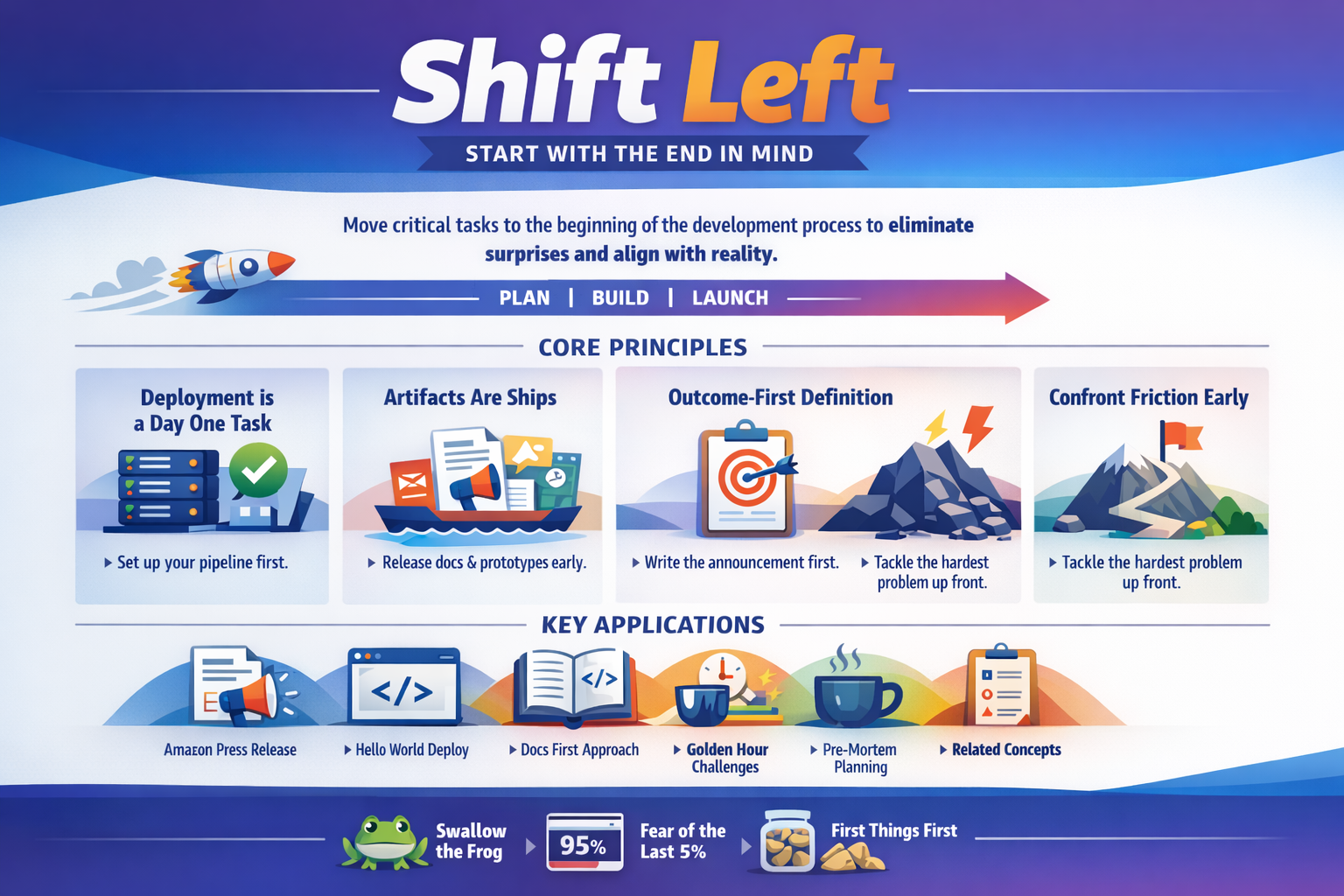
In the world of software development and building systems, "Shift Left" is the intentional practice of moving critical tasks, testing, and considerations to an earlier stage in the lifecycle. If you visualize a project timeline from left (start) to right (finish), most people save the "hard stuff"—deployment, testing, documentation, and user feedback—for the far right. They treat these as the final hurdles to clear before a project is "done."
Shift Left flips that script. It demands that you pull those downstream activities into the upstream phases of your work. It’s a refusal to defer reality. Instead of building in a vacuum and hoping it works when you finally flip the switch, you bring the "switch-flipping" moment as far to the left as possible. This means your deployment infrastructure is figured out on day one, your documentation is written while you are thinking through the logic, and your market assumptions are tested before you’ve written a single line of production code.
This is a mental model that prioritizes the "discovery of truth" over the "feeling of progress." It recognizes that the most dangerous part of any project is the delta between what you think is happening and what is actually happening. By shifting left, you close that gap early and often.
Why It Matters
The fundamental problem Shift Left solves is the exponential cost of error. In any system, the cost of fixing a mistake, a bug, or a market misalignment increases the further you get into the process. If you find a flaw in your logic while you're still sketching the workflow, it costs you five minutes of re-thinking. If you find that same flaw after the database is structured, the API is integrated, and the UI is polished, it could cost you weeks of refactoring and technical debt.
Without this principle, projects suffer from "The Big Bang" failure. You spend months building in secret, only to find out during the final week that the deployment environment doesn't support your libraries, or worse, that the customer doesn't actually want the feature you just perfected. This creates a high-stakes, high-stress environment where the end of a project is a gauntlet of "surprises" that usually involve late nights and compromised quality.
When you Shift Left, you transform the development process from a linear path into a series of learning loops. It makes the impossible possible: it allows you to fail safely and cheaply. By shipping artifacts like documentation and prototypes early, you gather technical and market feedback when you still have the flexibility to act on it. You aren't just building a product; you are building a feedback machine that constantly corrects your course.
How It Works
The mechanism of Shifting Left is built on four primary pillars:
1. Deployment Infrastructure First Standard practice is to build the app, then figure out where it lives. Shift Left says: figure out the "where" first. If you are building a no-code solution or a complex web app, your first task is to ensure you can get a "Hello World" to the live environment. By solving the deployment plumbing on day one, you remove a massive variable of risk. Every subsequent change can be tested in a "real" environment, ensuring that "it works on my machine" never becomes a project-killing excuse.
2. The Amazon Press Release Model (Begin with the End) One of the most powerful ways to shift left is to write the announcement of the product before you build it. If you can’t clearly articulate the value, the features, and the user benefit in a press release, you don't have a clear enough vision to start building. This shifts the "market fit" test to the absolute beginning of the process. If the press release sounds boring or confusing, you’ve saved yourself months of wasted effort.
3. Documentation as a Development Tool Instead of documentation being a post-mortem activity, Shift Left treats it as an "as-you-go" requirement. Writing documentation while you build forces you to clarify your logic. If a process is too hard to explain in the docs, it’s probably too complex in the code. This provides a real-time sanity check on the architecture of your system.
4. Continuous Testing and Feedback This involves moving considerations like security, performance, and user experience to the earliest possible stage. You don't "add security" at the end; you consider how data is handled in the first prototype. You don't "get feedback" after the launch; you share artifacts—press releases, prototypes, or even just documentation—with colleagues and potential users the moment they exist.
When to Apply
This mental model is most valuable in environments of high uncertainty. If you are building something that has never been built before, or if you are using a new toolset (like moving into No-Code for the first time), the "Shift Left" approach is non-negotiable.
Specific trigger scenarios include:
- Project Kickoff: Instead of starting with a feature list, start with the deployment pipeline and the "end" announcement.
- Integrating New Services: If you need to use a third-party API, don't wait until the UI is done to see if the API works. Build a "thin slice" that tests the integration immediately.
- Team Collaborations: When working with others, shift left by sharing early artifacts. Don't wait for a "final" version to get a critique. Share the rough draft to ensure everyone is aligned on the direction before the heavy lifting begins.
- Complex Logic Design: When you find yourself struggling to visualize how a multi-step automation will work, shift left by writing the "how-to" guide for that automation first.
Common Traps
The most common misconception is that Shifting Left means "doing everything at once" or "rushing to the finish line." This is not about being fast; it’s about being early.
The "Incomplete is Broken" Trap: Many builders feel they can't show anything until it’s polished. They think a prototype that only does one thing is "broken." Shift Left requires the ego-strength to share incomplete, unpolished artifacts because those artifacts contain the "learning" you need.
The Over-Engineering Trap: Some people interpret "figuring out infrastructure first" as an excuse to build a massive, complex system before they have an app. Shift Left should be practiced with "small features" and "small artifacts." You want the minimum infrastructure needed to ship, not a gold-plated server for an app that doesn't exist yet.
The "Checklist" Mentality: Shift Left is a principle, not just a task list. If you "write the press release" just to check a box, but you don't actually listen to the feedback it generates, you haven't shifted left; you've just added more work to the beginning. The goal is to address issues early, not just identify them.
How It Connects
While no direct concepts were listed in the metadata, Shift Left inherently connects to the broader philosophy of "Feedback Loops" and "Continuous Integration." It is the operational sibling to "Begin With the End in Mind." By starting with the end—whether that’s a press release or a deployed URL—you ensure that every step you take is grounded in reality rather than theory.
It also connects deeply to the concept of "Technical Debt." Most technical debt is the result of deferring difficult decisions or skipping testing to move faster. Shift Left argues that "moving fast" by skipping these steps is an illusion, because the time you "save" now will be paid back with high interest later when you have to fix the foundational issues you ignored at the start.
Evidence from Sources
On Early Deployment and Infrastructure
"Deploy early — Figure out deployment infrastructure first, not last" — Ray's Mental Model: Core Principles for Building with No-Code
On shipping artifacts and the Amazon model
"Ship artifacts — Documentation, press releases, prototypes, small features" — Ray's Mental Model: Core Principles for Building with No-Code
"Begin with the end in mind — Write the announcement before building (Amazon's press release model)" — Ray's Mental Model: Core Principles for Building with No-Code
On the core definition and timing
"The 'Shift Left' principle advocates for moving considerations, testing, and feedback processes earlier in the development lifecycle." — NCO Talk (6/23)
"A development practice that advocates for addressing issues and concerns as early as possible in the software development lifecycle." — Mental Model Map from Miro
On finding and fixing issues
""Shift Left" refers to finding and fixing issues as early as possible in the development process" — Mental Model Map from Miro
"Create documentation as you go" — NCO Talk (6/23)
In Practice
Scenario 1: The No-Code App Deployment
Imagine a builder creating a client portal using a tool like Bubble or WeWeb. Instead of spending three weeks building out every page and then trying to figure out how to point the custom domain and set up the SSL certificate, the builder applies Shift Left. On day one, they create a single page that says "Under Construction," connects the custom domain, and ensures the "Publish" button works. They have solved the "deployment infrastructure first." Now, every time they add a feature, they can see it live on the actual URL, ensuring no environment-specific bugs creep in at the last minute.
Scenario 2: The "Press Release" for a New Feature
A product manager wants to add an AI-driven reporting tool to their software. Instead of tasking the dev team to start an R&D phase, they "Shift Left" by writing the internal press release and a sample piece of documentation explaining how a user would configure the report. They share this "artifact" with three power users. The users point out that they don't need AI reporting; they just need a better CSV export. By shifting the feedback to the "artifact" phase, the team saves weeks of building a feature nobody wanted.
Scenario 3: Documentation as Architecture
A developer is building a complex automation that syncs data between a CRM and a project management tool. Instead of building the "zaps" or "make" scenarios immediately, they "Shift Left" by writing the step-by-step documentation for how the data should flow and what happens when an error occurs. While writing the documentation, they realize that their plan for handling duplicate records is flawed. They fix the logic in the document—which takes seconds—rather than having to rebuild a complex automation later when it starts creating thousands of duplicate entries in the production database.
Have questions about Shift Left?
Ask the AI Mentor — free, 10 questions/month
Synthesized Essay
Shift Left
Category: Principle Related Concepts: None listed
What It Is
In the world of software development and building systems, "Shift Left" is the intentional practice of moving critical tasks, testing, and considerations to an earlier stage in the lifecycle. If you visualize a project timeline from left (start) to right (finish), most people save the "hard stuff"—deployment, testing, documentation, and user feedback—for the far right. They treat these as the final hurdl
This is a preview. State Change members get the full essay, all infographics, audio, and unlimited AI mentoring.
Songs About This Model

Shift Left (Day One Ship)
Driving synth-pop with a steady, motivational beat and bright electronic textures

Shift Left (Day One Ship)
Driving synth-pop with a steady, motivational beat and bright electronic textures
Core Insight
The sooner you deploy/ship, the faster you learn from both technical and market feedback.
Mindset Shift
From "I'll ship when it's done" to "What can I ship today?"
See This Model in Action
Real sessions where Ray teaches Shift Left live.
Validating Income Statement Formula Dependencies
Join State Change to watch full sessions and access 1,000+ more.
Go Deeper
Mental models are just the beginning. Here’s what members get:
Live Office Hours
Ray teaches this model in real time — with your real problems, real code, and real breakthroughs.
Session Vault
1,000+ recorded sessions searchable by topic. Find exactly the moment this model clicks.
AI Skills & MCP Tools
Your AI assistant learns these models too — Skills and MCP servers that bring Ray's thinking to your workflow.
Builder Community
Ask questions, share breakthroughs, get unstuck with 500+ builders who think in models, not just code.