Shopping Mindset
What It Is
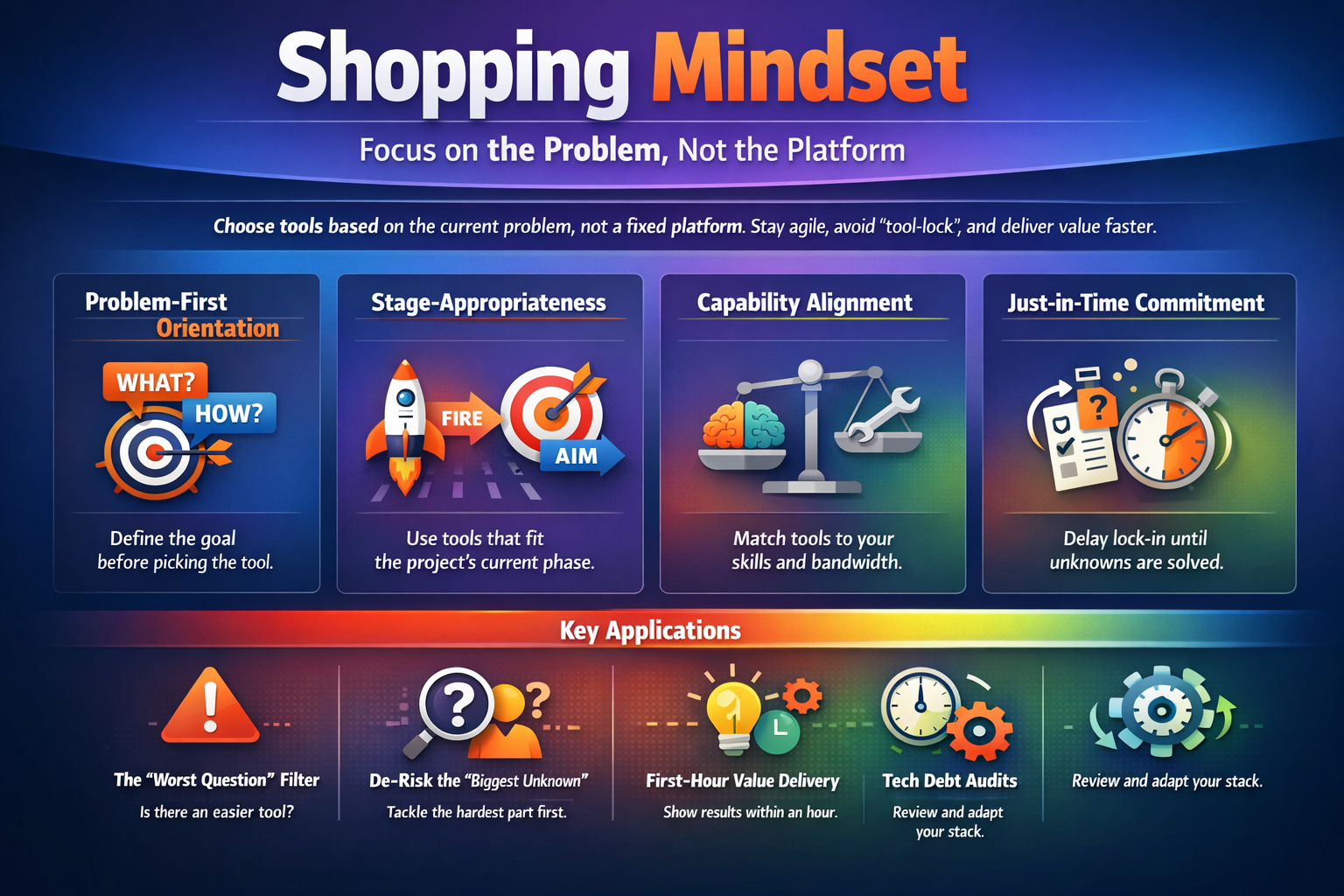
The Shopping Mindset is a fundamental shift in how you approach the construction of a technical product. It is the transition from being a "Tool Disciple"—someone who identifies with a specific stack or language—to being a "Sophisticated Consumer." In Ray’s view, most founders and developers approach a problem backward. They start with a tool they know (or a tool that is currently trendy) and then try to force their problem to fit the constraints of that tool. The Shopping Mindset flips this: you start with the problem, define the requirements of your current stage, and then "shop" for the tool that provides the shortest path to the solution.
This model is built on the realization that tools are not permanent identities; they are temporary employees. You are hiring a tool to do a specific job at a specific point in time. When you adopt a Shopping Mindset, you stop asking, "How do I make Tool Y do this?" and you start asking, "What is the best way to achieve X?" This keeps the focus on the business outcome rather than the technical implementation. It encourages a healthy level of detachment, allowing you to swap tools as your needs evolve without feeling like you are betraying a philosophy or losing your "identity" as a developer.
Why It Matters
Without the Shopping Mindset, you fall into the trap of "Maslow’s Hammer"—to a man with a hammer, every problem looks like a nail. In the context of software, this means that if you are a "React Developer," you will try to build everything in React, even if a simple static site or a no-code tool would have solved the problem in a tenth of the time. This leads to massive over-engineering, unnecessary complexity, and a "sunk cost" bias where you spend more time fighting your tools than shipping features.
When you lack this mindset, you lose the ability to adapt. Startups succeed based on their speed of iteration. If you are wedded to a specific tool, you are limited by that tool’s roadmap and constraints. If the tool can't do "X" easily, you'll either spend weeks building a custom workaround or you’ll convince yourself that your users don't actually need "X." Both outcomes are potentially fatal for a founder. By adopting the Shopping Mindset, you maintain your agility. You realize that what worked for your prototype (Stage A) might be a bottleneck for your MVP (Stage B), and that’s not a failure—it’s just time to go shopping again.
How It Works
The mechanism of the Shopping Mindset involves a three-step cognitive shift:
1. The "X" Priority The most critical practice is the linguistic shift in how you frame your technical hurdles. You must strip away the tool from the question. Instead of asking, "How do I do Stripe integration in Flutter?" you ask, "How do I collect a payment from a user?" By removing the tool from the premise, you open up the possibility that the best answer might not be in Flutter at all; it might be a redirected web view, a third-party checkout page, or a different integration entirely. You focus on the "X" (the outcome).
2. Identifying the Developmental Stage The Shopping Mindset requires an honest assessment of where you are in the journey. Tools are not "good" or "bad" in a vacuum; they are "appropriate" or "inappropriate" for a specific stage.
- The Discovery Stage: Needs tools that prioritize speed and changeability.
- The Validation Stage: Needs tools that prioritize reliability and user experience.
- The Scaling Stage: Needs tools that prioritize performance and cost-efficiency. The tool you "shopped" for at the Discovery stage should likely be replaced as you move into Scaling.
3. Capability-Based Selection Instead of looking at a tool's marketing site to see what it claims to do, you evaluate it based on your current capabilities and the tool's inherent strengths. If your team is proficient in JavaScript but the "best" tool for the job is written in Rust, the Shopping Mindset forces you to ask: "Is the benefit of this tool worth the cost of learning a new language?" You select based on the intersection of what the tool can do and what you can actually execute right now.
When to Apply
This mindset is most valuable during Technical Selection phases. Whether you are starting a new project or adding a major feature to an existing one, you should trigger the Shopping Mindset. It prevents you from default-picking the tools you used on your last project.
It is also crucial during Refactoring or Bottleneck phases. When you find your team saying, "We can't do that because the platform doesn't allow it," or "It’s going to take us a month to work around this limitation," that is a trigger to go shopping. You need to evaluate if you are still using the right tool for your current stage.
Finally, use this when hiring or outsourcing. Instead of hiring a "No-code expert" or a "Python dev," look for someone who understands the "X" you are trying to achieve. You want people who can shop for the right solution, not just people who only know how to use one specific store.
Common Traps
The biggest trap is Over-Optimizing for the Future. Founders often shop for the Scaling stage while they are still in the Discovery stage. They buy the "Enterprise-grade" tool that costs $2,000 a month and takes three months to set up because they expect to have a million users eventually. The Shopping Mindset dictates that you should shop for your current needs. If you don't survive the Discovery stage, the Scaling capabilities of your tool don't matter.
Another trap is Brand Loyalty. Many developers become fans of a specific ecosystem (Apple, Google, AWS, Vercel). They stop shopping and start following. This blinds you to more efficient solutions outside that ecosystem. You have to remember: the tools don't care about you. You shouldn't care about them. Use them until they no longer serve the outcome, then move on.
Lastly, there is the Infinite Shopping Trap. This is the opposite of being a "Tool Disciple." It’s the person who spends all their time researching new tools and never actually picks one to start building. The Shopping Mindset is about selection and execution, not perpetual window-shopping. You shop to buy, and you buy to build.
How It Connects
While no specific related concepts were listed in the source data, the Shopping Mindset inherently connects to the idea of Technical Debt Management. By acknowledging that tools have a shelf life and are stage-dependent, you treat the eventual replacement of a tool not as a disaster, but as a planned upgrade. It also aligns with Lean Methodology, where the goal is to minimize waste. Using a complex tool for a simple task is a form of waste that the Shopping Mindset helps identify.
This model also fits into a broader philosophy of User-Centric Design. By focusing on "How do I do X?" (where X is usually a user benefit), you ensure that technology serves the user, rather than forcing the user to adapt to the technology's limitations.
Evidence from Sources
Focus on the Outcome (The "X")
"Don't ask 'How do I do X with Tool Y?' but rather 'How do I do X?'" — Founders Institute Talk (8/23)
Stage-Appropriate Selection
"Different tools are appropriate at different stages of your journey" — Founders Institute Talk (8/23)
Needs and Capabilities Alignment
"Tools should be selected based on your current needs and capabilities" — Founders Institute Talk (8/23)
In Practice
Scenario 1: The Payments Pivot
A founder is building a subscription service in a no-code tool like Bubble. They want to implement a very specific, tiered pricing model that Bubble’s native Stripe plugin doesn't support. Instead of spending weeks trying to write custom API connectors within Bubble (asking "How do I do this with Tool Y?"), they apply the Shopping Mindset. They ask, "How do I do X (tiered pricing)?" They realize that a third-party service like Outseta or even a simple custom-coded microservice can handle the logic and just pass the result to Bubble. They shopped for a specialized tool for a specialized "X" rather than forcing their primary tool to do everything.
Scenario 2: The MVP vs. Scale
A developer is building a internal tool for a logistics company. Their instinct is to build a custom React dashboard with a PostgreSQL backend because that's "the right way" to build software. Applying the Shopping Mindset, they look at their current stage: Discovery. The "X" is simply "moving data from a spreadsheet to a driver's phone." They realize that for this stage, Airtable and Glide are the appropriate tools. They can ship in two days instead of two months. They acknowledge that if they hit 10,000 drivers, they will need to "shop" for a more robust database, but for now, the current tool fits the current needs.
Scenario 3: The Talent Constraint
A startup needs to build an AI-powered chatbot. They see that most documentation for the latest LLMs is in Python. However, their only two developers are specialized in Ruby on Rails. Instead of forcing their team to become Python experts overnight (which would slow down "X"), they shop for tools and libraries that bring those LLM capabilities into the Ruby ecosystem or utilize LangChain via an API. They selected the tool based on their current capabilities, ensuring they can actually execute on the goal rather than getting stuck in a learning curve.
Have questions about Shopping Mindset?
Ask the AI Mentor — free, 10 questions/month
Synthesized Essay
Shopping Mindset
Category: Principle Related Concepts: Outcome-Oriented Development, Tool Agnosticism, Just-in-Time Architecture
What It Is
The Shopping Mindset is a fundamental shift in how you approach the construction of a technical product. It is the transition from being a "Tool Disciple"—someone who identifies with a specific stack or language—to being a "Sophisticated Consumer." In Ray’s view, most founders and developers approach a problem backward. They start with a
This is a preview. State Change members get the full essay, all infographics, audio, and unlimited AI mentoring.
Songs About This Model

The Aisle of Solutions
Upbeat indie pop with a driving rhythm, bright synths, and a motivational energy

The Aisle of Solutions
Upbeat indie pop with a driving rhythm, bright synths, and a motivational energy
Core Insight
Tools are means to an end, and the right tool depends on the specific context and stage of the problem.
See This Model in Action
Real sessions where Ray teaches Shopping Mindset live.
Exploring Real-Time Updates for Wized Image Generation
Integrating Web Components with Toggle.dev
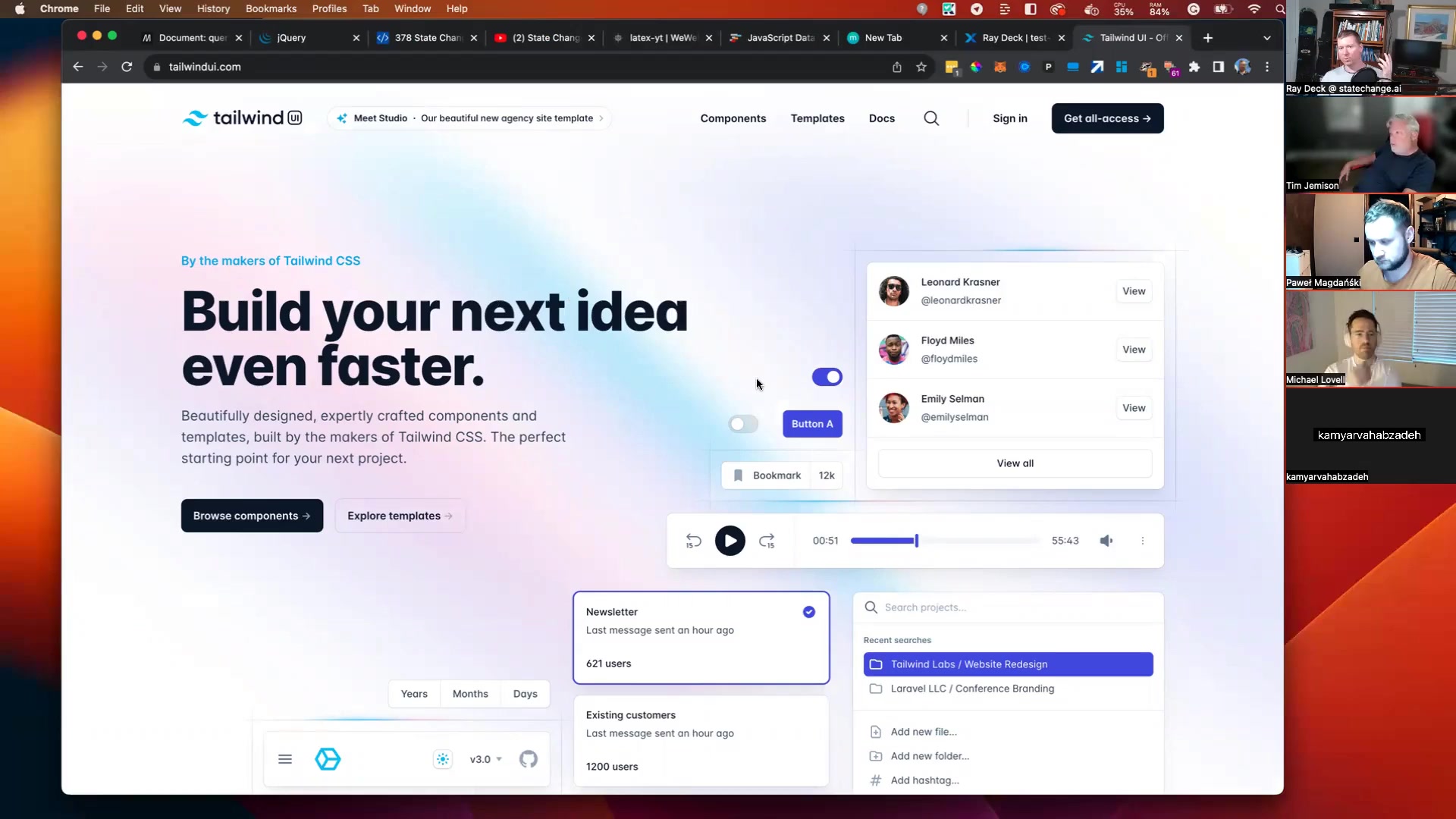
Integrating Tailwind with Weweb: Challenges and Recommendations
Deploying Python Apps to DigitalOcean: Navigating YAML and Git Integration
Join State Change to watch full sessions and access 1,000+ more.
Go Deeper
Mental models are just the beginning. Here’s what members get:
Live Office Hours
Ray teaches this model in real time — with your real problems, real code, and real breakthroughs.
Session Vault
1,000+ recorded sessions searchable by topic. Find exactly the moment this model clicks.
AI Skills & MCP Tools
Your AI assistant learns these models too — Skills and MCP servers that bring Ray's thinking to your workflow.
Builder Community
Ask questions, share breakthroughs, get unstuck with 500+ builders who think in models, not just code.