Slow is Smooth, Smooth is Fast
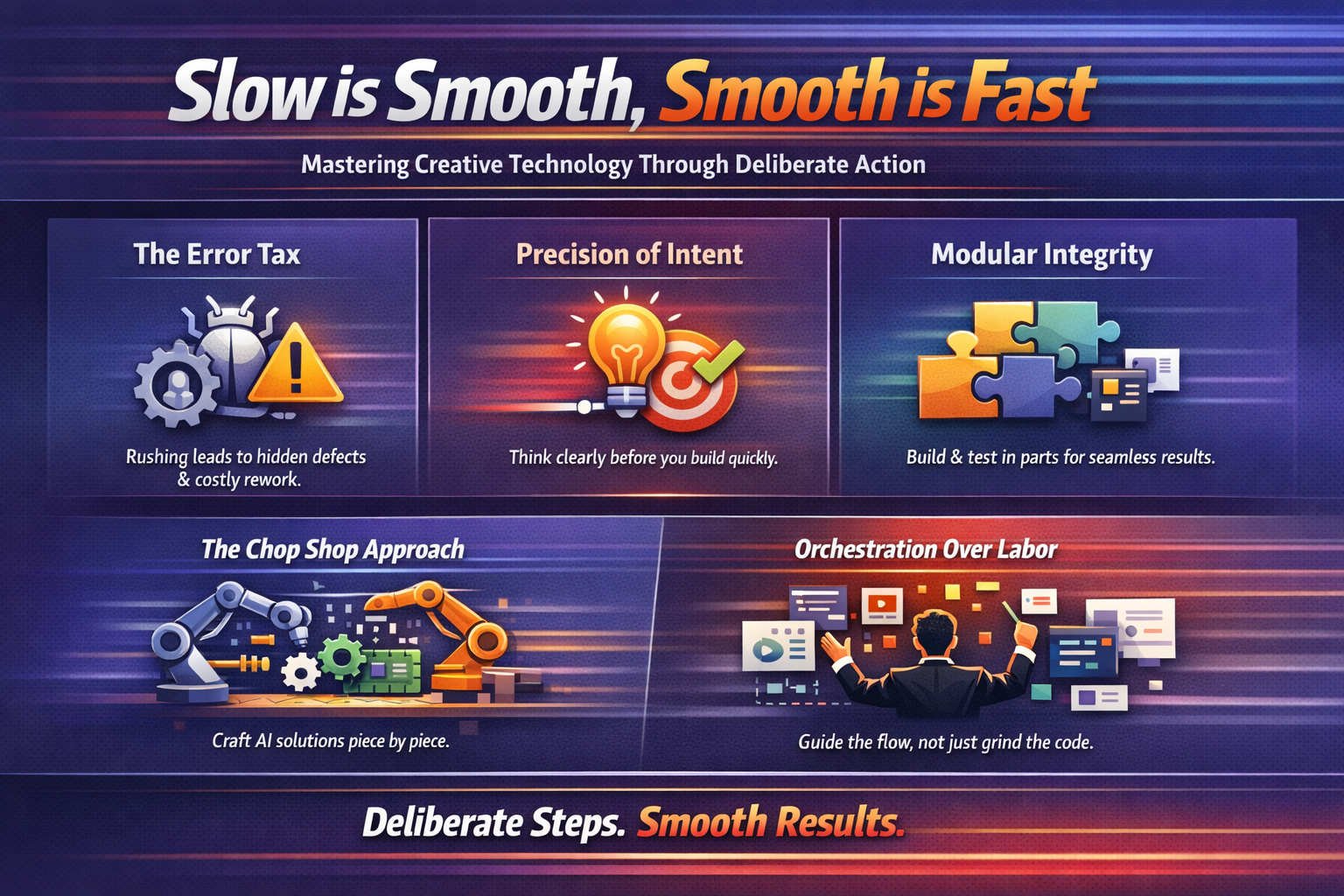
What It Is
"Slow is Smooth, Smooth is Fast" is a mental model that prioritizes the quality of execution over the raw speed of activity. In the context of building systems—especially in the high-leverage world of no-code and low-code—it is a rejection of the "hacker" ethos that values moving fast and breaking things. Instead, it posits that the only way to reach your destination quickly is to eliminate the friction that comes from mistakes, rework, and lack of clarity.
At its core, this model is about deliberate action. It means doing things one step at a time with full intentionality. It is the understanding that speed is an outcome of efficiency, and efficiency is an outcome of smoothness. You cannot force speed by simply rushing your physical or cognitive movements; you can only achieve it by removing the obstacles that slow you down. In a building environment, those obstacles are almost always errors born of haste.
Why It Matters
The actual problem this model solves is the "Rework Trap." When you are building a complex logic chain—whether in Xano, Bubble, or Make—the temptation is to race toward the finish line to see the "working" product. However, rushing creates errors. These aren't just small typos; they are logic flaws, unhandled edge cases, and architectural missteps that hide in the complexity of your build.
Without this model, you enter a cycle of "one step forward, two steps back." You spend twenty minutes building a feature in a rush, then spend four hours debugging why it doesn't work. The net speed of that session is abysmal. When you ignore the need for smoothness, you create technical debt instantly. With this model, however, you unlock the ability to make progress that sticks. When every step is methodical and patient, you don't have to go back and fix it. You move forward once, and you stay forward. This is how you actually finish projects.
How It Works
The mechanism of "Slow is Smooth, Smooth is Fast" relies on three primary principles derived from the core evidence of being deliberate and methodical.
First, you must decompose the work into its smallest deliberate steps. You don't "build the authentication system." You "create the database table for users," then you "configure the sign-up endpoint," then you "test the password hashing." By doing things one step at a time, you ensure that each individual component is "smooth"—meaning it is functional, tested, and understood. If you don't understand the step you are currently taking, you are rushing.
Second, you must actively resist the urge to skip ahead. Rushing is a psychological state where your mind is on Step 10 while your hands are on Step 2. This misalignment is where errors are born. To be "smooth," your mind and hands must be in the same place. This patience allows you to see the nuance of the current step, which prevents the "errors that slow you down" later.
Third, you verify smoothness at every increment. Methodical progress requires a feedback loop. Because you are moving one step at a time, you can verify that Step A works perfectly before you ever touch Step B. This incremental verification ensures that when you do encounter a bug, you know exactly where it is: it's in the one thing you just did. This eliminates the "needle in a haystack" debugging sessions that are the hallmark of a rushed builder.
When to Apply
This mental model is most valuable when the cost of an error is high or when the complexity of the system is high. In no-code building, where one misconfigured variable can break an entire automation, this applies to almost every task.
Specifically, apply this when you are mapping out logic. If you are designing a complex branching path in an API, moving "slowly" through the logic gates ensures you haven't left a hole. It is also critical during data migrations or schema changes. Rushing a database change can lead to catastrophic data loss; being methodical ensures the integrity of the system. Finally, use this when you feel the pressure of a deadline. Paradoxically, the more you feel the need to rush, the more important it is to slow down. Rushing under pressure is a guarantee of a "slow" outcome because the errors generated will be more frequent and harder to find.
Common Traps
The most common misconception is that "Slow is Smooth" is an excuse for procrastination or "analysis paralysis." This is not what the model suggests. Being "methodical" is not the same as being "stagnant." Deliberate action still requires action. The goal is not to move at a snail's pace for the sake of it, but to move at the maximum speed at which you can maintain perfect control and zero errors.
Another trap is the "Fix it Later" fallacy. People often think they can rush the build now and "clean it up" later. This violates the model because the "rushing creates errors" part of the principle is cumulative. Those errors don't just sit there; they compound, making every subsequent step harder and slower. You cannot build a smooth system on a foundation of rushed, error-prone steps.
Finally, do not confuse "smooth" with "perfect." This isn't about gold-plating or adding unnecessary features. It is about ensuring that whatever you are doing is done with deliberate, error-free execution.
How It Connections
While no specific related concepts were listed in the source, "Slow is Smooth, Smooth is Fast" serves as a foundational "operating system" for other building principles. It is the tactical application of disciplined execution.
It connects deeply to the idea of Atomic Building. If you believe in building one small, functional piece at a time, "Slow is Smooth" is the mindset required to do that effectively. It also relates to the concept of Feedback Loops. A methodical builder uses constant feedback to ensure their progress is smooth. In the broader context of State Change, this model is what allows a builder to maintain a "State" of flow. When you rush, you break your own flow by hitting the wall of your own mistakes. When you are smooth, you stay in the zone because the system is responding exactly as you intended.
Evidence from Sources
The Core Methodology
"Do things one step at a time deliberately" — Ray's Mental Model: Core Principles for Building with No-Code
The Danger of Haste
"Rushing creates errors that slow you down" — Ray's Mental Model: Core Principles for Building with No-Code
The Paradox of Speed
"Patient, methodical progress is ultimately faster" — Ray's Mental Model: Core Principles for Building with No-Code
In Practice
Scenario 1: Integrating a Third-Party API
A developer needs to connect a Stripe webhook to their database. A "fast" builder might try to map all thirty possible data fields at once, hitting "deploy" to see if it works. They spend the next hour wondering why the webhook is returning a 500 error. A "smooth" builder creates the endpoint and confirms it can receive a basic ping. Then, they map one field—the Customer ID—and verify it saves. Then they map the rest. By doing it one step at a time deliberately, they finish in twenty minutes with a fully working system, whereas the "fast" builder is still debugging.
Scenario 2: Refactoring a Database Schema
When a system needs to change how it stores user permissions, rushing can lead to users being locked out. A methodical builder writes out the steps: 1. Create new fields. 2. Write a script to copy data. 3. Verify data integrity. 4. Point the app to the new fields. By following these steps patiently, they avoid the "errors that slow you down," such as data corruption that would require a full database restore from a backup.
Scenario 3: Learning a New Tool
When starting with a complex tool like WeWeb or FlutterFlow, the temptation is to build the whole UI on day one. A "Slow is Smooth" approach involves building one button that changes one variable. Once that is understood and "smooth," the builder moves to the next component. This patient, methodical progress ensures that the builder actually learns the tool's underlying logic, making them "fast" in the long run because they aren't constantly guessing how things work.
Have questions about Slow is Smooth, Smooth is Fast?
Ask the AI Mentor — free, 10 questions/month
Synthesized Essay
Slow is Smooth, Smooth is Fast
Category: Practice Related Concepts: None listed
What It Is
"Slow is Smooth, Smooth is Fast" is a mental model that prioritizes the quality of execution over the raw speed of activity. In the context of building systems—especially in the high-leverage world of no-code and low-code—it is a rejection of the "hacker" ethos that values moving fast and breaking things. Instead, it posits that the only way to reach your destination quickly is to elim
This is a preview. State Change members get the full essay, all infographics, audio, and unlimited AI mentoring.
Songs About This Model

The Smooth Velocity
Driving synth-pop with a steady, rhythmic pulse

The Smooth Velocity
Driving synth-pop with a steady, rhythmic pulse
Core Insight
Speed is the byproduct of precision, not the result of rushing.
Mindset Shift
Shift from frantic activity that causes errors to methodical progress that builds momentum.
Go Deeper
Mental models are just the beginning. Here’s what members get:
Live Office Hours
Ray teaches this model in real time — with your real problems, real code, and real breakthroughs.
Session Vault
1,000+ recorded sessions searchable by topic. Find exactly the moment this model clicks.
AI Skills & MCP Tools
Your AI assistant learns these models too — Skills and MCP servers that bring Ray's thinking to your workflow.
Builder Community
Ask questions, share breakthroughs, get unstuck with 500+ builders who think in models, not just code.