Speed Over Perfection
What It Is
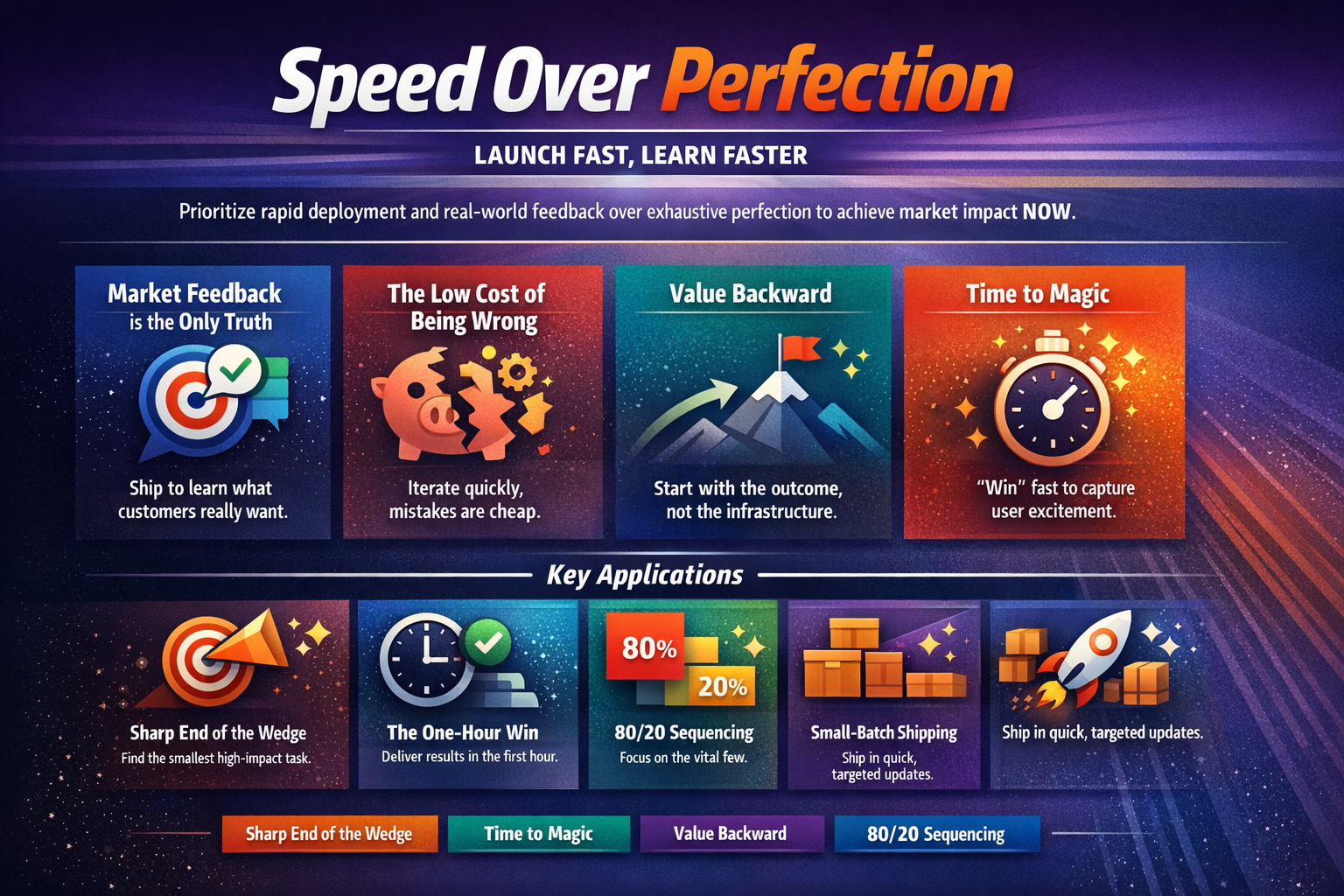
Speed Over Perfection is a strategic prioritization of time-to-market and iterative learning over the exhaustive pursuit of a "complete" or "flawless" initial product. In the context of modern software development, this mental model dictates that the most valuable asset a developer or founder can possess is not a polished codebase, but high-fidelity data from real-world usage.
This is a rejection of the traditional "waterfall" mindset where a product is perfected in a vacuum before being unveiled to the world. Instead, it treats the first release as a probe—a way to test hypotheses about what the market actually needs. It is built on the realization that the cost structure of software has fundamentally shifted. We are no longer in an era where software is "shipped" on physical discs that cannot be updated; we are in an era of continuous delivery where the distance between a mistake and a fix is measured in minutes, not months.
This model is a commitment to "good enough for now" as a vehicle for "better later." It’s the understanding that you cannot know what "perfect" looks like until you have real users interacting with your solution. Therefore, any effort spent polishing features that users might not even want is, by definition, waste.
Why It Matters
The primary problem Speed Over Perfection solves is the "Pre-Launch Vacuum." Without this model, teams spend months—or years—building features based on assumptions. This creates a massive risk: the risk of building a perfect solution to a problem that doesn't exist. When you prioritize perfection, you delay the most critical part of the development process: the collision between your software and the reality of the market.
By prioritizing speed, you solve for the "Cost of Learning." In the old world, making a mistake was expensive. If you built the wrong thing, you had to scrap months of work and hundreds of thousands of dollars. Today, the cost of being wrong is lower than it has ever been, but the cost of being slow is higher. If you wait to be perfect, your competitors who are iterating in public will outpace you by learning faster.
What becomes possible with this model is a "self-financing" development cycle. When you get a solution to market quickly, you start generating value—whether that's actual revenue or the "informational capital" of user feedback. This feedback then tells you exactly where to spend your next hour of development time, ensuring that every subsequent iteration is a high-confidence move rather than a guess.
How It Works
The mechanism of Speed Over Perfection relies on three core pillars:
1. The "Probe" Mentality Instead of building a "feature-complete" product, you build the "Minimum Viable Probe." What is the smallest possible thing you can put in front of a user to see if they derive value? This requires a ruthless pruning of the roadmap. If a feature isn't essential to the core value proposition, it is a distraction from the speed required to start learning.
2. Leveraging the New Economics of Software This model works because "rewrites are cheaper now than ever." In the past, "technical debt" was a terrifying ghost. Today, because of modern frameworks, low-code tools, and AI-assisted coding, the penalty for throwing away code and starting over is drastically reduced. We can afford to be "wrong" because the cost of fixing or refactoring is no longer a death sentence for the project. You don't need to get the architecture right the first time; you need to get the value right.
3. The Feedback-to-Finance Loop Market feedback serves as the "financing" for the next iteration. This isn't just about money; it’s about the allocation of resources. When a user tells you, "I love this, but I wish it did X," they are essentially providing you with a roadmap that is guaranteed to have ROI. By launching quickly, you stop spending your own "imagination capital" and start spending the "market capital" provided by your users.
When to Apply
This mental model is most valuable in high-uncertainty environments. If you are building something truly new—a new product, a new feature, or a new business model—Speed Over Perfection is your primary defense against failure.
Specific triggers for this model include:
- Early-Stage Development: When you are still searching for Product-Market Fit.
- Pivoting: When your current direction isn't working and you need to find a new path quickly.
- Testing "Edge" Features: When you have an idea for a feature but aren't sure if users will actually use it.
- Entering Competitive Markets: When being the first to learn from a specific niche is more important than having a comprehensive feature set.
It is less applicable in scenarios where the cost of failure is life-threatening or catastrophic (e.g., medical device software or aerospace engineering), but for the vast majority of SaaS and business applications, speed remains the dominant priority.
Common Traps
The biggest misconception is that "Speed Over Perfection" is an excuse for "Sloppy Over Functional." Speed does not mean shipping broken code that doesn't work. If the product is so buggy that it prevents the user from experiencing the core value, you won't get "market feedback"—you'll just get "market rejection." The speed must be directed toward the release of a functional core, not the release of a broken mess.
Another trap is failing to follow through on the iteration. Some people use this model to justify launching a "Version 1.0" and then abandoning it. Speed Over Perfection only works if you actually use the feedback to inform the "Version 1.1." If you don't iterate, you haven't used the model; you've just shipped a bad product.
Finally, do not confuse "perfect" with "necessary." Security, data integrity, and basic usability are not "perfection"—they are the baseline. Perfectionism is obsessing over the color of a button or the scalability of a database for a million users when you only have ten. Focus speed on the stuff that matters, and defer the "polishing" until the market demands it.
How It Connects
While no specific "Related Concepts" were provided in the initial evidence, this model is the engine that drives the broader philosophy of State Change development. It sits at the intersection of Iterative Development and Lean Methodology.
It connects to the concept of Optionality. By moving fast and keeping rewrites cheap, you maintain the option to change direction. Perfectionism is the opposite; it locks you into a specific path early on, reducing your ability to respond to what you learn. It also links to the idea of Information ROI—the belief that the most valuable thing a developer can produce in the early stages of a project is not code, but a confirmed understanding of user needs.
Evidence from Sources
On the Priority of Learning
"Get solutions to market quickly to start learning and generating value" — Nicky Taylor Podcast Interview 11/23
On the Shift in Development Economics
"Embrace that rewrites are cheaper now than ever" — Nicky Taylor Podcast Interview 11/23
On Iteration and Growth
"Use market feedback to finance and inform the next iteration" — Nicky Taylor Podcast Interview 11/23
In Practice
Scenario 1: The Internal Tool
A company needs a tool to manage lead intake. Instead of spending three months building a custom CRM with a perfect UI and complex permissions, the developer uses a low-code tool to ship a basic form and a list view in three days. By day four, the sales team is using it. They immediately point out that they don't need the "lead scoring" feature the developer planned, but they desperately need a "WhatsApp integration." Because the developer moved fast and didn't polish the scoring feature, they can pivot immediately to the integration without wasting resources.
Scenario 2: The SaaS Startup
A founder wants to build an AI-driven scheduling app. Instead of perfecting the proprietary AI model, they launch a version that uses a basic third-party API and a simple interface. Within a week, they see that users aren't using the "auto-scheduling" at all; they are using the app to "summarize" their meetings. The founder realizes the "perfection" they were aiming for—the scheduling engine—was the wrong target. They pivot to a summary tool, having saved months of wasted engineering effort.
Scenario 3: The Refactor Decision
A team is worried that their current database schema won't scale to 100,000 users. They currently have 50 users. Following the "Speed Over Perfection" model, they acknowledge that "rewrites are cheaper than ever." They choose to stick with the current schema to ship a new requested feature today, knowing that if they actually hit 100,000 users, the "market feedback" (and likely the revenue) will provide them with the resources and clarity to handle the refactor then.
Have questions about Speed Over Perfection?
Ask the AI Mentor — free, 10 questions/month
Synthesized Essay
Speed Over Perfection
Category: Principle Related Concepts: Rapid Iteration, Feedback Loops, Low-Cost Refactoring
What It Is
Speed Over Perfection is a strategic prioritization of time-to-market and iterative learning over the exhaustive pursuit of a "complete" or "flawless" initial product. In the context of modern software development, this mental model dictates that the most valuable asset a developer or founder can possess is not a polished codebase, but high-fidelity da
This is a preview. State Change members get the full essay, all infographics, audio, and unlimited AI mentoring.
Songs About This Model

The Sharp End of the Wedge
Energetic indie rock with driving drums and a bright, rhythmic electric guitar

The Sharp End of the Wedge
Energetic indie rock with driving drums and a bright, rhythmic electric guitar
Core Insight
In today's software landscape, early market feedback and iterative development cycles are more beneficial than aiming for perfect initial solutions.
Mindset Shift
From aiming for initial perfection to embracing rapid iteration and learning from market feedback.
Go Deeper
Mental models are just the beginning. Here’s what members get:
Live Office Hours
Ray teaches this model in real time — with your real problems, real code, and real breakthroughs.
Session Vault
1,000+ recorded sessions searchable by topic. Find exactly the moment this model clicks.
AI Skills & MCP Tools
Your AI assistant learns these models too — Skills and MCP servers that bring Ray's thinking to your workflow.
Builder Community
Ask questions, share breakthroughs, get unstuck with 500+ builders who think in models, not just code.