Swallow the Frog
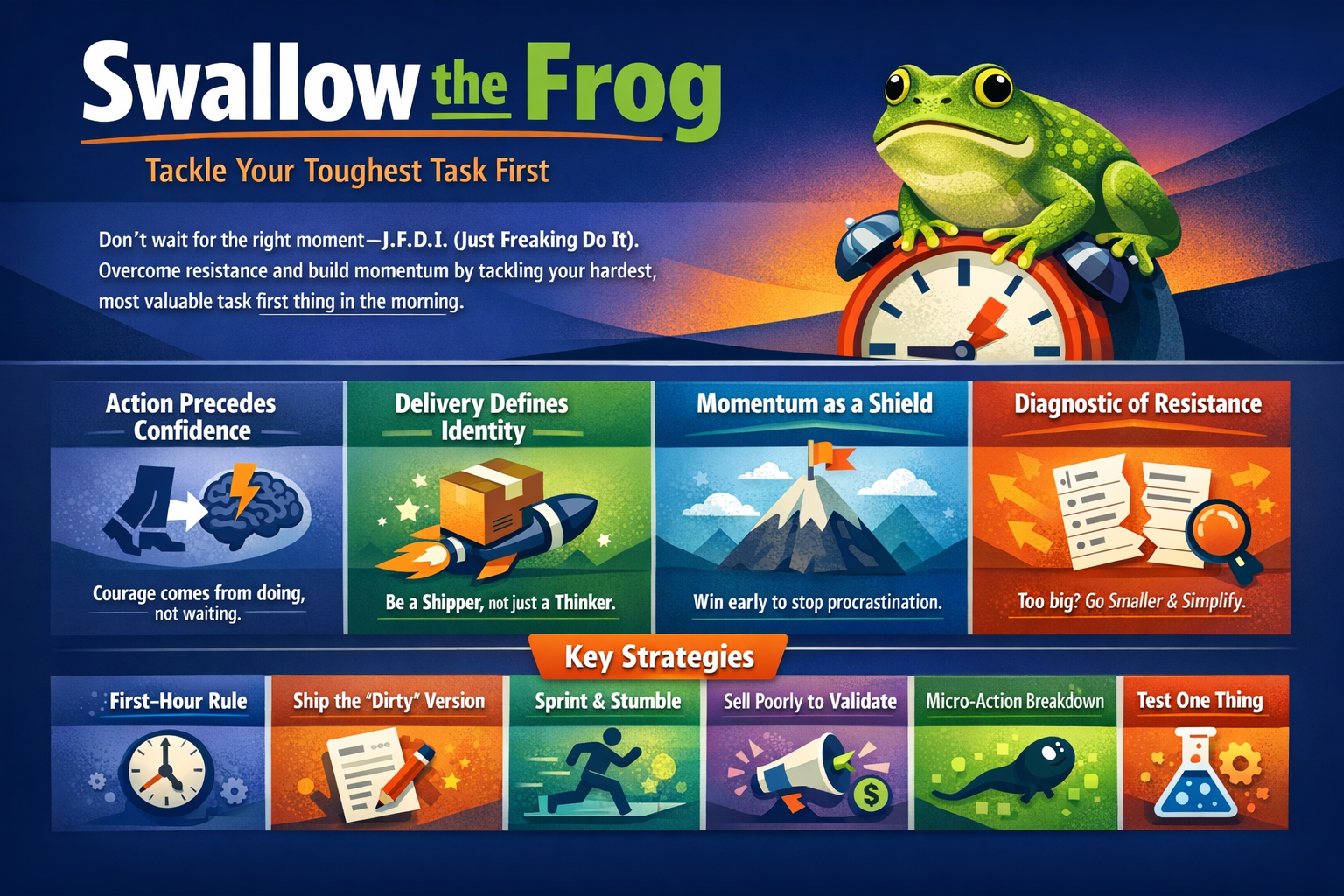
What It Is
"Swallow the Frog" is a deceptive-in-its-simplicity productivity practice that dictates a specific sequence for your workday: you identify the most difficult, most unpleasant, or most dreaded task on your list and complete it before you do anything else.
In the State Change context, this isn't about just being "busy." It is a tactical intervention designed to hack your own psychology. The "frog" is that specific item on your to-do list that you are most likely to procrastinate on—not necessarily because it is the largest task, but because it carries the most internal resistance. It’s the legacy code bug no one wants to touch, the difficult performance conversation you’ve been putting off, or the complex documentation for a system you barely understand.
Ray’s perspective on this is clear: if you have to eat a live frog, it doesn't pay to sit and look at it for very long. By tackling the hardest thing first, you ensure that the most significant obstacle to your progress is cleared while your energy, willpower, and cognitive resources are at their peak. It is the ultimate antidote to the "ugh field"—that mental barrier that prevents us from starting high-value work.
Why It Matters
Without this mental model, most people default to "productive procrastination." They start their day with "easy wins"—clearing out the inbox, responding to Slack messages, or tweaking low-priority UI elements. While this feels like progress, it is actually a drain on your cognitive battery. By the time you get to the "frog" in the afternoon, your willpower is depleted, your focus is fragmented by the day’s interruptions, and the task feels even more daunting than it did at 9:00 AM.
When you avoid the frog, the task doesn't just sit there; it occupies "background cycles" in your brain. It creates a low-level anxiety that colors every other task you perform. You aren't fully present in your meetings or your easier coding tasks because a part of your mind is constantly dreading the monster waiting for you at the end of the day.
When you apply "Swallow the Frog," you reclaim that mental energy. Completing the hardest task first provides an immediate dopamine hit and a surge of momentum. It changes the narrative of your day from "I’m struggling to keep up" to "The hardest part is behind me." This creates a "downhill" effect for the rest of your workday, where every subsequent task feels lighter and easier by comparison.
How It Works
The mechanism of "Swallow the Frog" relies on the finite nature of human willpower and the mechanics of momentum. It can be broken down into a three-step framework:
- Identify the Frog: This happens the night before or in the first five minutes of the morning. You look at your list and ask: "Which task am I most tempted to delay until tomorrow?" That is your frog. It is often the task with the highest leverage, but also the highest friction.
- Isolate the Frog: You must create a "zero-distraction" environment for this task. Do not check email. Do not open Slack. Do not look at the news. Any input from the outside world provides an excuse to let the frog hop away. You protect your first 60 to 90 minutes of the day as "frog-eating time."
- Commit to the "First Bite": If the frog is too big to swallow whole (e.g., "Refactor the entire billing system"), you don't change the task; you just focus on the first irrevocable action. This might be opening the specific file or writing the first test case. The goal is to cross the threshold of "starting," which is where 90% of the resistance lives.
The "momentum" mentioned in the sources is the key byproduct here. Momentum is a physical property applied to work; once an object (your productivity) is in motion, it requires less force to keep it moving. By doing the hardest thing first, you generate the maximum amount of force early on, making the rest of the day’s work move forward with significantly less effort.
When to Apply
This model is most valuable in high-stakes environments where tasks are complex and resistance is high. It is particularly useful for developers, founders, and technical leads who often face "undone" work that is cognitively taxing.
- The "Scary" Bug: When there is a bug in production that is hard to reproduce and involves a part of the stack you hate. This is a classic frog.
- Technical Debt: When you know a certain module needs a rewrite but you keep shipping "features" instead. Swallow the frog by spending the first hour of your day on the refactor.
- Difficult Communications: If you need to tell a stakeholder a project is delayed or have a hard conversation with a teammate, do it first. The longer it sits, the more it rots your morale.
- Deep Work Tasks: Any task that requires high-intensity "Type 2" thinking (deliberate, slow, effortful) should be treated as a frog, because your capacity for Type 2 thinking diminishes as the day progresses.
Common Traps
The most common mistake is Misidentifying the Frog. People often mistake "urgent" tasks for "frogs." An urgent email from a client might feel like a frog because it’s stressful, but if it's easy to answer, it’s not a frog—it's a distraction. A true frog is a task that you know is important but you are actively avoiding.
Another trap is "Nesting the Frog." This is when you decide to "prep" for the task by organizing your desk, cleaning up your desktop, or making a fresh pot of coffee. These are all forms of resistance. The rule is simple: don't clean the kitchen before you eat the frog. Just eat it.
Finally, there is the "Infinite Frog" trap. This happens when you pick a task so large that it cannot be finished in the morning session, leading to frustration. If your frog is a month-long project, your "frog for the day" must be a specific, executable chunk of that project that can be "swallowed" within your first focused block of time.
How It Connections
While the provided evidence is focused strictly on the practice itself, "Swallow the Frog" fits into a larger ecosystem of State Change mental models. It is the tactical execution of Leverage. In many cases, the "frog" is the highest-leverage activity you could possibly do—the thing that, if finished, makes everything else easier or unnecessary.
It also connects deeply to the concept of Momentum. In the State Change philosophy, momentum is the primary indicator of a healthy workflow. "Swallow the Frog" is the most reliable way to jumpstart momentum in a stagnant environment. By removing the largest source of friction (the dreaded task) at the start of the cycle, you ensure that the "velocity" of your work increases throughout the day rather than tapering off due to avoided responsibilities.
Evidence from Sources
Core Definition
""Swallow the frog" (tackle difficult tasks first)" — Mental Model Map from Miro
Origin and Application
""Swallow the frog" (from Mark Twain) means doing the hardest/most unpleasant task first" — Mental Model Map from Miro
Objective
"By addressing the dreaded task early, one can build momentum and reduce procrastination." — Mental Model Map from Miro
In Practice
Scenario 1: The Legacy Refactor
A developer has been meaning to refactor a messy, undocumented authentication module for weeks. Every day, they start by "clearing the deck" with easy bug fixes and UI tweaks. By 2 PM, they feel "too tired" to dive into the complex auth logic. Applying the model: The developer decides the auth module is the "frog." Monday morning, they don't open Slack or their email. They open the auth code at 9:00 AM sharp and spend the first 90 minutes solely on that task. By 10:30 AM, they've made a breakthrough. The rest of their day feels like a victory lap.
Scenario 2: The Project Manager’s Hard Conversation
A PM realizes a major feature won't make the release date. They dread telling the CEO. They spend all morning "polishing the slide deck" for a different meeting, but the dread of the upcoming announcement makes them distracted and irritable. Applying the model: The PM identifies the "CEO Update" as the frog. They schedule the call for the first available slot in the morning. Once the conversation is over—regardless of how it went—the "ugh field" vanishes. They can now focus on the actual problem-solving needed for the rest of the day without the weight of the secret hanging over them.
Scenario 3: The "Deep Work" Documentation
An engineer needs to write a technical specification for a new microservice. It’s cognitively demanding and "boring" compared to writing code. They usually leave it for the end of the day. Applying the model: The engineer treats the spec as the frog. They commit to writing the first three sections before they even check the build status of their current PR. By front-loading the "thinking" work, they utilize their freshest mental state, finishing in one hour what usually takes three hours of painful effort in the afternoon.
Have questions about Swallow the Frog?
Ask the AI Mentor — free, 10 questions/month
Synthesized Essay
Swallow the Frog
Category: Practice Related Concepts: Momentum, Procrastination Reduction, Cognitive Load Management
What It Is
"Swallow the Frog" is a deceptive-in-its-simplicity productivity practice that dictates a specific sequence for your workday: you identify the most difficult, most unpleasant, or most dreaded task on your list and complete it before you do anything else.
In the State Change context, this isn't about just being "busy." It is a tactical intervention
This is a preview. State Change members get the full essay, all infographics, audio, and unlimited AI mentoring.
Songs About This Model

Swallow the Frog
Energetic indie-rock with a driving drum beat and punchy guitar riffs

Swallow the Frog
Energetic indie-rock with a driving drum beat and punchy guitar riffs
Core Insight
Conquer your most dreaded task first to unlock a day of effortless momentum.
Mindset Shift
From procrastinating on daunting challenges to building momentum through early victories.
Go Deeper
Mental models are just the beginning. Here’s what members get:
Live Office Hours
Ray teaches this model in real time — with your real problems, real code, and real breakthroughs.
Session Vault
1,000+ recorded sessions searchable by topic. Find exactly the moment this model clicks.
AI Skills & MCP Tools
Your AI assistant learns these models too — Skills and MCP servers that bring Ray's thinking to your workflow.
Builder Community
Ask questions, share breakthroughs, get unstuck with 500+ builders who think in models, not just code.