The Wheel
What It Is
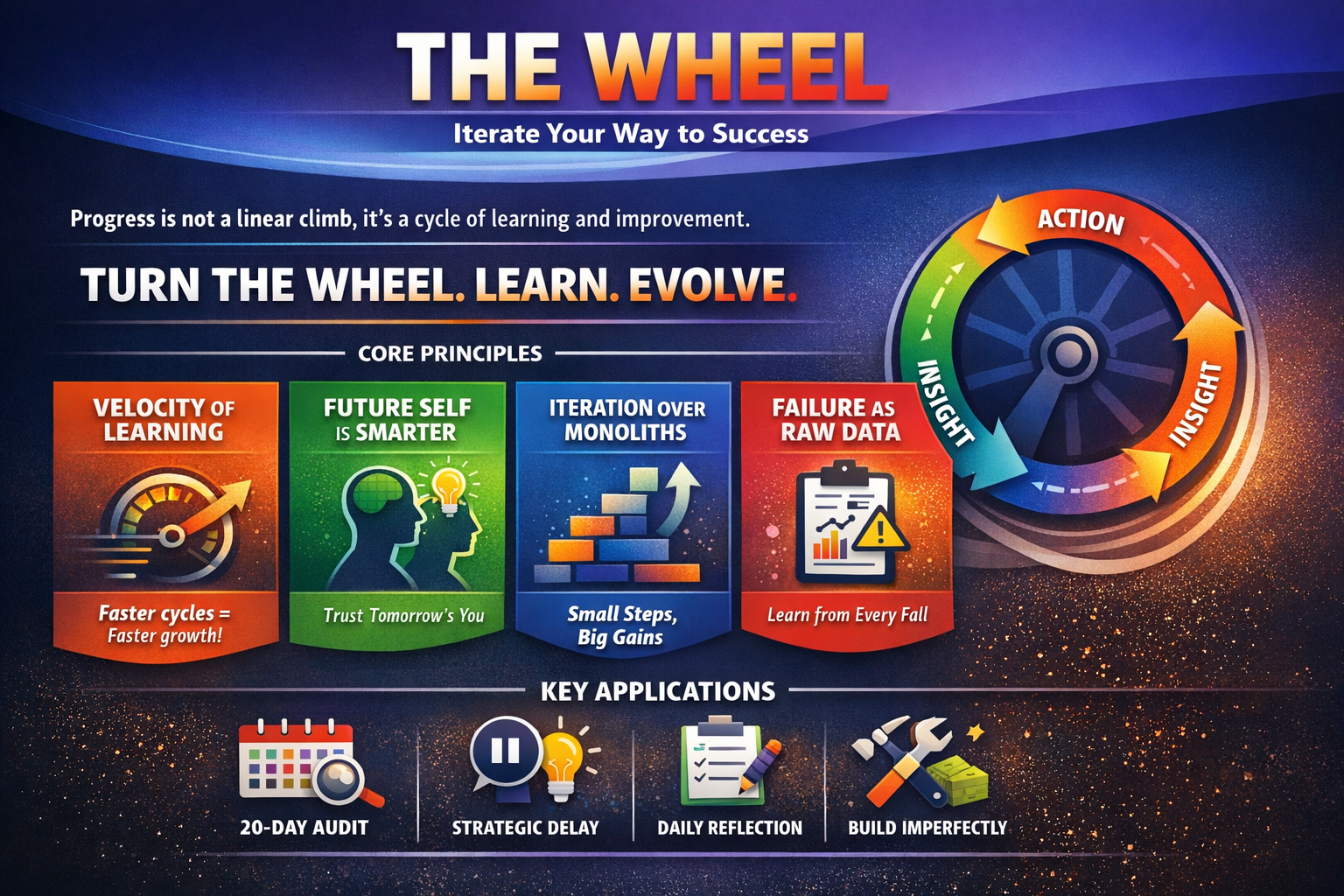
The Wheel is a mental model that reframes how we perceive and measure progress in high-uncertainty environments. In the State Change framework, the Wheel represents the iterative nature of building a business or solving a complex technical problem. Instead of viewing success as a linear path from point A to point B, the Wheel treats progress as a series of loops. Each "turn of the wheel" is a discrete cycle of action, feedback, and synthesis.
At its core, this model is about the conversion of effort into insight. You are not just doing work; you are performing an experiment to see what happens. Every time you complete a full rotation, you have moved the project forward—not necessarily by completing a task on a checklist, but by gaining the specific knowledge required to make the next turn more effective. It is a shift from a "production" mindset to a "learning" mindset.
In Ray’s view, the Wheel is the antidote to the "big reveal" or the "monolithic project." It acknowledges that you cannot know everything at the start. Therefore, your primary job is to get the wheel spinning as quickly as possible. You stop worrying about whether the first turn is perfect and start focusing on whether the turn happened at all.
Why It Matters
The primary problem the Wheel solves is the "Monolithic Fallacy"—the belief that you can achieve a massive result through one giant, perfectly executed step. In the real world, big steps are fragile. They rely on assumptions that haven't been tested. When you try to do everything at once, you delay the moment of feedback. If your initial assumption was wrong, you find out six months too late, having wasted significant capital and time.
With the Wheel, the risk is mitigated through frequency. When you break your goals down into smaller "turns," the cost of being wrong on any single turn is low. You become resilient to failure because no single iteration can sink the ship. What matters is the cumulative insight gained from multiple rotations.
Furthermore, this model provides a clear metric for productivity that isn't tied to "busywork." Without the Wheel, it’s easy to feel productive while actually spinning your tires in the mud—doing things that don't actually teach you anything about your market or your product. The Wheel forces you to ask: "What did we learn in this turn that we didn't know before?" If the answer is "nothing," the wheel didn't actually turn; you just moved in place.
How It Works
The mechanism of the Wheel is built on three specific principles: definition, speed, and extraction.
First, you must define what constitutes a "turn." A turn is not just "working for a week." A turn is a completed cycle that produces a data point. This could be launching a landing page to see if people click a button, running a technical spike to see if two systems can integrate, or making ten sales calls to see how people react to a specific price point. If there is no feedback mechanism at the end of the action, the wheel hasn't completed a rotation.
Second, the goal is to increase the speed and frequency of these cycles. This is the "RPM" of your business. If it takes your competitor a month to complete one learning cycle and it takes you a week, you will have four times the insights in the same period. Over time, that compounding knowledge creates an insurmountable advantage. You don’t win by being smarter; you win by having a faster wheel.
Third, you must extract the insight. This is the "knowledge" component mentioned in the sources. At the end of every turn, you must pause to document what was learned. This isn't about formal reporting; it's about updating your mental map of the problem. Did the users do what you expected? Did the code perform as predicted? That insight becomes the fuel for the next turn.
Finally, the model emphasizes continuous iteration. This means the wheel never stops. As soon as one turn is finished and the insight is gathered, you immediately use that insight to calibrate the next turn. You are looking for "turns" that are as small as possible while still being meaningful. If a turn takes too long, you are likely trying to "do everything in one big step," which the model specifically warns against.
When to Apply
The Wheel is most valuable in the "Discovery" and "Validation" phases of any project. If you are doing something you have done a hundred times before and the path is clear, you might not need the Wheel—you just need a checklist. However, if you are building a startup, launching a new product, or solving a novel technical challenge, the Wheel is your most important tool.
Apply this model when:
- Uncertainty is high: You don't know if the market wants the product or if the technology will scale.
- Resources are limited: You cannot afford to spend six months on a "monolith" that might fail.
- Speed is a competitive advantage: You need to out-learn the competition to find the "secret" or the "fit" before they do.
It is particularly useful during the early stages of the Founders Institute process or any incubator environment where the goal is to move from "idea" to "validated model" as quickly as possible.
Common Traps
The most common trap is the "Empty Turn." This happens when a team goes through the motions of iteration—doing work, shipping code, making calls—but they don't actually pause to gain "new insights and knowledge." They are just busy. If the "turn" doesn't change your behavior or your strategy for the next turn, you didn't actually gain insight. You just performed labor.
Another trap is the "Heavy Wheel." This is the tendency to make the "turns" too big. Founders often feel that they can't show anything to the world until it's "finished." This leads to turns that take months instead of days. The problem with a heavy wheel is that it's hard to get moving, and if it's heading in the wrong direction, it's hard to stop. You must fight the urge to "do everything in one big step" and instead find the smallest possible turn that yields a useful insight.
Lastly, there is the "Knowledge Leak." This occurs when a team makes a turn, learns something, but fails to incorporate that learning into the next turn. This often happens in larger teams where the person doing the work (turning the wheel) isn't the one making the decisions. The insights get lost in communication, and the next turn is just as uninformed as the first.
How It Connects
While no specific related concepts were listed in the evidence, the Wheel inherently connects to the broader concept of Feedback Loops. A feedback loop is the technical structure; the Wheel is the mental model for how to value and execute those loops.
It also relates to the idea of Velocity vs. Speed. Speed is how fast you are moving; Velocity is how fast you are moving in a specific direction. The Wheel ensures that your speed is actually converted into velocity by using the "insights" from each turn to steer the ship. Without the Wheel, you might be moving fast but just going in circles without gaining ground.
Evidence from Sources
Measuring Success
"Success is measured by how many 'turns of the wheel' you can make - each turn represents gaining new insights and knowledge" — Founders Institute Talk (8/23)
Optimizing for Velocity
"The goal is to increase the speed and frequency of these learning cycles" — Founders Institute Talk (8/23)
Iterative vs. Monolithic
"Progress comes from continuous iteration rather than trying to do everything in one big step" — Founders Institute Talk (8/23)
The Definition of a Turn
"each turn represents gaining new insights and knowledge" — Founders Institute Talk (8/23)
In Practice
Scenario 1: Developing a New SaaS Feature
Instead of spending three months building a full-featured analytics dashboard, a founder uses the Wheel.
- Turn 1: They send a manual email to 20 power users with a static PDF of what their data could look like and ask for a call.
- Insight: Users don't care about the graphs; they only want the raw CSV export.
- Turn 2: The founder builds a simple "Export to CSV" button that doesn't even work yet—it just tracks clicks.
- Insight: 80% of users clicked it within an hour. In two weeks (two turns of the wheel), the founder learned more than they would have in three months of "monolithic" development.
Scenario 2: Testing a New Sales Pitch
A sales team is struggling to close deals. Rather than rewriting the entire sales training manual (a "big step"), they use the Wheel.
- Turn 1: For one day, every salesperson uses a specific "pain-point" focused opening line.
- Insight: Prospective clients are hanging up faster than before.
- Turn 2: The next day, they try a "curiosity-based" opening.
- Insight: Engagement stays high for the first three minutes. By increasing the speed and frequency of these "turns," the team optimizes their pitch in a week rather than waiting for quarterly reviews.
Scenario 3: Technical Problem Solving
An engineer is trying to migrate a legacy database to a new system.
- Turn 1: Instead of migrating the whole database, they attempt to migrate just one table with ten rows.
- Insight: The data types are incompatible in a way the documentation didn't mention.
- Turn 2: They write a small script to transform just those ten rows and try again.
- Insight: The transformation works, but it's too slow for production. Each turn is a learning cycle that informs the ultimate migration strategy, preventing a "monolithic" failure on launch day.
Have questions about The Wheel?
Ask the AI Mentor — free, 10 questions/month
See This Model in Action
Real sessions where Ray teaches The Wheel live.
Nonprofit Accesses Free USPS Address Verification
Optimizing Marketing Funnels with AI-Generated Content
Resolving Wiz Chart Rendering Inconsistencies
Navigating Flutter SDK Compatibility for FlutterFlow Deployment
Join State Change to watch full sessions and access 1,000+ more.
Go Deeper
Mental models are just the beginning. Here’s what members get:
Live Office Hours
Ray teaches this model in real time — with your real problems, real code, and real breakthroughs.
Session Vault
1,000+ recorded sessions searchable by topic. Find exactly the moment this model clicks.
AI Skills & MCP Tools
Your AI assistant learns these models too — Skills and MCP servers that bring Ray's thinking to your workflow.
Builder Community
Ask questions, share breakthroughs, get unstuck with 500+ builders who think in models, not just code.