The Wheel That Turns
What It Is
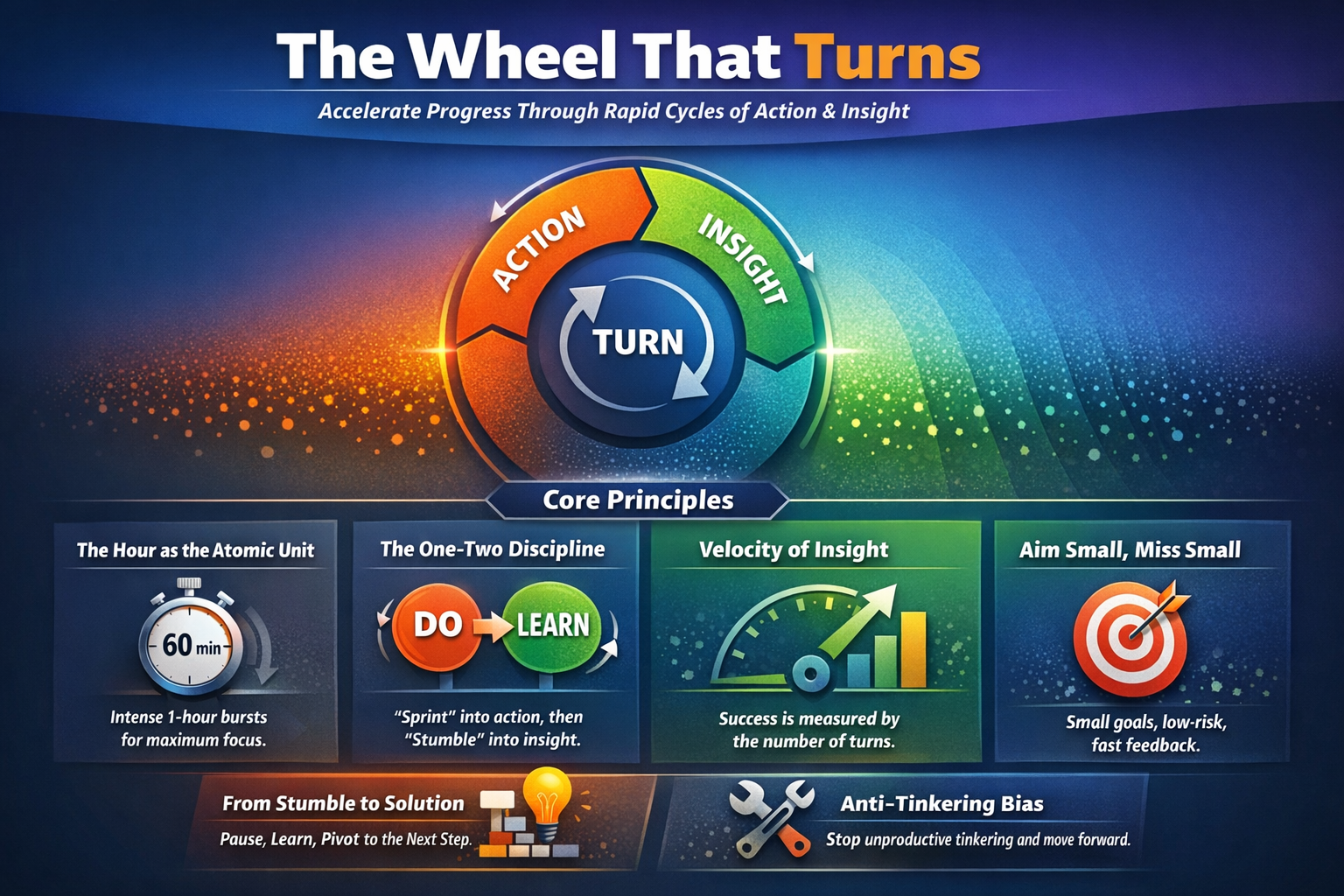
The Wheel That Turns is the central engine of professional evolution. It is a mental model that describes a self-reinforcing cycle where specific principles—Curiosity, Beginner’s Mind, Bias Toward Motion, and Shifting Left—feed into one another to create compounding momentum. It isn’t a linear checklist; it is a flywheel. Once you get it moving, each revolution becomes easier and faster, and the output isn't just a finished product, but a more capable version of yourself.
In my view, this model is the answer to the question: "How do I keep up with the pace of change?" In fields like no-code development or rapid prototyping, the "answer" to a problem changes every six months. If you rely on a static library of knowledge, you’re dead in the water. The Wheel That Turns suggests that your value isn’t in what you know today, but in the velocity at which you move from one insight to the next. Each "turn" of the wheel represents a complete circuit from initial curiosity to shipping a solution and extracting a new level of understanding.
Why It Matters
The primary problem this model solves is stagnation—the "Expert’s Trap." Many builders reach a plateau where they find a tool or a method that works, and they stop turning the wheel. They stop being curious; they stop moving fast. When the environment shifts, they lack the momentum to adapt. Without the Wheel, learning is episodic and painful. With the Wheel, learning is the byproduct of your daily workflow.
When you internalize this model, the metric of a "good day" changes. It’s no longer just about checking off a task; it’s about whether you completed a turn. Did you start with a question, build something, and end with a deeper insight than you had this morning? If you can achieve one turn a day, you will eventually outpace everyone who views learning as a separate activity from building. The Wheel turns your work into a laboratory where momentum is the ultimate competitive advantage.
How It Works
The mechanism of the Wheel is powered by four primary gears. If any gear is missing or jammed, the wheel stops turning, and your learning grinds to a halt.
- The Spark (Be Curious): Everything starts with a question. Not a "how-to" question that you can just Google, but a "what-if" or "why-is-it-this-way" question. Curiosity provides the initial energy to move the wheel. Without it, you are just a technician following instructions.
- The Friction Reducer (Beginner’s Mind): To get the wheel moving, you have to let go of your ego. If you think you already know the best way to do something, you create friction. Beginner’s Mind allows you to look at a problem without the weight of previous "best practices" that might no longer apply. It makes the wheel light and easy to spin.
- The Torque (Bias Toward Motion): You cannot think your way through a turn. You have to do something. Bias Toward Motion is the physical act of building, testing, or shipping. It’s the force that converts your curiosity into a tangible result. If you don't move, the wheel is just a theoretical concept.
- The Accelerator (Shift Left): This is where you tighten the circle. "Shifting Left" means moving the testing and validation as early as possible in the process. Instead of building for three weeks and then checking if it works, you check in three minutes. This makes the wheel smaller and allows it to spin much faster, leading to more insights in less time.
Success is measured by the number of turns. One turn = one cycle from "I don't know" to "I built it" to "Now I understand X." The more turns you achieve, the more "levels" of knowledge you unlock. You move from "How do I use this tool?" to "How do I architect this system?" to "How do I solve this business problem?"
When to Apply
You apply the Wheel That Turns when you are facing a "cold start" problem. When you are staring at a blank canvas or a new software stack, don't try to plan the final destination. Instead, focus on completing one turn of the wheel. Ask one small question, build one small thing, and get one small insight.
It is also vital when you feel yourself getting "comfortable." Comfort is a sign that the wheel has stopped turning. If you find yourself using the same patterns over and over without questioning them, it’s time to intentionally trigger a new turn. Use it when you are stuck on a bug; don't just stare at the code. Shift Left—test a tiny assumption—and move the wheel.
Finally, use this model during project retrospectives. Don't just ask "What did we build?" Ask "How many turns did we get through?" and "What was the biggest insight we gained in the last turn?" This shifts the focus from output to growth.
Common Traps
The most common trap is "The Treadmill." This is when you have a high Bias Toward Motion but zero Curiosity or Beginner’s Mind. You are moving fast—doing lots of work—but you aren't gaining insights. The wheel is spinning, but it’s not connected to the transmission of your brain. You’re just busy. If you aren't moving from "insight to insight," you aren't actually turning the wheel.
Another trap is "The Analysis Abyss." This is the opposite of the Treadmill. You have plenty of Curiosity, but no Bias Toward Motion. You are gathering information, reading documentation, and watching tutorials, but you never actually push the wheel into motion. Knowledge without the "turn" of building is just trivia. It doesn't become part of your skill set until it's been tested by motion.
Lastly, people often mistake "Complexity" for "Progress." They think a "turn" has to be a massive project. In reality, the most effective wheels are small and fast. If your wheel takes six months to complete one turn, you will be overtaken by the person whose wheel turns every six hours.
How It Connects
The Wheel That Turns is the meta-model that houses several other key State Change principles. It acts as the framework that gives them a purpose.
Bias Toward Motion and Shift Left are the tactical tools that determine the speed and size of the wheel. If you have a Bias Toward Motion, you provide the torque. If you Shift Left, you reduce the diameter of the wheel so it can spin faster with less effort.
Meanwhile, Beginner's Mind and Be Curious are the psychological prerequisites. They ensure that the wheel is actually pointed toward growth. Beginner's Mind ensures you don't get stuck in the "ruts" of your previous successes, while Curiosity ensures you have a constant source of fuel. Without these, the wheel might spin, but it won't take you to a "new level of knowledge." It will just keep you circling the same drain.
Evidence from Sources
The Definition of the Model
"The mental model forms a self-reinforcing cycle where each principle feeds into the next, creating momentum and accelerating learning." — Ray's Mental Model: Core Principles for Building with No-Code
The Metric of Success
"Success is measured by how many turns of this wheel you can achieve—each turn represents moving from insight to insight, from one level of knowledge to the next." — Ray's Mental Model: Core Principles for Building with No-Code
In Practice
Scenario 1: Learning a New API
Instead of reading the entire documentation (Analysis Abyss), a builder applies the Wheel.
- Curiosity: "Can I get this API to return my name?"
- Motion: They fire off one request in Postman.
- Insight: "The API requires a specific header I didn't know about."
- Turn Complete. They immediately start the next turn: "Now, can I get it to return a list of items?" By the end of the hour, they have completed ten turns and understand the API better than someone who spent the hour reading the docs.
Scenario 2: Debugging a Workflow
A builder’s automation is failing. Instead of guessing what's wrong, they Shift Left.
- Curiosity: "Does the data even reach step 2?"
- Motion: They add a simple log statement.
- Insight: "The data is missing a field."
- Turn Complete. They don't stop there; they use the insight to fuel the next turn: "Why is the field missing from the trigger?" Each turn brings them closer to the root cause through action rather than contemplation.
Scenario 3: Launching a Feature
A developer wants to add a complex filtering system to an app. Rather than building the whole system, they build a single hard-coded button that filters for one thing.
- Curiosity: "Will users even click a filter?"
- Motion: They ship the button to a small group.
- Insight: "Users didn't click it, but they asked for a search bar instead."
- Turn Complete. The wheel has saved them weeks of wasted effort by moving from one level of knowledge (what they thought users wanted) to the next (what users actually want).
Have questions about The Wheel That Turns?
Ask the AI Mentor — free, 10 questions/month
See This Model in Action
Real sessions where Ray teaches The Wheel That Turns live.
Troubleshooting Audio-Visual Issues for Kai
Join State Change to watch full sessions and access 1,000+ more.
Go Deeper
Mental models are just the beginning. Here’s what members get:
Live Office Hours
Ray teaches this model in real time — with your real problems, real code, and real breakthroughs.
Session Vault
1,000+ recorded sessions searchable by topic. Find exactly the moment this model clicks.
AI Skills & MCP Tools
Your AI assistant learns these models too — Skills and MCP servers that bring Ray's thinking to your workflow.
Builder Community
Ask questions, share breakthroughs, get unstuck with 500+ builders who think in models, not just code.